| The Complete Guide for American Drivers |
Imagine you’re stopped at a red light when another driver slams into your car. You’re injured, your vehicle is damaged — and then you discover the other driver has no insurance. Who pays for your medical bills and repairs?
That’s exactly why uninsured motorist coverage exists. It steps in when the at-fault driver either carries no insurance or doesn’t have enough to cover your losses. In a country where roughly 1 in 8 drivers is uninsured, this protection isn’t just a nice-to-have — for millions of Americans, it’s a financial lifeline.
|
⚡ Quick Answer
Uninsured Motorist Coverage
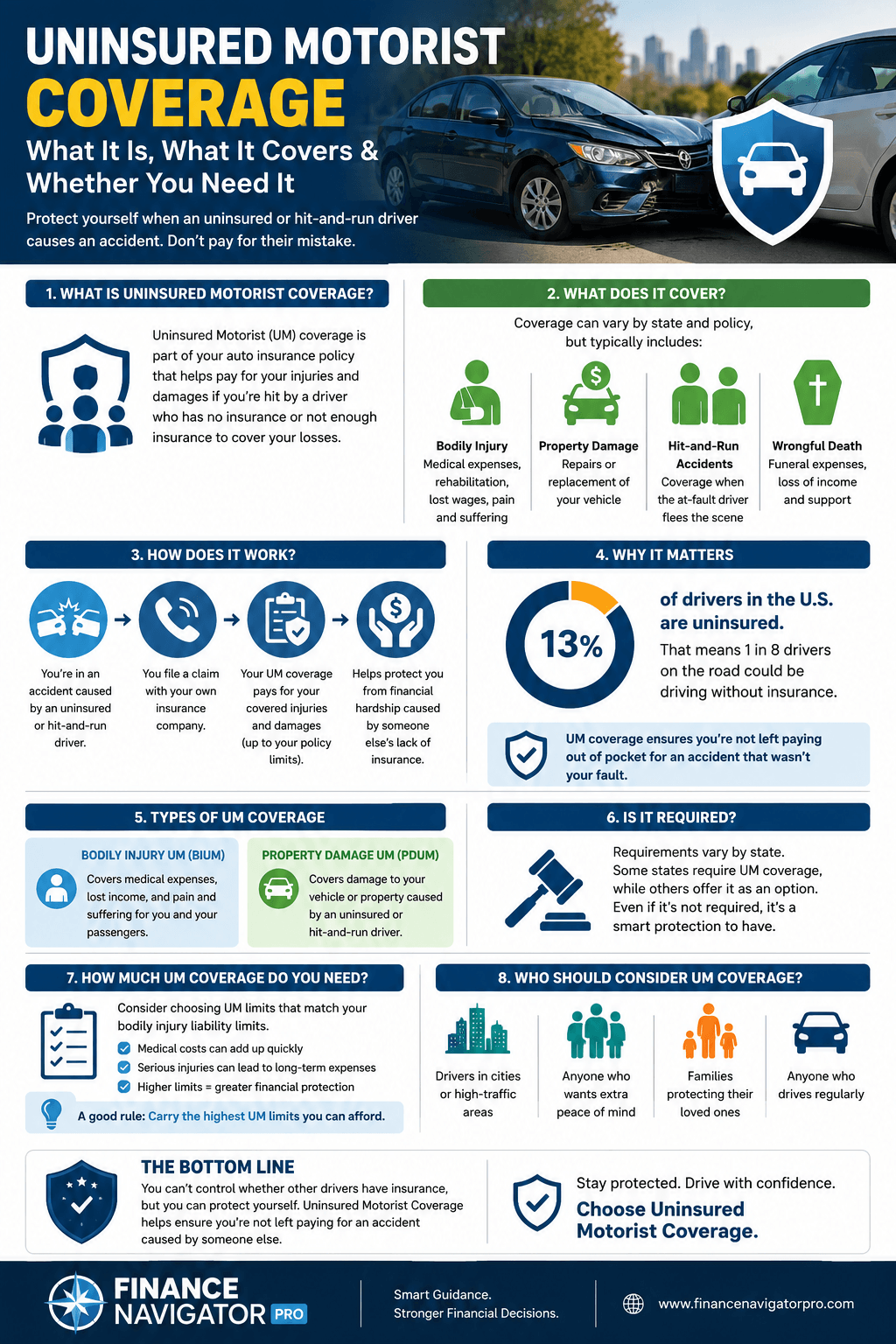
Uninsured motorist coverage (UM) is an optional or required add-on to your auto insurance policy that pays for medical bills, lost wages, and vehicle repairs when you’re hit by a driver with no insurance — or too little insurance — or who flees the scene after a hit-and-run. It typically costs $5–$15 per month and can save you thousands after a serious accident.
|
Uninsured motorist coverage at a glance
|
What Is Uninsured Motorist Coverage?
Uninsured motorist coverage is an auto insurance protection that pays your expenses when a driver with no insurance causes an accident and injures you or damages your vehicle. Think of it as standing in for the at-fault driver’s liability insurance — because they simply don’t have any.
Here’s the fundamental problem it solves: Every state requires drivers to carry liability insurance, but millions ignore that requirement. When one of those uninsured drivers hits you, you’re left holding the bill unless you have UM coverage on your own policy.
Insurance companies offer it because standard liability coverage follows the at-fault driver, not you. If the at-fault driver has no coverage, you have no automatic recourse — unless your own policy includes UM protection.
| 📊According to the Insurance Information Institute (III), approximately 12.6% of U.S. drivers — roughly 1 in 8 — were uninsured in the most recent year studied. In states like Mississippi, Michigan, and Tennessee, that figure exceeds 20%. |
Why Uninsured Motorist Coverage Matters
Numbers on a page don’t capture what it actually feels like to get hit by an uninsured driver. Medical bills start arriving within days. Your car may be totaled. You can’t work. And the person who caused all of this? They have nothing.
The Scale of the Problem
| • | Approximately 32 million U.S. drivers are uninsured at any given time (Insurance Information Institute) |
| • | Hit-and-run accidents account for roughly 6% of all crashes, per the National Highway Traffic Safety Administration (NHTSA) |
| • | The average ER bill after a car accident exceeds $3,500; serious injuries can generate $50,000+ in medical costs |
| • | Lost wages from a serious injury often equal three to six months of income |
| • | Pain and suffering damages can exceed medical bills by 2–3 times in litigation |
A Real-World Scenario
|
Sarah’s Story — Florida
Sarah, a 34-year-old teacher in Florida, was T-boned at an intersection by a driver who ran a red light. The at-fault driver had no insurance. Sarah’s medical bills totaled $28,000. Her car was totaled — worth $19,000. She missed eight weeks of work. Total financial exposure: over $50,000. Because she carried $50,000/$100,000 uninsured motorist coverage, her insurer covered everything. Without it, she would have been suing an uninsured driver with no assets.
|
| Takeaway: Even a moderate accident without UM coverage can lead to financial devastation. The coverage isn’t about fear — it’s about having a plan when someone else fails their legal obligations. |
Types of Uninsured Motorist Coverage
1. Uninsured Motorist Bodily Injury (UMBI)
The most common type. UMBI pays for medical expenses, lost wages, and pain and suffering for you and your passengers when an uninsured driver causes an accident. It also covers hit-and-run accidents in most states.
Typical limits: $25,000/$50,000 minimum; $100,000/$300,000 for solid protection; $250,000/$500,000 for high-income households or families.
2. Uninsured Motorist Property Damage (UMPD)
UMPD pays to repair or replace your vehicle when it’s damaged by an uninsured driver. Coverage varies significantly by state. Some states offer it routinely; others exclude it entirely. If you have collision coverage, your collision policy may handle this — though you’ll pay a deductible with collision and often not with UMPD.
Typical limits: $10,000–$25,000. Most policies cap UMPD at the value of the vehicle.
3. Underinsured Motorist Coverage (UIM)
This is different from UM, though often sold together. Underinsured motorist coverage applies when the at-fault driver has insurance, but not enough to cover your losses. For example, if you suffer $80,000 in medical bills and the at-fault driver only carries $25,000 in liability coverage, your UIM policy pays the $55,000 gap.
UIM is often more important than UM in states where minimum liability limits are very low — and most states allow minimums as low as $25,000 per person, which is barely enough to cover a single ER visit.
4. Stacked vs. Non-Stacked Coverage
5. Split Limit vs. Combined Single Limit (CSL)
| • | Split Limit: Two separate maximums — one per person, one per accident. Example: $100,000/$300,000 means $100K maximum per person, $300K maximum for the whole accident. |
| • | Combined Single Limit (CSL): One total pool of money for all injuries in one accident. Example: $300,000 CSL means up to $300K for all injured parties combined. Simpler, and often better for households with multiple occupants. |
What Does Uninsured Motorist Coverage Cover?
UM coverage is broader than most policyholders realize. Here’s what it typically pays for:
Medical Expenses
| • | Emergency room visits and hospitalization |
| • | Surgery and specialist care |
| • | Ambulance and emergency transportation |
| • | Prescription medications |
| • | Physical therapy and long-term rehabilitation |
| • | Mental health treatment (in many states) |
Lost Income
| • | Wages lost while recovering from injuries |
| • | Future earning capacity if injuries cause permanent disability |
| • | Self-employment income in most policies |
Pain and Suffering
Non-economic damages — including physical pain, emotional distress, loss of enjoyment of life, and psychological trauma — are covered under UMBI. These damages often exceed medical bills in serious injury cases.
Funeral and Death Benefits
| • | Funeral expenses when a covered accident causes a fatality |
| • | Wrongful death claims by surviving family members |
Hit-and-Run Accidents
This is one of the most valuable features of UM coverage. If a driver hits you and flees, there’s no one to sue. UM coverage steps in — even when the at-fault driver is never identified. Most states require physical contact with the fleeing vehicle to trigger UMBI; a handful allow claims without contact.
Vehicle Damage (UMPD)
Where UMPD is available, it covers repairs to your vehicle after an uninsured driver hits it — including hit-and-run damage in many states. Check your policy carefully, as UMPD is not universally offered or required.
Passenger Injuries
All passengers in your vehicle at the time of the accident are covered under your UMBI policy — not just you. This is especially important for parents driving carpools, rideshare drivers, or anyone who regularly carries other people.
| Important: UM coverage typically applies whether you are a driver, a passenger in someone else’s vehicle, or a pedestrian hit by an uninsured driver. Check your policy’s definitions. |
What Uninsured Motorist Coverage Does NOT Cover
Understanding the exclusions is just as important as knowing what’s covered. UM is not a catchall.
How Does Uninsured Motorist Coverage Work?
The claims process for UM coverage is similar to filing against a third-party insurer — except you’re filing with your own company. Here’s what a typical UM claim looks like from start to finish.
Step-by-Step UM Claim Timeline
| 1 | Accident occurs — document everything at the scene: photos, witness contacts, dashcam footage, license plate (if fleeing) |
| 2 | Call the police — a police report is critical for UM claims; hit-and-run especially |
| 3 | Seek medical treatment — even if you feel okay; document injuries immediately; delayed care complicates claims |
| 4 | Notify your insurance company — call your insurer within 24–72 hours; most policies have prompt notification requirements |
| 5 | Investigation begins — your insurer verifies the at-fault driver’s insurance status; this typically takes 2–10 business days |
| 6 | Submit documentation — medical records, bills, lost wage documentation, repair estimates |
| 7 | Adjuster review — your insurer assigns a claims adjuster who evaluates total damages and coverage limits |
| 8 | Negotiation — you or your attorney negotiate the settlement amount with your own insurer |
| 9 | Payment issued — once settlement is agreed, payment is typically made within 30 days |
| 10 | Claim closure — your insurer may seek subrogation (reimbursement) from the at-fault driver |
| Important: Filing a UM claim with your own insurer typically does NOT raise your rates — because you are not at fault. Always confirm this with your specific carrier before assuming otherwise. |
Uninsured vs. Underinsured Motorist Coverage: What’s the Difference?
These two coverages are often confused — and frequently bundled together on a single policy. Here’s a side-by-side comparison.
| Pro Tip: Buy both UM and UIM at the same limits. If you carry $100K/$300K in liability, mirror that with $100K/$300K in UM and UIM. This creates symmetrical protection across all scenarios. |
Do You Need Uninsured Motorist Coverage?
The short answer for most drivers: yes. But the strength of that recommendation depends on your situation. Here’s a practical decision framework — and if you’re unsure what else your policy should include, see our guide on what insurance coverage you need.
Who Should Definitely Buy UM Coverage
| • | Daily commuters and city drivers — higher exposure to traffic and statistically more uninsured drivers in urban areas |
| • | Families with children — one accident with an uninsured driver can generate hundreds of thousands in medical bills |
| • | Teen and young drivers — statistically higher accident rates; UM ensures family protection even when young drivers are passengers |
| • | New drivers — limited financial cushion to absorb uncompensated losses |
| • | Residents of high-uninsured-driver states — Mississippi (29.4%), Michigan (25.5%), Tennessee (23.7%) top the list |
| • | Gig economy workers (rideshare/delivery) — personal UM coverage may apply during off-platform moments; verify with your insurer |
| • | Anyone without robust health insurance — UM picks up medical costs that a thin health plan won’t cover |
Who Might Reasonably Consider Skipping It
| • | Drivers with full health insurance + strong disability income coverage — medical and wage gaps may already be covered (though pain and suffering is still unaddressed) |
| • | Drivers in no-fault states with strong PIP — Personal Injury Protection may cover medical expenses regardless of fault |
| • | Very low-mileage drivers — the lower your road exposure, the lower your risk (though not zero) |
| Verdict: Given the average monthly cost of $5–$15, UM coverage is one of the highest-value purchases in auto insurance for the vast majority of American drivers. The math rarely makes sense to skip it. |
Is Uninsured Motorist Coverage Required in Your State?
Requirements vary dramatically by state. Some states mandate UM coverage; others allow drivers to reject it in writing. The National Association of Insurance Commissioners (NAIC) tracks these requirements annually.
Always verify your state’s current requirements with your state’s Department of Insurance, as laws change.
How Much Uninsured Motorist Coverage Do You Need?
Choosing the right limit is more art than science — but these benchmarks will point you in the right direction.
| Rule of Thumb: Set your UM/UIM limits equal to your liability limits. If you carry $100K/$300K in liability insurance, carry the same in UM. This creates the most complete and balanced protection. |
Average Cost of Uninsured Motorist Coverage
Uninsured motorist coverage is one of the most affordable add-ons available in auto insurance. For what it protects against, the premium is remarkably low — see how it compares in our guide to the average insurance cost in the US.
Typical Cost Ranges
Cost by State
Premiums vary based on local uninsured driver rates, litigation history, medical cost indices, and state insurance regulations. States with more uninsured drivers — such as Louisiana, Florida, and Michigan — typically have higher UM premiums. States with strong driving records — such as New Hampshire and Maine — tend to have lower costs.
Cost by Age
| • | Under 25: $12–$22/month — higher overall auto rates inflate all add-ons |
| • | 25–40: $7–$14/month — prime driving age, moderate risk |
| • | 40–65: $6–$12/month — lowest premiums overall |
| • | 65+: $7–$15/month — slight increase due to slower reaction time risk profiling |
Factors That Affect Uninsured Motorist Coverage Costs
Your UM premium doesn’t exist in a vacuum. Insurers calculate it based on a combination of personal and geographic factors — find out exactly how insurance quotes are calculated.
Real Uninsured Motorist Claim Examples
These scenarios illustrate how UM coverage works in practice — and what happens without it.
Scenario 1: Hit-and-Run in a Parking Lot
|
Mark — Parking Lot Hit-and-Run
Mark parked his car at a shopping center. He returned to find his rear bumper destroyed. No note. No witnesses. Total repair cost: $4,200. His insurer paid the full amount under UMPD with no deductible required. Without UMPD, Mark would have paid out of pocket.
|
Scenario 2: Major Injury, Uninsured At-Fault Driver
|
Maria — Head-On Collision
Maria was struck head-on by a driver who ran a stop sign. The at-fault driver had no insurance. Maria suffered a broken femur, requiring surgery, rehab, and six weeks off work. Total damages: $64,000 in medical bills + $12,000 in lost wages + $45,000 in pain and suffering = $121,000 total. Her $100K/$300K UMBI policy covered the first $100,000; the remaining $21,000 was absorbed as her personal exposure. Had she carried $250K limits, she’d have been fully covered.
|
Scenario 3: Multi-Passenger Family Accident
|
Kevin — Family of Four
Kevin was driving his family of four when an uninsured driver rear-ended them at highway speed. All four family members were injured. Combined medical bills: $178,000. His split-limit $50K/$100K policy maxed out at $100,000 — leaving $78,000 uncompensated. Had he carried $250K/$500K, the family would have been fully covered. This scenario illustrates why families should always buy higher limits.
|
Scenario 4: Underinsured Driver, UIM Coverage in Action
|
David — Underinsured Driver
David was hit by a driver with a minimum $25,000 liability policy. David’s injuries totaled $87,000. The at-fault driver’s insurer paid $25,000 — the policy max. David’s UIM policy ($100K/$300K) covered the remaining $62,000. Without UIM, David would have sued an underinsured driver with no assets to collect.
|
How to File an Uninsured Motorist Claim: Step-by-Step Checklist
Follow this checklist to protect your claim from the moment of impact to settlement.
At the Scene
| • | Call 911 — always get a police report, even for minor accidents |
| • | Photograph everything — all vehicles, damage, license plates, road conditions, skid marks |
| • | Collect witness contact information — names and phone numbers |
| • | Note the at-fault driver’s license plate — even a partial number helps |
| • | Do not admit fault or make statements to the other driver |
Within 24–72 Hours
| • | Seek medical attention — see a doctor even if you feel fine |
| • | Notify your insurance company — call and report the accident |
| • | Do NOT post about the accident on social media — insurers monitor this |
During the Claim Process
| • | Request a copy of the police report |
| • | Keep all medical records, bills, and receipts |
| • | Document lost wages in writing from your employer |
| • | Keep a daily injury journal — document pain levels, limitations, and impact on daily life |
| • | Do not give a recorded statement without consulting an attorney for serious injuries |
| • | Review and don’t rush to accept the initial settlement offer — it may be lower than your damages |
Common Uninsured Motorist Claim Mistakes to Avoid
Uninsured Motorist Coverage: Pros and Cons
Best Insurance Companies Offering Uninsured Motorist Coverage
Not all UM policies are created equal. Customer satisfaction, claims handling speed, digital tools, and available limits vary significantly across carriers — for a broader rate comparison, see our roundup of the cheapest car insurance companies in the US.
Note: J.D. Power ratings reflect auto claims satisfaction. AM Best ratings indicate financial strength. Always verify current data with the carrier before purchasing.
Ways to Save Money on Uninsured Motorist Coverage
UM coverage is already affordable — but these strategies can lower your overall auto insurance bill while keeping your UM limits intact.
| • | Bundle auto + home or renters insurance — most major carriers offer 10–25% discounts |
| • | Maintain a clean driving record — each accident-free year at renewal improves your rate |
| • | Raise your collision deductible instead — keep UM limits high while reducing collision premium |
| • | Shop and compare quotes annually — rates vary by 15–35% across carriers for identical coverage |
| • | Ask about safe driver discounts — telematics programs reward low-risk driving habits |
| • | Pay annually instead of monthly — most insurers charge 3–8% more for monthly installments |
| • | Good student discounts — for teen drivers on your policy with a B average or better |
| • | Defensive driving course — many states mandate discounts after completion (check your state) |
| • | Ask about loyalty discounts — long-term customers may qualify for renewal rate reductions. See more insurance discounts most people don’t know about. |
Frequently Asked Questions About Uninsured Motorist Coverage
These questions represent the most common real-world searches from American drivers researching UM coverage.
|
What is uninsured motorist coverage?
Uninsured motorist (UM) coverage is an auto insurance add-on that pays your medical bills, lost wages, and pain and suffering when you’re hit by a driver with no insurance, or when a hit-and-run driver flees. You file the claim with your own insurer.
|
|
Is uninsured motorist coverage mandatory?
It depends on your state. Twenty-two states and the District of Columbia require UM coverage. In the remaining 28 states, insurers must offer it, but you can decline it in writing.
|
|
Does uninsured motorist coverage cover hit-and-run accidents?
Yes, in most states. UMBI typically covers hit-and-run injuries. UMPD covers vehicle damage in many states. Most policies require that there be physical contact with the fleeing vehicle to file a claim.
|
|
Does UM coverage pay for pain and suffering?
Yes. UMBI specifically includes non-economic damages such as pain and suffering, emotional distress, and loss of enjoyment of life — coverage that health insurance does not provide.
|
|
Can I reject uninsured motorist coverage?
In states where it’s not mandatory, yes — but you must sign a written waiver. Insurers are required to document your refusal. Rejecting it is rarely advisable given the low cost.
|
|
Is uninsured motorist coverage expensive?
No. Most drivers pay $5–$15 per month for solid UM coverage. It’s one of the best-value protections available in auto insurance.
|
|
Does health insurance replace UM coverage?
No, and this is the biggest misconception about UM. Health insurance may cover medical expenses, but it won’t pay for property damage, lost wages (beyond short-term disability), or pain and suffering. UM covers all three.
|
|
Does UM coverage cover passengers?
Yes. All occupants of your vehicle at the time of the accident are covered under your UMBI policy — not just the driver.
|
|
Can I stack UM policies?
Stacking is allowed in approximately 20 states. It lets you combine UM limits across multiple vehicles on your policy (or multiple policies in some states), significantly increasing available coverage.
|
|
How long does a UM claim take?
Straightforward claims are typically resolved in 30–90 days. Complex injuries, disputed liability, or litigation can extend the process to 6–18 months.
|
|
What happens if the at-fault driver flees the scene?
Call the police immediately. Document everything. File a police report. Then notify your insurer. Your UM policy handles hit-and-run claims, though most states require physical contact with the fleeing vehicle.
|
|
Will a UM claim raise my insurance rates?
Not typically. Because you’re the victim in an uninsured motorist claim, most insurers do not surcharge your premium at renewal. Confirm this policy with your specific carrier before assuming.
|
|
What is the difference between UM and UIM?
UM (uninsured motorist) applies when the at-fault driver has zero insurance. UIM (underinsured motorist) applies when the at-fault driver has insurance, but not enough to cover your damages. Both are often sold together.
|
|
Does UM cover a rental car?
UM coverage often extends to you when you’re driving a rental — but it’s policy-specific. Verify with your insurer before assuming rental protection.
|
|
What is underinsured motorist property damage?
UIMPD pays the gap between the at-fault driver’s property damage liability limit and your actual vehicle repair costs, when the at-fault driver’s policy isn’t sufficient to cover everything.
|
|
Does UM coverage apply if I’m a pedestrian?
Yes, in most states. If you’re struck by an uninsured driver while walking or cycling, your own auto policy’s UMBI coverage typically applies.
|
|
How do I know if the other driver is uninsured?
Your insurer verifies this through the state’s insurance database and by contacting the other driver’s listed insurer. An uninsured confirmation can take 2–10 business days.
|
|
Can I sue an uninsured driver even if I have UM coverage?
Yes. Filing a UM claim doesn’t prevent you from also pursuing the at-fault driver in civil court. However, recovering money from an uninsured driver is often difficult — most have no assets.
|
|
Is there a deductible for uninsured motorist coverage?
UMBI typically has no deductible. UMPD may have a deductible (often $100–$300) in states where it’s available. Check your declarations page.
|
|
What states have the most uninsured drivers?
According to the Insurance Information Institute, Mississippi, Michigan, Tennessee, New Mexico, and Washington have the highest rates of uninsured drivers in the U.S.
|
|
Does my UM coverage apply when driving someone else’s car?
Your UM coverage often follows you as a driver — not the vehicle. But coverage stacking rules and state law affect this. Review your policy and consult your agent.
|
|
What is the statute of limitations for UM claims?
It varies by state — typically 1–3 years from the date of the accident. Missing this deadline bars your claim permanently. Contact an attorney quickly if approaching the deadline.
|
|
Can my insurer deny a UM claim?
Yes, if you violate policy terms (late reporting, excluded driver, fraud, policy lapse) or if the claim falls outside covered scenarios. Always read your policy’s conditions carefully.
|
|
Do I need UM coverage if I have full coverage?
Yes. ‘Full coverage’ refers to liability + collision + comprehensive. It does not include UM/UIM coverage. They are separate add-ons that must be elected explicitly.
|
|
Is UM coverage worth it?
For most American drivers, yes. At $5–$15/month, the cost is minimal relative to the financial protection it provides. Given that 1 in 8 U.S. drivers is uninsured, the risk you’re covering is statistically significant.
|
Auto Insurance Glossary: Key Terms Explained
Insurance terminology can be confusing. Here’s a plain-English guide to the terms used throughout this article.
Expert Tips for Maximizing Your Uninsured Motorist Protection
After 20+ years covering personal finance and auto insurance, here are the insider moves that most policyholders don’t know to make:
| 1 | Mirror your liability limits with UM/UIM — if you carry $100K/$300K liability, set your UM at the same level. Asymmetrical protection creates gaps. |
| 2 | Check if stacking is available in your state — if you have two or more vehicles, stacking can double your effective UM coverage for a relatively small premium increase. |
| 3 | Don’t rely on health insurance to substitute for UM — health insurance has deductibles, copays, and network restrictions. More critically, it doesn’t cover pain and suffering or lost wages. |
| 4 | Review your UM coverage every two years — if your income has increased, your family has grown, or you’ve changed vehicles, your original limits may no longer be sufficient. |
| 5 | Consider a personal umbrella policy — for $150–$300/year, a $1 million umbrella policy provides excess UM coverage and overall liability protection that a standard auto policy can’t match. |
| 6 | Keep a dashcam — footage of an accident or hit-and-run can be decisive in a disputed claim. Dashcams are $40–$150 and pay for themselves with one claim. |
| 7 | Don’t wait to report a UM claim — notify your insurer within 24–72 hours. Late notice is the #1 reason UM claims are denied or disputed. |
| 8 | Hire an attorney for serious injuries — auto accident attorneys typically work on contingency (no upfront cost) and statistically recover more than self-represented claimants on large claims. |
Final Verdict: Is Uninsured Motorist Coverage Worth It?
Let’s cut to it.
Uninsured motorist coverage costs $5–$15 per month. For that, you get protection against a risk that affects 1 in 8 drivers on American roads. If you’re hit by one of the estimated 32 million uninsured U.S. drivers, you won’t be left paying for someone else’s negligence out of your own pocket.
Health insurance helps — but it doesn’t cover your car repairs, your lost wages at full value, or your pain and suffering. Collision coverage helps with your vehicle — but has a deductible and doesn’t touch your medical bills.
Only uninsured motorist coverage closes all of those gaps at once.
The question isn’t really whether UM coverage is worth it. The question is how much to buy.
Who Should Buy UM Coverage?
| • | Every driver who doesn’t have a separate plan to absorb $50,000–$200,000+ in unexpected medical and property costs after an accident |
| • | Families with children, commuters, urban drivers, gig workers, new drivers, teen drivers, and anyone without excellent health insurance |
| • | Residents of states with uninsured driver rates above 15% |
Who Might Skip It?
| • | Low-mileage drivers in no-fault states with comprehensive PIP coverage and excellent health insurance — though even then, pain and suffering damages remain uncovered |
| Bottom Line: At $5–$15 per month, uninsured motorist coverage is one of the highest-value protections in auto insurance. We recommend at minimum $100,000/$300,000 in UMBI for most households — and $250,000/$500,000 for families or high-income earners. Don’t skip it to save a few dollars a month. |
|
Ready to Compare Auto Insurance Quotes?
|
Related Coverage Guides
Continue exploring auto insurance topics with these related guides:
| → Auto Insurance: The Complete Guide |
| → Liability Coverage Explained |
| → Collision Coverage: What It Covers and When You Need It |
| → Comprehensive Coverage Guide |
| → Rental Reimbursement Coverage |
| → Medical Payments Coverage (MedPay) vs. PIP |
| → Personal Injury Protection (PIP): No-Fault State Guide |
| → Gap Insurance: Do You Need It? |
| → Full Coverage Auto Insurance: What It Actually Means |
| → SR-22 Insurance: Who Needs It and How to Get It |
| → Teen Driver Insurance: How to Save Money |
| → High-Risk Auto Insurance Guide |
| → Car Insurance Deductibles: How to Choose the Right Amount |
| → Car Insurance Discounts: 25+ Ways to Save |
| → How Much Car Insurance Do I Need? |
| → How to File an Auto Insurance Claim |
|
About This Article
Written by: Senior Finance & Insurance Writer, FinanceNavigatorPro
Expertise: 20+ years covering personal finance, auto insurance, and consumer protection for U.S. readers Reviewed by: Licensed Insurance Professional (P&C) Published: January 2026 | Last Reviewed: June 2026 Sources: Insurance Information Institute (III), National Association of Insurance Commissioners (NAIC), National Highway Traffic Safety Administration (NHTSA), Consumer Financial Protection Bureau (CFPB), individual state Departments of Insurance. |