
Updated April 2026 • IRS Publication 544 • IRS Topic 423
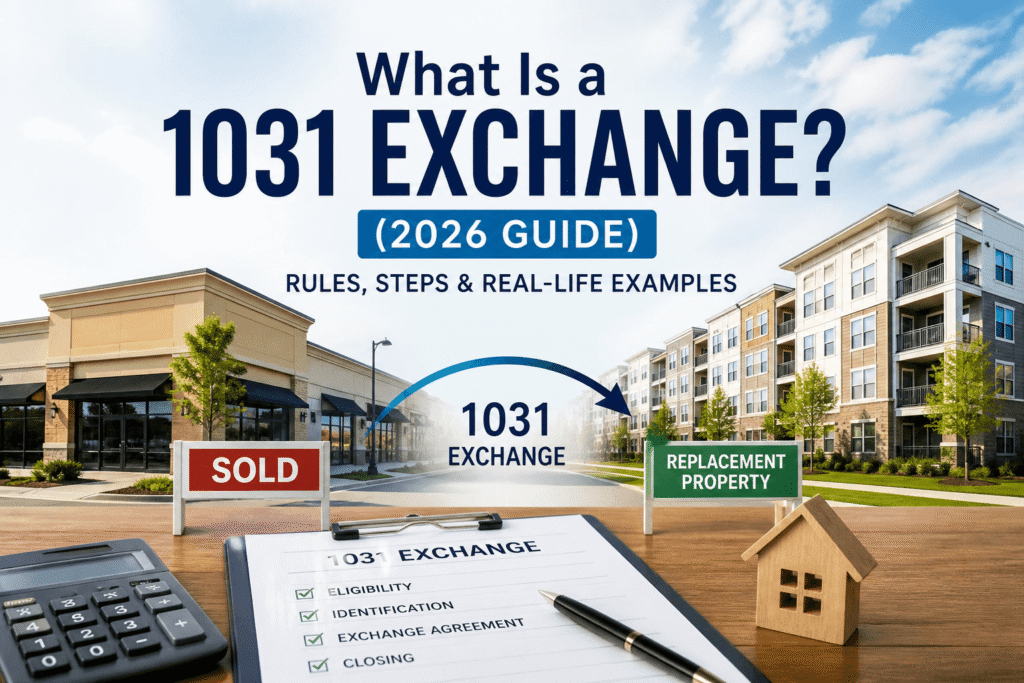
A 1031 exchange is a powerful IRS tax provision that lets real estate investors sell an investment property and defer all capital gains taxes — as long as they reinvest the proceeds into a “like-kind” replacement property. Named after Section 1031 of the Internal Revenue Code, it’s one of the most effective wealth-building tools available to American real estate investors. Done correctly, you can keep rolling your equity forward, potentially for decades, without Uncle Sam taking a cut each time.
Quick Summary
What it is: A tax-deferral strategy for investment real estate under IRC Section 1031
Who it’s for: Real estate investors, landlords, and business property owners
Core benefit: Defer capital gains taxes and depreciation recapture when selling investment property
Key rule: You must exchange for “like-kind” property of equal or greater value
Time deadlines: 45 days to identify replacement property; 180 days to close
What it is NOT: A tax elimination — taxes are deferred, not forgiven (unless you hold until death)
What Is a 1031 Exchange? (Explained Simply)
Let’s start with the basics. Normally, when you sell an investment property for more than you paid, the IRS wants its share. We’re talking capital gains taxes that can run anywhere from 15% to 20% at the federal level — plus the 3.8% Net Investment Income Tax if your income is above certain thresholds, and potentially state taxes on top of that. Ouch.
A 1031 exchange — also called a “like-kind exchange” or a “Starker exchange” — lets you sidestep that tax bill, at least for now. Here’s the deal: instead of pocketing the proceeds from your sale and paying taxes on the gain, you roll that money directly into a new investment property. The IRS treats it as an exchange rather than a sale, so no taxes are due at that point.
Think of it like trading in your car for an upgrade. You’re not cashing out — you’re rolling forward. The gain doesn’t disappear; it gets carried over into your new property’s cost basis. The taxes get deferred until you eventually sell without doing another exchange.
The legal basis for this is Section 1031 of the Internal Revenue Code. Congress has kept this provision in place because it encourages productive reinvestment in real estate rather than investors sitting on properties just to avoid taxes.
Most people don’t realize how powerful this is until they do the math. If you’ve built up $500,000 in equity on a rental property over the years, a standard sale might cost you $100,000 or more in federal and state taxes. A 1031 exchange lets you keep every dollar of that $500,000 working for you.
How a 1031 Exchange Works (Step-by-Step Overview)
The basic concept is simple. The execution? That’s where it gets detailed. Here’s how a typical 1031 exchange flows from start to finish.
The Basic Flow
You sell your investment property (the “relinquished property”). Instead of receiving the proceeds directly, a neutral third party called a Qualified Intermediary (QI) holds the funds. You then have a strict window of time to identify and close on a replacement property. The QI releases the funds to the closing, and you walk away with a new property and a deferred tax bill.
Sounds straightforward, right? The devil is in the details — and there are several rules you absolutely cannot bend.
Sell Relinquished Property
QI Holds Proceeds
Identify Replacement (45 days)
Close on New Property (180 days)
The Role of the Qualified Intermediary
This is the part most beginner investors miss, and it’s critical. A Qualified Intermediary (QI) — also called an accommodator or exchange facilitator — is a third party who holds your sale proceeds during the exchange. You cannot, under any circumstances, receive or control those funds yourself. The moment you do, the exchange is disqualified and the full tax bill comes due.
The QI must be engaged before the sale closes. You can’t just decide after the fact that you want to do an exchange. Think of the QI like an escrow company, but specifically for 1031 exchanges. Their job is to hold your money, ensure the paperwork meets IRS requirements, and transfer funds to purchase the replacement property.
Choose your QI carefully. They are not federally regulated, so look for members of the Federation of Exchange Accommodators (FEA) and verify they carry fidelity bonds and errors & omissions insurance.
Key Rules You Must Follow
This is where a lot of investors trip up. The IRS doesn’t mess around with 1031 exchange requirements. Let’s walk through every major rule, one by one.
Types of 1031 Exchanges
Not all 1031 exchanges work the same way. Here are the main structures you should know.
Delayed Exchange
Most Common
This is the standard exchange described throughout this guide. You sell first, then buy the replacement within the 45/180-day windows. This is what most people mean when they say “1031 exchange.”
Simultaneous Exchange
You close both transactions on the same day. This is rare and complicated to pull off because everything has to align perfectly. A QI is still required.
Reverse Exchange
You buy the replacement property first, then sell the relinquished property. You’ll need an Exchange Accommodation Titleholder (EAT) to hold title temporarily. This approach costs more — often $3,000–$5,000 in additional fees — but it’s useful in hot markets where you can’t afford to lose your target property while waiting to sell.
Build-to-Suit (Improvement) Exchange
Also called a construction exchange, this allows you to use exchange funds to build improvements on the replacement property — useful when the property you’re buying needs significant renovation, or when the replacement is worth less than the relinquished property and you need to build up value.
DST (Delaware Statutory Trust) Exchange
A popular option for investors who want the tax benefits of a 1031 exchange without the headaches of active management. You exchange into fractional ownership of institutional-grade properties — like apartment complexes or office buildings — managed by professionals. Learn more from the SEC’s real estate investing guide.
Real-Life Scenarios: When a 1031 Exchange Makes the Difference
Scaling from Single-Family to Multi-Unit
Sarah owns a single-family rental in Austin she bought for $180,000 fifteen years ago. It’s now worth $520,000. If she sold outright, she’d face roughly $68,000 in federal capital gains tax (at 20%) plus depreciation recapture. Instead, she does a 1031 exchange into a 4-unit apartment building worth $600,000. She defers the entire tax bill, keeps her equity fully invested, and now generates significantly more monthly cash flow. The tax bill doesn’t disappear — it transfers to the new property’s basis — but she has years (or decades) before she has to deal with it.
Upgrading from One Rental to a Commercial Property
Marcus has owned a rental duplex in Phoenix for ten years and wants to diversify into commercial real estate. He sells the duplex for $450,000 (purchased for $200,000) and uses a 1031 exchange to acquire a small retail strip center for $480,000. He defers approximately $50,000+ in taxes and now owns a commercial asset with triple-net leases and less hands-on management.
The Deadline Miss (A Cautionary Tale)
This one hurts. David sold his rental property in October and moved quickly on identifying a replacement. He found the perfect property, went under contract, and then the deal fell through on day 177. He scrambled to find something else but couldn’t close a new deal within the 180-day window.
The result: the entire exchange was disqualified. He owed capital gains taxes, depreciation recapture, and state taxes on the full gain — all due the following April. And because he hadn’t set aside funds for taxes, he had to liquidate other investments to pay the bill. Lesson: always have a backup property identified, and always plan for deals to fall through.
Always identify 2–3 replacement properties under the 3-Property Rule. Never rely on a single option. If your first choice falls through, you still have others to pursue.
Using a 1031 Exchange as an Estate Planning Tool
This is the scenario most people don’t think about until it’s almost too late. If you continue doing 1031 exchanges until you die, your heirs receive the property with a stepped-up basis — meaning the cost basis resets to the fair market value at the time of your death. All that deferred capital gains tax? It disappears. Your heirs can sell the property without owing a dime on the gains you accumulated.
For investors building generational wealth, this is the real power move. Hold, exchange, repeat — and let the estate reset the clock entirely.
How to Do a 1031 Exchange: Step-by-Step
Decide if a 1031 Exchange Makes Sense for Your Situation
Not every property sale warrants a 1031 exchange. Ask yourself: Do I want to stay invested in real estate? Is my gain large enough that deferring taxes materially matters? Do I have the bandwidth to find a replacement property in 45 days? If the answers are yes, proceed. If you’re cashing out of real estate entirely, or if your gain is minimal, the complexity may not be worth it.
Run the numbers with your CPA before making any decisions. Calculate your expected tax liability with and without an exchange to understand what’s at stake.
Hire a Qualified Intermediary Before You List Your Property
Repeat: before you list, not after you accept an offer. The QI must be in place before the sale closes. Your QI will provide exchange agreements, hold your proceeds in a segregated account, and guide you through the paperwork. Expect to pay between $750 and $1,500 for a standard delayed exchange. Check the FEA member directory to find a reputable QI.
Sell Your Relinquished Property
Close the sale. Your QI takes custody of the proceeds. Your clock starts now — both the 45-day identification window and the 180-day closing window.
Notify your closing agent and title company about the exchange well in advance. They need to prepare specific language in the closing documents assigning your rights to the QI.
Identify Replacement Property Within 45 Days
Submit a written identification letter to your QI before midnight on day 45. The letter must describe the properties with enough specificity to be clearly identifiable — typically a legal address or legal description. Most investors identify 2–3 options under the 3-Property Rule.
Close on the Replacement Property Within 180 Days
Work with your QI to coordinate the closing. They’ll transfer the held funds directly to the title company. You’ll need to bring any additional funds if the replacement property costs more than the QI is holding. Once you close, the exchange is complete.
If your tax return is due before the 180-day window closes, file an extension (Form 4868) to preserve your full 180 days. Otherwise, the deadline is the earlier of 180 days or your tax return due date.
File IRS Form 8824 With Your Tax Return
Report the exchange to the IRS using Form 8824 (Like-Kind Exchanges). Your tax advisor or CPA should handle this, but it reports the details of both properties, the gain deferred, and the new cost basis. This isn’t optional — it’s how the exchange gets officially recognized.
1031 Exchange vs. Regular Property Sale
| Feature | 1031 Exchange | Regular Property Sale |
|---|---|---|
| Capital Gains Tax | Deferred (potentially indefinitely) | Paid immediately upon sale |
| Depreciation Recapture | Also deferred | Owed at time of sale |
| Flexibility | Limited (must reinvest in like-kind property) | Full — do whatever you want with proceeds |
| Complexity | High (strict rules, intermediary required) | Low |
| Timeline Pressure | Strict — 45 days to identify, 180 to close | None |
| Cost | Intermediary fees ($750–$1,500+), closing costs | Standard closing costs only |
| Best For | Active investors scaling their portfolio | Investors cashing out or downsizing |
| Estate Planning Benefit | Yes — step-up in basis at death | No special benefit |
When a 1031 Exchange Makes Sense — and When It Doesn’t
When It Makes Sense
You have a large capital gain. The larger the gain, the more you stand to benefit from deferral. A $10,000 gain might not justify the fees and complexity. A $300,000 gain absolutely does.
You want to stay invested in real estate. 1031 exchanges are for investors who are upgrading, diversifying, or scaling — not cashing out.
You want to move from active to passive management. DST exchanges let you get into professionally managed real estate without active landlord duties.
You’re building long-term generational wealth. The step-up in basis at death makes repeated exchanges an extremely powerful estate planning tool.
You want to consolidate multiple properties. Sell two or three smaller properties and exchange into one larger, easier-to-manage asset.
When It Might NOT Make Sense
You’re exiting real estate entirely. If your plan is to use the proceeds for something other than real estate, a 1031 exchange isn’t available to you.
Your gain is small. QI fees, additional due diligence costs, and deadline pressure may cost more than the tax savings for modest gains.
You can’t find suitable replacement property. In a competitive market, finding and closing on replacement property in 45/180 days is genuinely hard. Don’t start an exchange you can’t finish.
You need the cash. Exchanges require you to reinvest proceeds. If you need liquidity, this strategy isn’t for you.
You want to ‘trade down.’ Buying a less expensive replacement property means you’ll have taxable boot. This can still work, but you’ll owe some tax.
The Hidden Costs of a 1031 Exchange
Everyone talks about what you save with a 1031 exchange. Fewer people talk about what it costs. Here’s a realistic breakdown.
The Tax Strategy Angle: Deferral Is Not Elimination
Let’s be clear about something: a 1031 exchange doesn’t make your tax bill disappear. It defers it. When you eventually sell the replacement property without doing another exchange, you’ll owe taxes on all the accumulated deferred gains from every exchange in the chain, plus the gain on the replacement property itself.
This is why the step-up in basis at death is such a big deal. Under current law (IRC Section 1014), when you die, your heirs inherit the property at its current fair market value. All those years of deferred gains get wiped out. This is sometimes called “dying into a stepped-up basis” — and it’s why sophisticated estate planners encourage high-net-worth investors to keep exchanging rather than ever triggering the gain.
If you do decide to eventually sell and stop exchanging, plan ahead. Work with your CPA to estimate the total tax liability across all deferred exchanges so you’re not caught off guard.
Risks of a 1031 Exchange
Here’s where we have to get real. A 1031 exchange has genuine risks that deserve your attention.
Timeline Pressure Risk
Forty-five days is not a lot of time to find and identify replacement property in a competitive real estate market. Investors who are rushed sometimes buy the wrong property — overpaying, skipping proper due diligence, or acquiring something that doesn’t fit their investment strategy. A bad property bought under exchange deadline pressure can cost you far more than the taxes you were trying to avoid.
Market Risk
Real estate markets don’t pause for your exchange timeline. If values drop between when you sell and when you buy, you may end up overpaying for the replacement relative to market conditions. Conversely, in rising markets, you might pay a premium for property that doesn’t pencil out.
Counterparty / QI Risk
Your QI is holding your exchange funds — sometimes $500,000 or more — during the entire exchange period. If the QI becomes insolvent, gets into legal trouble, or misappropriates funds, you could lose everything. This is rare but has happened. Always verify your QI carries adequate insurance and uses segregated (not pooled) accounts.
Legislative Risk
Congress periodically proposes changes to or elimination of the 1031 exchange. While it has survived multiple reform cycles, there’s no guarantee the rules will stay the same indefinitely. Pay attention to tax law developments, especially around election cycles.
Liquidity Risk
By requiring you to reinvest proceeds, the exchange leaves you illiquid. If you need cash for other purposes — a business opportunity, an emergency, retirement — the locked-up equity is unavailable.
Frequently Asked Questions
Tools and Resources for Real Estate Investors
Managing a real estate portfolio — especially while navigating 1031 exchanges — involves a lot of moving parts. Here are some resources worth knowing about:
IRS Publication 544
Sales and Other Dispositions of Assets — the IRS’s official guidance on like-kind exchanges
Rental Software
Tools like Buildium or AppFolio can help you track income, expenses, and depreciation across multiple investment properties — simplifying your tax reporting at year-end.
Tax Preparation
For straightforward exchanges, TurboTax Premier and H&R Block Premium both support Form 8824, though complex exchanges should always involve a CPA.
DST Platforms
Platforms offering DST (Delaware Statutory Trust) investments can be a useful option for investors doing passive 1031 exchanges.
Net Worth Tracker
A good net worth tracker (like Personal Capital / Empower) helps you see how your real estate equity fits into your overall financial picture as you scale.
Final Thoughts: Is a 1031 Exchange Right for You?
Here’s the bottom line: if you own investment real estate with meaningful appreciation and you want to keep building wealth without constantly giving a chunk to the IRS, the 1031 exchange is one of the most powerful tools in your arsenal.
It’s not for everyone. It’s not a magic trick — the taxes are deferred, not forgiven, and the rules are strict. Miss a deadline, and you’re on the hook for the full bill. Rush into a bad replacement property, and you’ve traded a tax bill for a worse investment.
But for disciplined, long-term real estate investors? A well-executed 1031 exchange strategy can keep your equity compounding for decades, ultimately passing a stepped-up estate to your heirs with all those deferred gains wiped clean.
If you’re serious about building wealth through real estate, this is one strategy worth not just understanding — but mastering.
Talk to a CPA or tax advisor before you list your property. Engage a Qualified Intermediary early. Do the math on your expected tax liability. And make sure you have a solid pipeline of replacement properties before the clock starts.
Disclaimer: This article is for educational and informational purposes only and does not constitute tax, legal, or financial advice. 1031 exchange rules are complex and fact-specific. Consult a qualified CPA, tax attorney, or financial advisor before making any decisions. Tax laws are subject to change.