Many people apply for a personal loan expecting quick approval — only to get rejected within minutes.
That rejection rarely feels fair. But here’s the truth: lenders aren’t being arbitrary. They’re following a specific checklist when evaluating every application.
The good news? Once you understand what’s on that checklist, you can take practical steps to improve your chances — sometimes dramatically. This guide breaks it all down.
✅ QUICK QUALIFICATION CHECKLIST
You’re more likely to qualify if you:
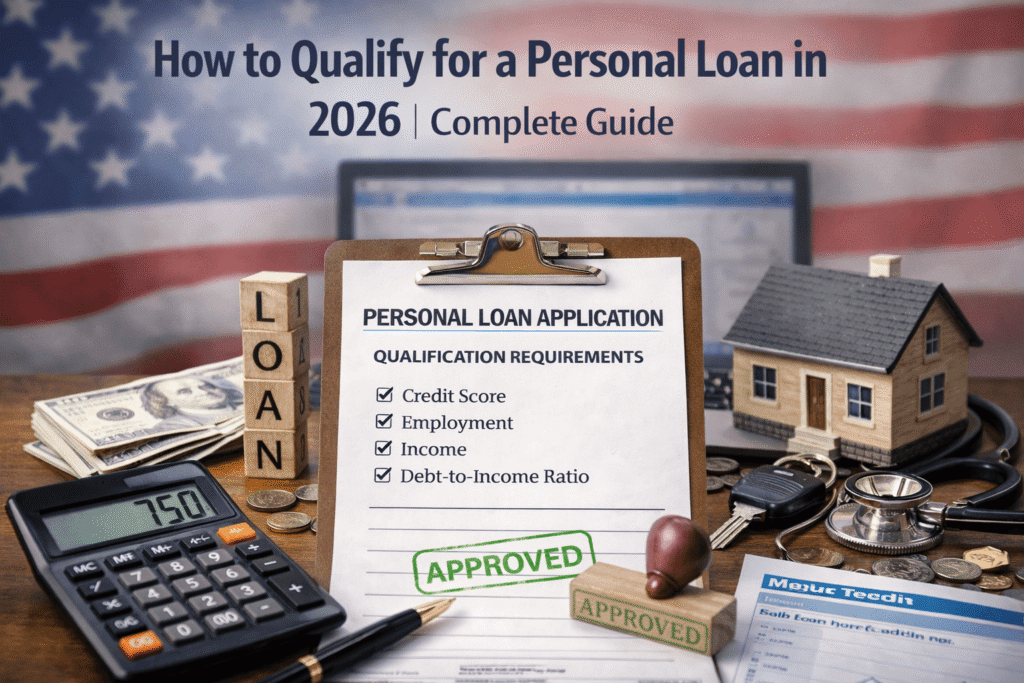
- ✔ Have a credit score of 650 or above
- ✔ Earn a stable, verifiable monthly income
- ✔ Keep your debt-to-income ratio below 40%
- ✔ Have at least 1–2 years of credit history
- ✔ Maintain a positive payment record with no recent defaults
- ✔ Are applying for a loan amount reasonable relative to your income
📋 IN THIS GUIDE
- What Does It Mean to Qualify for a Personal Loan?
- Basic Personal Loan Requirements
- 7 Key Factors Lenders Evaluate
- Minimum Credit Score by Lender Type
- 10 Proven Ways to Improve Approval Chances
- Why Loan Applications Get Rejected
- Qualifying with Bad Credit
- Step-by-Step Eligibility Check
- Mistakes to Avoid
- Frequently Asked Questions
What Does It Mean to Qualify for a Personal Loan?
When you apply for a personal loan, the lender is asking themselves one core question: “Can I trust this person to repay the money on time?”
Qualifying means meeting enough of their criteria — credit score, income, debt levels — to give them the confidence to approve your application and offer you a loan at a specific interest rate. To understand how that interest rate is then calculated, see our guide on how personal loan interest works.
How the Approval Process Actually Works
Most lenders run your application through an automated underwriting system that scores your financial profile against their internal criteria. If your numbers meet their threshold, you’re approved. If not, you’re declined — or asked for additional documentation. Human review kicks in for edge cases: applications close to the line, or borrowers with unusually complex files (like self-employment income or a thin credit file).
Secured vs. Unsecured Personal Loans
This distinction is critical when it comes to qualifying:
🔓 Unsecured Loans
No collateral required. Lenders rely entirely on your creditworthiness. Require a stronger financial profile to qualify.
🔐 Secured Loans
Backed by an asset (car, savings account). Lender can claim the asset if you default — so they’re more willing to approve applicants with lower credit or income.
💡 PRO TIP
If you’re struggling to qualify for an unsecured loan, a secured option can be a useful stepping stone — especially for rebuilding credit.
Basic Personal Loan Requirements
Here’s a high-level overview of what most lenders expect. These are typical ranges — individual lenders may differ.
| Requirement | Typical Expectation | Why It Matters |
|---|---|---|
| Credit Score | 580 – 720+ | Indicates repayment reliability |
| Monthly Income | Stable & verifiable | Proves ability to repay |
| Debt-to-Income Ratio | Below 36–40% | Shows you’re not over-leveraged |
| Employment History | 6–24 months consistent | Demonstrates income stability |
| Credit History Length | 2+ years preferred | Longer history = lower risk |
| Existing Defaults | None recent | Missed payments raise red flags |
| U.S. Residency | Required by most lenders | Regulatory requirement |
7 Key Factors Lenders Use to Approve Personal Loans
Every lender has their own scoring model, but these factors appear on almost every lender’s evaluation. Understanding them gives you a major advantage.
Credit Score
Your credit score is the single most-referenced number in any loan application — a 3-digit summary (300–850) of your credit history generated by Experian, Equifax, and TransUnion. The higher your score, the lower the lender’s risk and the better the terms they’re willing to offer. To understand where your score stands nationally, read our guide on the average credit score in the US.
| Score Range | Rating | Typical Loan Impact |
|---|---|---|
| 750 – 850 | Excellent | Best rates, highest approval odds |
| 700 – 749 | Good | Competitive rates, easy approval |
| 650 – 699 | Fair | Decent options, moderate rates |
| 600 – 649 | Poor | Limited lenders, higher rates |
| 580 – 599 | Very Poor | Specialized lenders, high APR |
| Below 580 | Bad | Secured loans or co-signer likely needed |
💡 Pro Tip: Even moving your score from 630 to 680 can unlock significantly better loan terms. A short credit-improvement sprint before applying can save you thousands in interest. Learn how in our guide to raising your credit score fast.
Your Income Level
Income tells lenders whether you can actually afford the monthly payments. Most lenders calculate a debt-to-income ratio — and your income is the denominator. You’ll typically need to provide at least one of the following:
- Recent pay stubs (last 30–60 days)
- Bank statements showing consistent deposits
- W-2 forms or federal tax returns (last 1–2 years)
- 1099 forms or profit/loss statements if self-employed
📌 SELF-EMPLOYED? HERE’S WHAT TO KNOW
Lenders view self-employment income with more scrutiny because it can fluctuate. Expect to provide 2 years of tax returns and bank statements. Some lenders specialize in self-employed borrowers — it’s worth seeking them out rather than applying through traditional banks.
Debt-to-Income Ratio (DTI)
Your DTI is one of the most important — and most misunderstood — factors in loan qualification. It tells lenders how much of your monthly income is already committed to existing debt payments.
DTI FORMULA
Total Monthly Debt Payments ÷ Gross Monthly Income × 100
Example: You earn $5,000/month. You pay $800 on a car loan, $300 on student loans, and $400 on credit cards = $1,500 total.
DTI = $1,500 ÷ $5,000 = 30% ✔ Most lenders would approve this.
| DTI Ratio | Lender’s View | Approval Likelihood |
|---|---|---|
| Below 20% | Excellent | Very high — premium borrower |
| 20% – 35% | Good | Strong approval chances |
| 36% – 43% | Acceptable | May require higher income or smaller loan |
| 44% – 50% | High | Only some lenders will consider |
| Above 50% | Very High | Most lenders will decline |
Employment Stability
Lenders aren’t just looking at your current income — they want to know it’ll continue. Most lenders prefer:
- At least 6 months at your current job
- At least 2 years of consistent employment history overall
- No recent gaps in employment (unless explainable, like parental leave)
💡 Pro Tip: If you recently changed jobs for a higher salary in the same industry, that’s generally viewed positively. Lenders care more about career consistency than job-hopping within a field.
Credit History Length
The age of your credit accounts matters more than most people realize. The average age of your accounts factors into your FICO score:
- Less than 2 years: May limit approval at traditional lenders
- 2–5 years: Adequate for most lenders
- 5+ years: Viewed positively, contributes to better rates
⚠️ WARNING
Closing old credit card accounts can actually shorten your average credit history and hurt your score. Even if you rarely use an old card, consider keeping it open to maintain credit age.
Existing Debt Load
Having multiple open loans or high credit card balances signals financial stress to lenders — even if you’ve never missed a payment. Lenders look at: number of open credit accounts, total outstanding balances, whether you’re near your credit limits, and recent hard inquiries.
Loan Amount Requested
The amount you request directly affects your chances. A $3,000 loan is far easier to qualify for than a $40,000 loan, even with the same credit profile. Requesting an amount whose monthly payment exceeds 10–15% of your take-home pay can trigger denials at conservative lenders.
💡 Pro Tip: If you’re on the borderline, consider requesting a slightly smaller amount to improve approval odds. You can always refinance or take an additional loan later once you’ve established a payment history.
Minimum Credit Score to Qualify for a Personal Loan
There’s no single universal minimum — different lenders cater to different credit tiers. Here’s a practical breakdown of your options by credit score range. See our detailed guide on what is a good credit score to understand where you fall.
| Credit Score | Approval Odds | Typical APR Range | Best Lender Type |
|---|---|---|---|
| 750+ | Excellent | 6% – 12% | Banks, credit unions, online lenders |
| 700 – 749 | High | 10% – 17% | Most lenders available |
| 650 – 699 | Moderate | 15% – 22% | Online lenders, credit unions |
| 600 – 649 | Limited | 22% – 30% | Specialized online lenders |
| 580 – 599 | Low | 28% – 36% | Bad credit lenders (Avant, OppFi) |
| Below 580 | Very Difficult | 35%+ | Secured loans, cosigner, or credit builder |
10 Proven Ways to Increase Your Chances of Loan Approval
These aren’t vague platitudes — each tip directly addresses one of the qualifying factors lenders evaluate. Work through as many as you can before applying.
Check Your Credit Score First
Pull your free report from AnnualCreditReport.com before applying. Identify errors and target lenders whose minimums match your profile — avoiding hard inquiries from lenders who’ll decline you anyway.
Reduce Your Existing Debt
Paying down credit cards and small loans has a double benefit: it improves your credit utilization ratio (boosting your score) AND lowers your DTI (improving your qualification odds).
Apply for a Realistic Amount
Applying for the minimum amount necessary reduces lender risk. A good rule: your requested monthly payment should be no more than 10–15% of your monthly take-home pay.
Improve Credit Utilization
Utilization accounts for ~30% of your FICO score. Stay below 30% — under 10% is even better. Paying down balances before applying can sometimes add 10–30 points within 30 days.
Add a Co-Signer
A creditworthy co-signer (family member or close friend) agrees to be equally responsible for repayment. Especially effective if you have a thin credit file or recent credit setback.
Choose Lenders That Match Your Profile
A traditional bank might decline a 620 score outright, while an online lender specializing in fair-credit borrowers might approve the same application at a reasonable rate.
Prequalify Before You Apply
Prequalification uses a soft inquiry — no credit score impact. A hard inquiry (full application) can lower your score by 5–10 points. Prequalify first; apply only with your chosen lender.
Correct Errors on Your Credit Report
Look for incorrect late payments, accounts that aren’t yours, outdated negatives (fall off after 7 years), and duplicate accounts. Disputes are filed directly with the three bureaus under the FCRA.
Show Stable, Sufficient Income
Wait until you have 3–6 months at a new job before applying. Include all income sources (side income, rental income, alimony) where allowed. Use bank statements to demonstrate cash flow.
Avoid Applying to Multiple Lenders at Once
Each full loan application triggers a hard inquiry. Apply to three banks on the same day and your score takes three hits — and each lender can see the others, raising red flags.
💡 Pro Tip: Rate shopping for a personal loan within a 14–45 day window is often treated as a single inquiry by FICO. Take advantage of this window when comparing final loan offers.
Why Personal Loan Applications Get Rejected
Understanding why lenders say no can be just as valuable as knowing what makes them say yes.
| Rejection Reason | What It Means | How to Fix It |
|---|---|---|
| Credit score too low | Falls below lender’s minimum threshold | Improve score before reapplying, or find lenders with lower minimums |
| High debt-to-income ratio | Too much income committed to debt | Pay down existing debts or apply for a smaller amount |
| Insufficient income | Income too low to support the payment | Apply for a smaller amount or wait for income to grow |
| Too many recent inquiries | Looks like financial desperation | Wait 3–6 months before applying again |
| Short credit history | Not enough data to assess risk | Build credit with a secured card; revisit in 6–12 months |
| Recent missed payments | Signals unreliable repayment | Bring all accounts current; wait 6+ months before applying |
| Unverifiable income | Can’t confirm ability to repay | Gather documentation; some lenders accept bank statements |
📌 ONE THING MANY BORROWERS MISS
If your application is denied, the lender is required by law to send you an “adverse action notice” explaining why. Read it carefully — it tells you exactly what to work on before your next application.
Can You Qualify for a Personal Loan with Bad Credit?
Short answer: yes — but it requires being strategic about where and how you apply. Here are your realistic options.
🏦 Bad Credit Lenders
Online lenders like Avant and OppFi specialize in 580–650 scores. Pay close attention to APR range, origination fees (some charge 5–10% upfront), and whether they report to all three bureaus — important for rebuilding.
🔐 Secured Personal Loans
By pledging an asset (savings account, CD, or vehicle) as collateral, you reduce the lender’s risk, enabling easier approval and lower rates even with bad credit. Credit unions often offer the best terms.
👥 Using a Co-Signer
A creditworthy co-signer can transform a rejection into an approval. This is often the fastest path to qualifying for a fair-rate loan. Remember: they’re equally on the hook if you default.
🔨 Credit Builder Loans
Work in reverse: you make payments first, funds are released at the end. Offered by credit unions and community banks, they’re specifically designed to establish or rebuild credit history — often dramatically improving your score in 12 months.
How to Check Your Personal Loan Eligibility (Step-by-Step)
Ready to move from learning to doing? Here’s the practical process to follow before submitting any application.
Pull your free credit report from AnnualCreditReport.com (the only government-authorized site) and get your score from a free monitoring tool like Credit Karma. Look for errors and note your score tier.
Add up all monthly debt payments (credit cards, auto loans, student loans) and divide by your gross monthly income. Aim for below 36%.
Decide how much you actually need. Calculate the monthly payment and make sure it’s comfortably within your budget before applying.
Based on your credit score and DTI, identify lenders whose stated criteria match your profile. Many lenders publish minimum credit score requirements upfront.
Use prequalification tools (soft inquiries only) to compare rate offers without damaging your credit. This takes 5–10 minutes per lender.
Don’t compare just interest rates. Factor in origination fees, prepayment penalties, and other charges to calculate the true cost. Our guide on how personal loan interest works explains APR in detail.
Once you’ve selected the best offer, complete the full application. Have your income documentation ready to speed up the process. Online lenders can fund within 1–3 business days.
CHECK YOUR OPTIONS
See What Personal Loan Rates You Qualify For
Compare multiple lenders without affecting your credit score. Find loans from $1,000 to $50,000 — results in minutes.
Personal Loan Qualification Mistakes to Avoid
Even well-informed borrowers make these errors. Avoiding them can be the difference between approval and rejection.
- ✗Applying before checking your credit report — You might be carrying errors that artificially lower your score.
- ✗Borrowing more than you need — A larger loan means higher monthly payments and increased DTI. Apply for what you actually need.
- ✗Ignoring the APR in favor of the payment — A low monthly payment on a long-term, high-interest loan can cost far more than a higher payment on a shorter loan.
- ✗Not shopping around — Rates for the same borrower profile can vary by 10+ percentage points across lenders. Always compare at least 2–3 offers.
- ✗Applying during financial instability — If you recently lost a job or had a major credit event, wait until your profile stabilizes before applying.
- ✗Missing the fine print on fees — Origination fees of 3–8% can add hundreds or thousands of dollars to your loan cost. Always factor these into your comparison.
Frequently Asked Questions
Final Thoughts
Getting approved for a personal loan isn’t just about having a high credit score — although that certainly helps. Lenders are evaluating your complete financial picture: your income, how much debt you’re already carrying, your employment stability, and how much you’re asking to borrow.
The most important thing you can do right now is check your credit score and calculate your DTI. These two numbers tell you exactly where you stand and what needs attention before you apply.
Key takeaways:
- ✔Credit score is critical but not the only factor — income and DTI matter just as much
- ✔Prequalify before applying to protect your credit score
- ✔Target lenders whose criteria match your current financial profile
- ✔Even with bad credit, options exist — secured loans and co-signers can bridge the gap
- ✔Correcting credit report errors is one of the fastest ways to improve your eligibility
READY TO APPLY?
See What You Qualify For — No Credit Impact
Use a loan marketplace to compare personalized offers from multiple lenders in under 5 minutes.
📚 RELATED ARTICLES
Disclaimer: This article is for informational purposes only and does not constitute financial or legal advice. Loan terms, rates, and eligibility criteria vary by lender and are subject to change. Always review the terms and conditions of any loan offer carefully before accepting. The external links to AnnualCreditReport.com and Credit Karma are provided for informational purposes.