
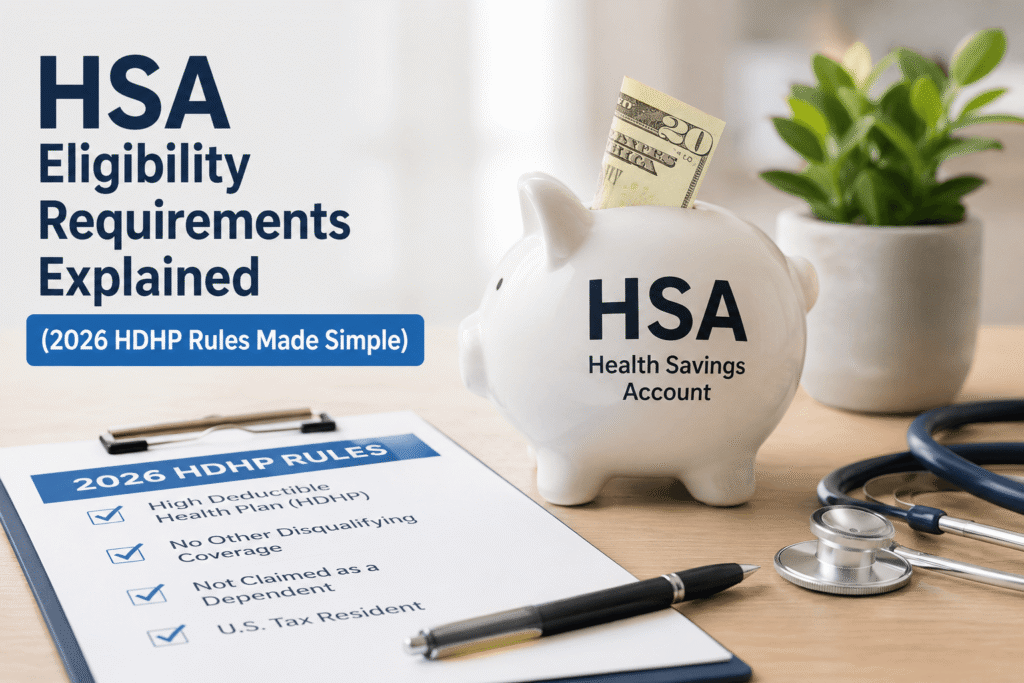
To open and contribute to a Health Savings Account (HSA) in 2026, you must meet all four of these requirements:
- Be enrolled in an HSA-qualified High Deductible Health Plan (HDHP)
- Have no disqualifying secondary health coverage
- Not be enrolled in Medicare (any part)
- Not be claimed as a dependent on someone else’s tax return
Family min. deductible: $3,400
Individual OOP max: $8,500
Family OOP max: $17,000
- Not every “high deductible” plan qualifies — the IRS has specific rules
- Medicare enrollment — even just Part A — stops your HSA contributions immediately
- Your spouse’s FSA could disqualify you from contributing to an HSA
- Some ACA Bronze and Catastrophic plans become more HSA-friendly in 2026
- HSA eligibility works month-by-month, not annually
- You can keep using your HSA funds forever, even after losing eligibility
- Accidentally overcontributing carries real IRS penalties — fix it fast
What Is HSA Eligibility?
Here’s the thing about Health Savings Accounts: they’re one of the best tax breaks available to everyday Americans. The triple tax advantage — contributions go in pre-tax, grow tax-free, and come out tax-free for medical expenses — is genuinely hard to beat. But the IRS has surprisingly strict rules about who can actually use one.
Most people assume they qualify. Many are wrong. And some find out the hard way, after they’ve already contributed thousands of dollars and owe back taxes and penalties. See the most common HSA myths that lead people astray.
This guide breaks down every eligibility rule in plain English — including the hidden disqualifiers most people never see coming.
💰 The triple tax advantage: Contributions reduce your taxable income. Growth is tax-free. Withdrawals for qualified medical expenses are tax-free. No other account does all three.
What Is an HDHP?
A High Deductible Health Plan (HDHP) is exactly what it sounds like: a health insurance plan with a higher-than-average deductible. In exchange, you typically pay lower monthly premiums. The idea is that you save money each month and use your HSA to cover out-of-pocket costs until your deductible is met.
Here’s where people get confused: just because your deductible is high doesn’t mean your plan is IRS-qualified for an HSA. The IRS sets specific minimum and maximum thresholds every year, and your plan must meet them exactly. For a full breakdown of how these accounts work, see our complete HSA guide.
Your plan documents will usually say “HSA-qualified” or “HSA-compatible” if you’re good to go. When in doubt, call your insurance provider and ask directly.
2026 HDHP Requirements (IRS Rules)
For 2026, your health plan must meet all of these to qualify:
| Coverage Type | Minimum Deductible | Maximum Out-of-Pocket |
|---|---|---|
| Individual | $1,700 | $8,500 |
| Family | $3,400 | $17,000 |
The deductible is what you pay before insurance kicks in. The out-of-pocket maximum is the most you’ll ever pay in a year before your insurance covers 100%. Both limits must fall within the IRS range.
One important exception: preventive care (annual physicals, screenings, vaccinations) can be covered by your HDHP before your deductible is met without affecting your HSA eligibility. That’s a built-in safety net most people appreciate.
NEW 2026 Rule Changes Most People Haven’t Heard About
This is where things get interesting — especially if you’re self-employed, a freelancer, or buying your own insurance through the ACA marketplace.
ACA Bronze and Catastrophic Plans
Starting in 2026, more Bronze and Catastrophic marketplace plans qualify as HSA-compatible under updated federal guidance. This is a significant change that affects:
- Freelancers and self-employed workers buying coverage on Healthcare.gov
- Gig economy workers without employer-sponsored insurance
- Early retirees who haven’t reached Medicare age yet
📄 Real Example: A self-employed graphic designer buying coverage through Healthcare.gov may now qualify for an HSA with a Bronze plan that didn’t meet IRS criteria before. If that designer earns $75,000/year, contributing the full $4,400 self-only limit could save roughly $1,100 or more in federal taxes alone.
This doesn’t mean all Bronze plans qualify — but more of them do than in previous years. Always verify your specific plan’s HSA status before contributing.
Telehealth and Direct Primary Care (DPC) Updates
The IRS has also continued to clarify rules around telehealth services and Direct Primary Care memberships. In 2026, certain DPC arrangements can coexist with HSA eligibility under specific conditions — without the membership being considered “other coverage” that disqualifies you.
If you have a DPC membership, confirm with your tax advisor whether it affects your HSA status.
Who Qualifies for an HSA in 2026?
Before diving in, it’s worth understanding the full picture of HSA pros and cons — so you know whether qualifying is even worth pursuing for your situation. Here’s who the IRS says can participate:
- You have an IRS-qualified HDHP as your primary health insurance
- You are not enrolled in Medicare Part A, B, C, or D
- You are not claimed as a tax dependent by someone else
- You have no conflicting secondary coverage (like a general-purpose FSA)
- Your ACA marketplace plan meets the 2026 HDHP deductible requirements
- You have Medicare (any part, including Part A only)
- You’re covered by a traditional PPO or HMO that doesn’t meet HDHP standards
- Your spouse has a general-purpose Flexible Spending Account (FSA)
- You’re listed as a dependent on someone else’s tax return
- You have non-qualified secondary coverage like Medicaid or certain VA benefits
HSA Eligibility Comparison Table
| Your Situation | Eligible for HSA? | Why |
|---|---|---|
| HDHP only | Yes ✓ | Meets all IRS requirements |
| HDHP + Medicare (any part) | No ✗ | Medicare disqualifies HSA contributions |
| HDHP + spouse’s general FSA | Usually No ✗ | FSA counts as other disqualifying coverage |
| Self-employed with ACA Bronze plan | Possibly Yes in 2026 ✓ | New ACA rule changes may qualify |
| Traditional PPO | No ✗ | PPO is not HDHP-qualified |
| Veteran using VA care recently | Sometimes No ⚠️ | Depends on VA benefits received and timing |
| HDHP + limited-purpose FSA | Yes ✓ | Limited FSA doesn’t disqualify HSA |
| Enrolled as someone’s dependent | No ✗ | Tax dependents cannot contribute to HSAs |
Hidden HSA Disqualifiers Most People Miss
This is the section most insurance articles skip entirely. These are the “gotchas” that catch people off guard — sometimes costing them thousands in back taxes and penalties.
Medicare Enrollment
Medicare is the single most common HSA trap, especially for Americans approaching retirement age. The moment you enroll in any part of Medicare — Part A, B, C, or D — your ability to contribute to an HSA stops completely.
Here’s where it gets tricky: many Americans are automatically enrolled in Medicare Part A when they turn 65, even if they don’t want it. If you’re still working and covered by an employer HDHP, you may not realize this happened.
⚠️ Common trap: Retroactive Medicare enrollment. If you delay signing up for Medicare and then enroll later, Social Security may backdate your Part A coverage up to 6 months. This means you could have been ineligible for months you already contributed. Those contributions become taxable and subject to a 6% excess penalty.
The fix: Talk to your HR department and a tax advisor before turning 65 if you plan to keep contributing to your HSA.
Your Spouse’s FSA
This one surprises a lot of couples. If your spouse has a general-purpose Flexible Spending Account (FSA) through their employer, it can disqualify you from contributing to your own HSA — even if you’re enrolled in a perfectly valid HDHP.
Why? Because a general FSA can be used to reimburse medical expenses for spouses and dependents. The IRS considers this “other coverage,” which conflicts with HSA rules.
💡 The exception: A limited-purpose FSA (used only for dental and vision) or a dependent care FSA doesn’t disqualify you. If your spouse’s employer offers a limited FSA option, that’s worth requesting.
VA Benefits and TRICARE
Veterans who have received VA health benefits for non-service-connected conditions within the past three months may be ineligible for HSA contributions during that period. TRICARE (military health insurance) is generally not HSA-compatible as a primary plan.
If you’re a veteran with both VA benefits and an employer HDHP, consult a tax professional to confirm your eligibility status.
Being Claimed as a Tax Dependent
If your parents (or anyone else) claim you as a dependent on their tax return, you cannot contribute to an HSA — even if you have your own HDHP. This affects many young adults on their parents’ plans, though note that being on a parent’s health plan doesn’t automatically make you their dependent for tax purposes.
Step-by-Step: How to Check If You’re HSA Eligible
Don’t guess. Here’s how to actually verify your eligibility before contributing a single dollar. Once you’ve confirmed you qualify, our guide on how to open an HSA account walks you through the next steps.
Look for these exact phrases in your Summary of Benefits and Coverage (SBC):
- “HSA-qualified” or “HSA-compatible”
- IRS HDHP language in the deductible section
- Deductible amounts that meet the 2026 minimums ($1,700 individual / $3,400 family)
Pull up your plan documents and confirm your deductible meets the minimum and your out-of-pocket maximum doesn’t exceed the limit. If the numbers are close to the IRS thresholds, double-check — even a small shortfall disqualifies you.
Ask yourself these questions:
- Does my spouse have a general-purpose FSA?
- Am I enrolled in Medicare Part A, B, C, or D?
- Do I have any secondary insurance (Medicaid, TRICARE, VA benefits)?
- Am I being claimed as a dependent on someone else’s taxes?
This is the part most articles skip. HSA eligibility is determined month-by-month — specifically, on the first day of each month. If you switch to an HDHP mid-year, you only qualify for months when you were enrolled on the first of the month. Miss this detail, and you could overcontribute without realizing it.
Mid-Year Eligibility Rules Explained Simply
Life changes mid-year — new job, marriage, job loss, turning 65. HSA rules account for this, but you have to know how they work.
The Prorated Contribution Method
📋 Example: Sarah switches to an HDHP on July 1, 2026. She’s eligible for 6 months (July–December). Her prorated individual contribution limit would be roughly $2,200 (6/12 of $4,400). Contributing more than this creates an excess contribution she’ll need to correct.
The Last-Month Rule (And Its Risks)
There’s a special rule: if you’re HSA-eligible on December 1, you can contribute the full annual amount for that year, regardless of when you became eligible. This sounds great — but there’s a catch.
To use the last-month rule, you must remain HSA-eligible for the entire following year (called the “testing period”). If you lose eligibility in that window — say, you take a new job with a traditional PPO in March — the excess contributions become taxable plus a 10% penalty.
The last-month rule is a powerful strategy, but only if you’re confident your HDHP coverage will continue.
2026 HSA Contribution Limits
| Coverage Type | 2026 Contribution Limit | 55+ Catch-Up Contribution |
|---|---|---|
| Self-Only (Individual) | $4,400 | +$1,000 = $5,400 |
| Family | $8,750 | +$1,000 = $9,750 |
Real-Life Examples People Actually Relate To
Jake is 28, single, and healthy. He rarely goes to the doctor and his employer offers both a PPO and an HDHP. The HDHP has lower premiums, so he saves $180/month compared to the PPO. He puts that savings into his HSA and invests it in index funds. By 65, if his HSA grows at a modest 7% annually, that account could be worth over $400,000 — all tax-free for medical expenses (or taxable but penalty-free for anything else after 65).
The Martinez family has two young children. They use a lot of healthcare — well-child visits, the occasional urgent care trip, dental. They’re nervous about a high deductible. But with the 2026 family contribution limit of $8,750, they can fully fund their HSA and use it like a checking account for medical bills. Their contributions reduce their taxable income, effectively giving them a discount on every dollar of healthcare spending.
Carol retired at 60 and isn’t eligible for Medicare until 65. She buys an ACA marketplace plan that qualifies as an HDHP. For five years, she contributes the maximum to her HSA, building a substantial tax-free reserve for future medical costs — right before Medicare, when healthcare expenses typically rise.
Marcus is a freelance developer. He buys his own insurance through Healthcare.gov. In prior years, his Bronze plan didn’t qualify for an HSA. With the 2026 ACA rule changes, his updated Bronze plan now meets IRS HDHP criteria. He can now contribute $4,400 to an HSA, reducing his self-employment taxable income — one of the few reliable tax breaks available to people who work for themselves.
Common HSA Eligibility Mistakes
A plan can have a high deductible and still not be IRS-certified for HSA use. Always look for the “HSA-qualified” label in your plan documents — don’t just check the deductible number.
You enrolled in Medicare and forgot to stop contributions. Now you have excess contributions for months you weren’t eligible. This is fixable, but you’ll owe income tax on the excess plus a 6% penalty unless you withdraw it before the tax filing deadline.
You left a job in April and lost your HDHP. You contributed for the full year. The months before HDHP coverage and after losing it don’t count. Calculate your prorated limit carefully whenever your coverage changes.
Your spouse’s employer offers an FSA and they enrolled in it during open enrollment. You’re now ineligible for your own HSA contributions. This conversation needs to happen before benefits elections, not after.
FSAs have use-it-or-lose-it rules. HSAs don’t — your balance rolls over forever. This confusion leads people to treat their HSA like an FSA, spending it down unnecessarily instead of letting it grow tax-free for decades.
How to Avoid HSA Eligibility Problems
-
✔
Review your insurance plan documents every open enrollment season — don’t assume your plan is still HSA-qualified -
✔
If you’re turning 65, talk to HR and a tax advisor before your birthday about Medicare timing -
✔
Coordinate with your spouse during open enrollment to check for FSA conflicts -
✔
When your coverage changes mid-year, recalculate your contribution limit immediately -
✔
Keep good records of when your HDHP coverage started and stopped each year -
✔
If you accidentally overcontribute, withdraw the excess before your tax filing deadline to avoid the 6% penalty
Frequently Asked Questions
Final Thoughts
HSA eligibility sounds complicated at first glance — and honestly, the IRS doesn’t make it easy. But for most Americans, the rules come down to a few core questions: Do you have a qualified HDHP? Are you on Medicare? Does anything else conflict with your coverage?
Answer those right, and you unlock one of the best tax advantages available in America today. The biggest mistake isn’t making a wrong choice — it’s assuming you’re eligible without checking.
Before open enrollment closes, pull up your plan documents, have a quick conversation with your spouse about their benefits, and check the IRS thresholds for 2026. That ten-minute review could be worth thousands of dollars in tax savings over your lifetime.
Verify eligibility annually. Check for Medicare timing if you’re approaching 65. Coordinate spouse benefits before elections close. And if you’re self-employed, 2026 may be the year your marketplace plan finally qualifies.
Sources: IRS HSA Guidance · Healthcare.gov 2026 Updates · Fidelity HSA Resources · IRS Publication 969