
⚡ Quick Answer
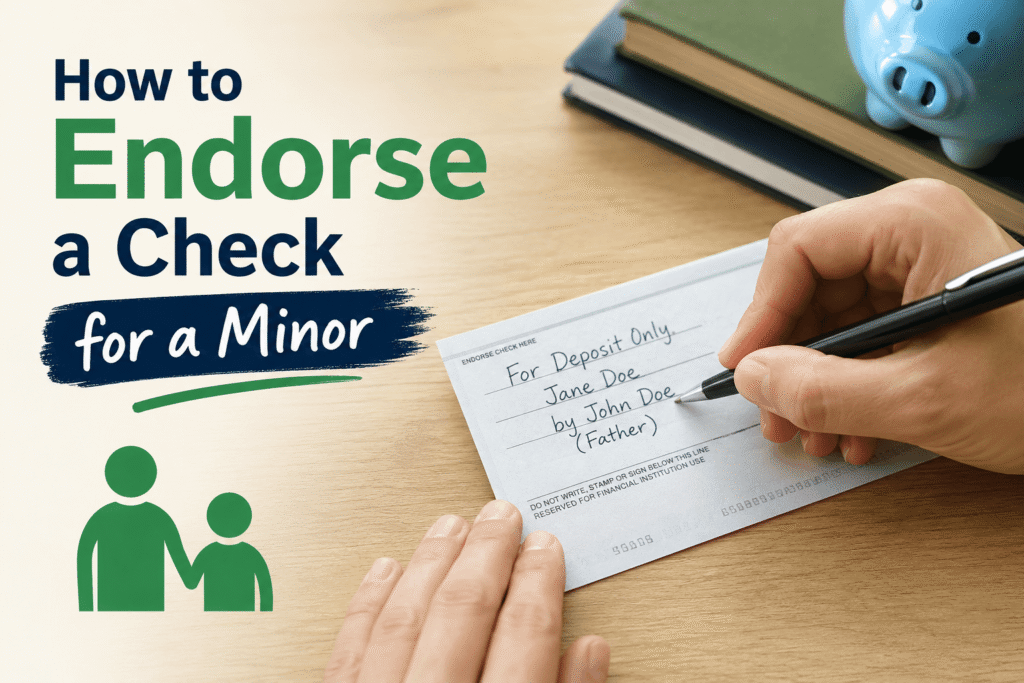
Most banks require a parent or guardian to sign the check on behalf of the minor — typically by writing “For deposit only,” the child’s account number, and their own signature below the child’s name. The exact process varies by bank, but the two non-negotiables are: proof of your relationship to the minor and depositing into an account connected to the child. If your child doesn’t have a bank account yet, you’ll need to set one up — a custodial or joint account works best — before the check can be deposited.
📋 Quick Summary at a Glance
| Who signs | A parent or legal guardian signs on behalf of the minor (some banks allow older teens to sign with a parent co-signature) |
| What to write | The child’s name, “by [Parent’s Name], parent/guardian,” and “For deposit only” |
| Where to deposit | Into the minor’s custodial account, a joint account, or in some cases a parent’s account (varies by bank) |
| Common mistakes | Signing only the child’s name, skipping “For deposit only,” depositing into the wrong account, or not having the right ID |
| Bank restrictions | Policies differ widely — Chase, Bank of America, Wells Fargo, and credit unions each have their own rules. Always call ahead |
What Does It Mean to Endorse a Check for a Minor?
Endorsing a check simply means signing the back of it to authorize the deposit or cashing of the funds. Adults do this every day without thinking about it — you flip the check over, sign your name in the endorsement area, and you’re done.
But when a check is made out to a child under 18, things get a little more complicated. Minors generally can’t legally enter into financial contracts, which means they usually can’t endorse checks on their own. That’s where parents and legal guardians step in.
When you endorse a check for a minor, you’re essentially saying: “I’m authorized to act on behalf of this child.” You’re taking legal responsibility for the transaction. Banks need to see that authorization written clearly on the check itself — and in most cases, they’ll also ask for ID.
The specific phrasing matters more than most people realize. Write it wrong and the bank has every right to reject the deposit, even if everything else looks perfectly fine.
When Would a Minor Receive a Check?
You might be surprised how often kids end up on the receiving end of a check. Here are the most common real-life situations:
Birthday or Holiday Gifts
Grandparents and relatives still love writing checks. A $50 or $100 birthday check from Grandma is probably the most frequent reason parents end up Googling “how to endorse a check for a minor.”
Tax Refunds
If your child had a part-time job and filed a tax return, any refund from the IRS will come in their name. The IRS issues refund checks to the taxpayer on record, so if your 16-year-old worked at a local grocery store, that refund belongs to them. You can learn more about dependent tax filing rules directly from the IRS’s official website.
Insurance Payouts
If a minor was involved in an accident or is a beneficiary on a policy, the insurance company may issue a check in their name. These can be more complex situations — if the amount is substantial, you may need court involvement or a guardian ad litem, depending on your state.
Settlements and Legal Awards
Courts sometimes award settlements to minors in personal injury cases. In these situations, a judge typically requires the funds to go into a blocked account or a structured settlement — not a regular bank deposit. Always get legal advice for this type of situation.
Scholarships and Awards
Some private scholarships and academic awards are paid directly to the student rather than the school. These checks may come in a teenager’s name and need to be deposited properly.
Earnings from Odd Jobs or Side Work
If your child mows lawns, babysits, or does freelance work, clients might pay by check. Even if the amount is small, the process for depositing it is the same.
Can a Minor Endorse a Check Themselves?
Technically, it depends — on the bank, the state, and sometimes the amount of money involved.
In most states, minors under 18 are considered legally incompetent to enter into contracts, which generally includes financial transactions. That said, many banks apply their own internal policies that are more nuanced.
Under Age 13
Generally, no. A child this young cannot endorse a check themselves. A parent or guardian must handle the entire process, and the check should be deposited into a custodial account (like a UGMA or UTMA account) where the adult is the custodian.
Ages 13–17
Some banks will accept an endorsement from a teenager if a parent or guardian co-signs. Others require the parent to sign entirely. A few banks with teen-specific accounts (like Greenlight or Step) have more flexible policies. It’s best to call your specific branch and ask before heading in.
Age 18+
Once your child turns 18, they’re legally an adult and can endorse and deposit checks just like anyone else. At that point, you’re out of the picture — unless they’ve asked you to help.
Pro tip: Even if your teenager is 16 or 17 and has their own bank account, don’t assume they can just sign and deposit the check. Call the bank first. A rejected deposit wastes everyone’s time.
How to Endorse a Check for a Minor — The Correct Way
This is the part most guides gloss over, but it’s the most important. The exact wording you write on the back of the check determines whether the bank accepts it or sends you home empty-handed.
Standard Endorsement (Minor’s Own Account)
This is the most common scenario — you’re depositing the check into an account that’s already in your child’s name (usually a joint or custodial account).
What to Write on the Back of the Check
Depositing Into the Parent’s Account
Some banks allow this, some don’t. If your bank permits it, the endorsement looks like this:
Endorsement for Parent’s Account Deposit
Important: Many banks will reject this because the check was originally made out to the child. If you want to do this, call your bank first and get confirmation. Some will require you to come in-branch with ID and the child present.
Joint Account Endorsement
If the check is made out to both the child and a parent (for example, “Emily Jones and John Jones”), both parties typically need to sign. The wording is simpler:
Joint Endorsement
Step-by-Step: How to Endorse a Check for a Minor
Let’s walk through the whole process from start to finish so there’s no guesswork.
Comparison Table: Endorsement Scenarios at a Glance
Use this table to figure out which scenario matches your situation:
| Scenario | Who Signs | Where It Goes | Risk | Notes |
|---|---|---|---|---|
| Minor (under 13) receives gift check | Parent/Guardian only | Custodial account | Low | Easiest scenario; bring birth certificate |
| Teen (13–17) with own account | Parent + teen (or parent alone) | Minor’s checking/savings | Low | Call bank first; policies vary widely |
| Parent deposits check into own account | Parent only, with third-party endorsement | Parent’s account | Medium | Many banks restrict this; verify in advance |
| Joint account (child + parent) | Both parties (or parent alone if joint) | Joint account | Low | Usually the simplest solution |
| Minor receives legal/settlement check | Court-appointed guardian or attorney | Blocked/trust account | High | Consult an attorney; do not attempt solo |
| Scholarship check to teen | Parent + teen signature | Minor’s account or school directly | Low | Contact scholarship issuer for guidance |
Real-Life Examples That Show How This Works
Example 1: The $100 Birthday Check from Grandma
Your 8-year-old gets a $100 check for her birthday, made out to “Sophia Martinez.” You have a custodial savings account at your local credit union. Here’s what you do:
- Flip the check over
- Write: “Sophia Martinez”
- Write: “By: Maria Martinez, Mother/Guardian”
- Write: “For Deposit Only, Account #1234567”
- Sign your name
- Head to the credit union with your ID and the check
Result: Smooth deposit. The teller sees the correct endorsement, verifies your ID, and processes it without any issues. If you’d just signed “Sophia Martinez” and nothing else, there’s a real chance they’d reject it.
Example 2: Your 16-Year-Old Gets a Tax Refund Check
Your teenager worked a summer job, filed their own tax return with your help, and now has a $320 refund check from the IRS in their name. They have a teen checking account at your bank.
- Have your teen endorse the back of the check in the endorsement area
- You sign below as parent/co-signer (some banks require this, some don’t)
- Both of you go to the branch together
- Bring your teen’s ID (school ID or passport) and your own photo ID
Result: Deposited successfully. For a 16-year-old with their own account, many banks actually let them handle it themselves — but going together removes any doubt.
Example 3: The Birthday Check You Can’t Figure Out
Your 11-year-old receives a $250 check from a distant relative, made out to “Jacob Williams.” You don’t have a custodial account set up. Here’s the problem: you can’t just deposit it into your personal account without a third-party endorsement, and your bank may not accept that either.
The best move here is to open a custodial savings account first. Many banks (and online options like Fidelity or Schwab) let you open one quickly. Then deposit the check into the new account once it’s set up.
You can learn more about how custodial accounts work from the Consumer Financial Protection Bureau (CFPB), which outlines the key differences between account types for minors.
Common Mistakes That Get Checks Rejected
Here’s where most parents get tripped up — and what to do instead:
Mistake #1: Signing Only the Child’s Name
This is the most common error. You write “Emily Johnson” on the back and think you’re done. But the bank has no idea who signed it. Was it Emily herself (who is 9 years old)? That’s not a valid endorsement. Always add “By: [Your Name], Parent/Guardian” below the child’s name.
Mistake #2: Skipping “For Deposit Only”
Without a restrictive endorsement, anyone who gets their hands on the check could theoretically cash it. Writing “For Deposit Only” means even if the check is lost or stolen, it can only be deposited into the specified account. It’s a simple protection step that takes two seconds.
Mistake #3: Depositing Into the Wrong Account
If the check is made out to your child and you deposit it into your account without proper authorization, the bank may freeze the funds, reverse the transaction, or in rare cases flag it for fraud. Always deposit into an account that has the child’s name on it — at minimum as a joint or custodial holder.
Mistake #4: Not Matching the Bank’s Records
If your child’s account uses her full legal name (Elizabeth) but you wrote “Beth” on the check endorsement, some banks will flag it. Use full legal names that match exactly.
Mistake #5: Trying to Mobile Deposit a Minor’s Check
Mobile deposit works fine for standard personal checks, but for third-party or minor’s checks, many banks require in-person verification. Chase, for example, typically requires you to visit a branch for checks made out to minors. Save yourself the hassle — go in person the first time.
Mistake #6: Not Bringing Proof of Relationship
A teller who’s following the rules may ask you to prove you’re the child’s parent or guardian. A birth certificate, adoption papers, or court-issued guardianship documents usually do the trick. For regular birthday checks, you’ll likely never be asked — but it’s smart to have it on hand for larger amounts.
How Major Banks Handle Checks Made Out to Minors
Every bank has its own policy, and they’re often not posted online. Here’s a general overview based on typical practices (always confirm directly with your bank):
🏦 Chase Bank
Chase generally requires a parent or guardian to endorse the check alongside the minor’s name. For larger checks (usually over $500), they may ask for the minor to be present or for additional documentation. Mobile deposit is typically not accepted for checks made out to minors.
🏦 Bank of America
Bank of America’s policy generally allows a parent or guardian to endorse a check for a minor by writing “For deposit only” along with the account number. They typically want the endorsement to show the parent’s relationship clearly. Branch visits are recommended for any check over $100.
🏦 Wells Fargo
Wells Fargo typically requires both the minor’s name and the parent’s endorsement. For checks deposited into a joint account where both the child and parent are on the account, the process tends to be smoother. They may require in-person visits for checks made out to minors under 13.
🏦 Credit Unions
Credit unions often have more flexible policies than big banks, especially if you’ve been a member for years. They’re generally more willing to work with you on the paperwork if something is slightly off. However, the core requirement — parent endorsement — still applies.
Bottom line: Call your specific branch before you go. Ask specifically: “I have a check made out to my [age]-year-old. What do I need to write on the back, and do I need to bring anything with me?” That three-minute phone call saves a wasted trip.
Does Your Child Have a Bank Account? If Not, Here’s What to Do
If you’re holding a check made out to your kid and they don’t have a bank account, you’ve got a few options:
Open a Custodial Bank Account
A custodial account is an account held in the child’s name but managed by an adult until the child reaches adulthood (usually 18 or 21 depending on state law). Many banks offer these — and so do investment platforms like Fidelity and Charles Schwab for investment custodial accounts.
For more information on how custodial accounts work, the FDIC’s Consumer Resource Center is a reliable, government-backed resource.
Open a Joint Checking Account
Many parents prefer joint accounts because both the parent and child can access funds. This works especially well for teens who are learning to manage money. Most banks allow you to open a joint account for a minor with just your ID and the child’s Social Security Number.
Teen Banking Apps
Apps like Greenlight, Copper, or GoHenry offer debit cards and banking features specifically built for kids and teens. While you’d still need to handle the initial check deposit through a bank, these platforms can be great for teaching financial responsibility alongside a traditional account.
USA.gov has a helpful guide on protecting your child’s identity from fraud and identity theft, which becomes more relevant as kids open their own financial accounts.
📚 Related Guides on Finance Navigator Pro
Building your child’s financial foundation starts early. Here are some related guides that can help you take the next step:
📊
🧮
📋
Frequently Asked Questions
Final Thoughts
Endorsing a check for a minor isn’t complicated once you know what you’re doing — but it’s one of those things where the details really matter. The wrong endorsement or the wrong account can turn a simple deposit into a frustrating back-and-forth with your bank.
The Simple Version to Remember
Write the child’s full name → Add “By: [Your Name], Parent/Guardian” → Write “For Deposit Only” → Sign your name → Deposit into an account with the child’s name on it. That’s it.
If you’re ever unsure, the five-minute phone call to your bank is always worth it. Banks deal with this situation regularly and can tell you exactly what they want to see before you make the trip in.
And if your child doesn’t have a bank account yet, now’s a great time to set one up. A custodial or joint account gives them a financial foundation they’ll use for years — and it makes every future check deposit a lot less stressful.
You’ve got this.
About This Guide
This guide was written for Finance Navigator Pro, a U.S.-focused personal finance resource. The information is based on standard U.S. banking practices and federal regulations. Bank policies change frequently — always verify current procedures with your specific financial institution. This content is for informational purposes only and does not constitute legal or financial advice. Last updated: June 2026