
Complete 2026 Guide to Coverage, Costs, Requirements & Best Companies
You finally found it. Maybe it’s a beautifully restored 1957 Chevy Bel Air sitting in a garage two towns over. Maybe it’s your grandfather’s 1965 Mustang that’s been sitting under a tarp for thirty years, and you just spent eighteen months and more money than you’d admit bringing it back to life. Or maybe you tracked down a vintage Cadillac Eldorado you dreamed about as a kid and wrote a check without thinking too hard about what came next.
Whatever the car, you’ve got something rare — something that doesn’t just depreciate like a normal vehicle. It appreciates. It has history. It has meaning. And the last thing you want is to protect it with the same $89-a-month policy you’d throw on a 2019 Honda Accord.
That’s where antique car insurance comes in. And this guide walks you through everything — not the watered-down version you find on most insurance comparison sites, but the real details that make the difference between a claim that goes smoothly and one that leaves you shortchanged by thousands of dollars. If you want a primer on how insurance pricing works in general first, our guide on how insurance quotes are calculated is a useful companion read.
📌 Quick Answer: What Is Antique Car Insurance?
Antique car insurance is a specialized policy for vehicles typically 25+ years old that are preserved or restored for collector purposes rather than daily driving. It offers agreed value coverage (no depreciation on claims), lower premiums for limited mileage, and protections standard auto policies exclude — like spare parts coverage and vehicle transport. Eligibility requires garage storage, mileage limits (usually under 2,500–5,000 miles/year), and a valid standard driver’s license.
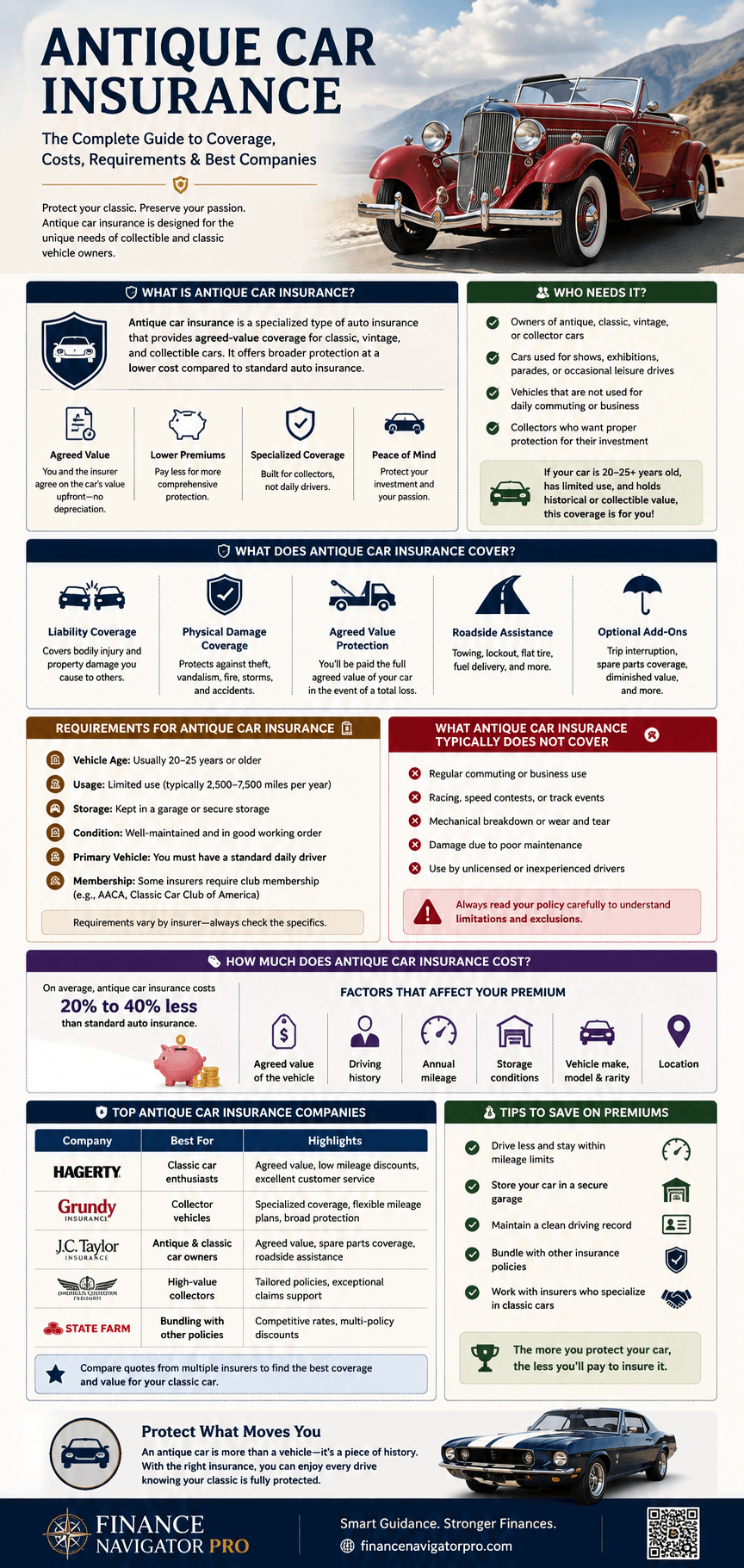
Antique Car Insurance at a Glance: Coverage, Costs, Requirements & Top Companies
What Is Antique Car Insurance?
Antique car insurance is a collector vehicle policy specifically engineered for vehicles that aren’t being used as everyday transportation. It’s built on fundamentally different assumptions than a standard auto policy — and understanding those differences could save you thousands of dollars when it matters most.
Standard auto insurance is designed for vehicles that depreciate. Every year a modern car sits in your driveway, it loses value — and your insurer prices that in. If your 2022 SUV gets totaled, the insurer pays its current market value, which might be 20–30% less than what you paid three years ago. That’s the Actual Cash Value model, and it works fine for everyday vehicles.
Antique cars don’t depreciate — they appreciate. A 1969 Dodge Charger RT in excellent condition was worth around $40,000 ten years ago. Today it might appraise for $90,000 or more depending on provenance, numbers-matching drivetrain, and documentation. A standard auto policy would pay based on a depreciated value formula and potentially leave you holding the bag for tens of thousands of dollars.
How Insurers Define “Antique”
Most specialty insurers define an antique vehicle as one that is at least 25 years old — though some use a 20-year threshold. The National Association of Insurance Commissioners (NAIC) doesn’t mandate a universal definition, so it varies slightly by state and company. A few key points:
Why Standard Auto Insurance Isn’t Enough
Here’s the core problem: a standard auto insurer treats your collector car the same way it treats a used commuter vehicle. That means:
✅ Key Takeaway
Standard auto insurance undervalues collector vehicles and lacks the protections serious collectors need. Antique car insurance closes these gaps with agreed value coverage, parts protection, and mileage-based pricing that reflects how you actually use your vehicle.
Antique vs. Classic vs. Vintage vs. Collector
The terms antique, classic, vintage, collector, muscle, exotic, and historic get used interchangeably in casual conversation — but insurers, DMVs, and car clubs each define them differently. Getting the classification wrong can affect eligibility, premiums, and claim payouts.
The Antique Automobile Club of America (AACA) defines a vehicle as an antique if it is at least 25 years old and preserved in, or restored to, its original condition. The Classic Car Club of America (CCCA) has a narrower definition: American and foreign vehicles manufactured between 1915 and 1948 that are fine or distinctive automobiles.
For insurance purposes, the most important distinction isn’t the label — it’s whether the policy uses agreed value coverage, how the insurer defines eligible use, and what mileage limits apply.
✅ Key Takeaway
Don’t assume your “classic” car gets classic car insurance rates automatically. Each insurer uses its own age and condition thresholds. Confirm your vehicle’s classification in writing before buying a policy.
How Antique Car Insurance Works
The process of getting and using antique car insurance is meaningfully different from buying a standard auto policy. Here’s how it flows from application to claim:
One thing most people don’t realize: because agreed value is set upfront, claims on antique car policies tend to settle faster than standard auto insurance claims. There’s no argument about depreciation. The check is based on the number you both agreed to when you bought the policy.
✅ Key Takeaway
Antique car insurance starts with an agreed value — the cornerstone that separates it from standard coverage. Everything else flows from that number. Set it accurately and update it as your vehicle appreciates.
What Qualifies as an Antique Car?
Not every old car automatically qualifies for antique car insurance. Insurers assess a combination of factors — and meeting all of them matters.
✅ Key Takeaway
Eligibility hinges on age, condition, use, and storage. The biggest disqualifiers are daily use, street parking, and a missing primary vehicle.
Antique Car Insurance Requirements Checklist
Use this checklist before applying for a collector vehicle policy. Meeting all requirements upfront speeds the application and ensures you won’t be declined or have a claim disputed later.
Driver Requirements
Vehicle Requirements
Storage & Mileage Requirements
Other Requirements
✅ Key Takeaway
Verify each item before you shop for quotes. Missing storage documentation or lacking a primary vehicle are the most common reasons applications stall or get declined.
What’s Covered Under Antique Car Insurance?
Antique car insurance covers more ground than most people expect — and the specifics vary meaningfully by insurer. Here’s a comprehensive breakdown of what you can typically include in a collector vehicle policy.
✅ Key Takeaway
Comprehensive and collision are the core coverages — but spare parts coverage, vehicle transport protection, and specialty towing are the items that separate a good collector policy from a great one.
What’s NOT Covered — Exclusions to Know
Understanding exclusions is just as important as knowing what’s covered. These are the situations where your antique car policy won’t pay out — and where collectors most often get surprised.
✅ Key Takeaway
The biggest claim denials in collector car insurance come from unauthorized drivers and undisclosed use changes. If you plan to take the car on a road trip or let someone else drive it — call your insurer first.
Agreed Value vs. Actual Cash Value — The Most Important Decision
This is the single most critical coverage concept in collector car insurance. The difference between agreed value and actual cash value (ACV) can be the difference between replacing your vehicle and walking away with a fraction of what it’s worth.
Example: a 1969 Camaro SS agreed at $85,000 is totaled in a garage fire. Under agreed value, you receive $85,000. Under ACV, the same car might be valued by the insurer at $62,000 based on comparable sales — a $23,000 gap that appears regularly in real collector car disputes.
One nuance: some policies use the term “stated value” rather than “agreed value.” Stated value policies set a maximum payout but may still pay ACV if it’s lower. Always confirm your policy uses true agreed value language.
✅ Key Takeaway
Never accept an ACV policy for an appreciating collector vehicle. If an insurer can’t offer agreed value coverage, shop elsewhere — every major specialty insurer does.
How Much Does Antique Car Insurance Cost?
Antique car insurance is almost always dramatically cheaper than standard auto insurance — but the final number depends on several factors. Here’s what you can realistically expect to pay in 2026.
These figures assume enclosed garage storage, fewer than 3,000 miles annually, a clean driving record, and a driver over age 25. Deviating from any of these can push premiums higher.
Cost by Annual Mileage
✅ Key Takeaway
For most collector vehicles, antique car insurance costs between $200 and $600 per year — often less than a single month of standard auto insurance. Want to dig deeper into what drives auto premiums generally? See our guide on how to lower your insurance premium.
Factors That Affect Your Premium
Specialty insurers look at a different mix of factors than standard auto insurers. Here’s what drives your antique car insurance cost up or down:
✅ Key Takeaway
The fastest way to lower your antique car insurance premium is to maximize storage security, minimize annual mileage, and join a recognized collector club. Together, these three factors can reduce your premium by 15–30%. For broader savings strategies, see insurance discounts most people don’t know about.
Best Antique Car Insurance Companies (2026)
The specialty collector car insurance market is smaller and more specialized than standard auto insurance. The companies below dominate it — each with distinct strengths depending on your vehicle, driving habits, and budget.
Hagerty
Hagerty is the largest and most recognized name in collector car insurance, insuring more than 2 million vehicles. Their policies are built exclusively for collectors, with agreed value coverage as standard, the Hagerty Drivers Club community perks, and a claims team that actually understands collector vehicles. Weaknesses: not always the cheapest option for lower-value vehicles.
Grundy Insurance
Grundy pioneered the collector car insurance market in 1947. Their “Guaranteed Value” approach means your agreed amount is locked in and can’t be reduced at claim time. Grundy is often the most competitive for vehicles in the $15,000–$60,000 range.
American Collectors Insurance
American Collectors offers one of the most straightforward online quoting experiences in the specialty market, making them a strong choice for first-time collector car buyers. Their $0 deductible option is genuinely rare in this market.
✅ Key Takeaway
Hagerty is the default recommendation for most serious collectors. But Grundy often beats them on price for mid-range vehicles, and American Collectors is the easiest entry point for new collectors. Get quotes from at least two specialty insurers before deciding.
How to Choose the Right Policy
✅ Key Takeaway
The right policy depends less on brand name and more on three things: agreed value, claims reputation, and mileage flexibility. Score each insurer on these three criteria before making your final decision.
Antique Car Insurance by Vehicle Type
American Classics (1930s–1960s)
Vehicles like Ford Model A’s, 1950s Chevrolets, and early 1960s Fords are the bread and butter of the collector market. Insurance for this category is straightforward with any major specialty insurer. Focus on agreed value and spare parts coverage.
European Classics
MGs, Triumphs, early Porsches, vintage Mercedes-Benz, and early Ferraris require special consideration. Agreed value should account for import costs in restoration value. Hagerty is particularly strong here.
Classic Pickup Trucks
The collector truck market has exploded over the past decade. Most specialty insurers handle classic trucks like classic cars — same agreed value model, same mileage restrictions.
Muscle Cars (1964–1974)
The muscle car segment includes some of the most valuable American vehicles in existence. Agreed value for numbers-matching muscle cars needs to be set with documentation: window sticker, Protect-o-Plate, or PHS documentation.
Hot Rods, Street Rods & Modified Vehicles
A 1932 Ford with a modern engine and custom bodywork isn’t an antique in the traditional sense — it’s a hot rod. These require custom or street rod policies that evaluate the vehicle based on build quality and replacement cost.
✅ Key Takeaway
Vehicle type affects parts availability, appraisal complexity, and which insurer has the most experience with your make. For rare or unusual vehicles, choose an insurer with hands-on experience in your category — not just the cheapest quote.
State-by-State Considerations
While antique car insurance is a specialty market with its own standards, state regulations significantly affect registration, titling, mileage limits, and minimum liability requirements.
Regardless of state registration rules, your insurance policy’s mileage limits are set by your insurer — not the DMV. Always verify with your insurer what the annual mileage cap is on your policy.
✅ Key Takeaway
State rules affect registration and plates, but your insurer sets the coverage rules. Research both before applying.
Discounts Available
Specialty insurers offer a range of discounts that can meaningfully reduce your premium. Here’s what to ask about:
✅ Key Takeaway
Stacking discounts is legitimate and encouraged. A collector with an alarmed garage, active AACA membership, two vehicles on one policy, and a clean driving record could realistically reduce their base premium by 30–40%. See more general strategies in insurance discounts most people don’t know about.
Filing a Claim
One practical advantage of collector car insurance is that the claims process is usually faster and less contentious than standard auto claims — largely because the agreed value eliminates the biggest source of disputes.
Pro tip: keep a claims-ready folder with your agreed value policy documents, vehicle photographs (updated annually), current appraisal, and your insurer’s 24-hour claims number.
✅ Key Takeaway
The faster you document and notify, the faster your claim resolves. Insist on adjusters with specialty vehicle experience and never let a standard auto repair shop quote work on a vehicle with rare or original parts.
Insurance Coverage During Restoration
Vehicles under restoration occupy an awkward insurance gray area. The vehicle isn’t operational, it may be partially disassembled, and its value sits somewhere between what you paid for a barn find and what it will be worth when finished.
Before Restoration Begins
If the vehicle is being stored in your garage, check whether your homeowner’s insurance covers it for fire and theft. For vehicles worth more than $5,000–$10,000, a scheduled personal property endorsement may be smarter than going without coverage.
During Active Restoration
Hagerty offers specific restoration coverage for vehicles currently undergoing restoration. American Collectors also offers options for unfinished vehicles. Document parts purchased, labor invested, and current photos at each stage.
After Restoration
Once complete, schedule a formal appraisal before securing your final agreed value policy. This is when agreed value matters most — the vehicle is at peak value, and a standard ACV policy would penalize you immediately.
✅ Key Takeaway
The restoration period is the most underinsured phase of collector car ownership. Don’t wait until the car is complete to think about insurance. Get restoration coverage from day one and update the agreed value at completion.
Frequently Asked Real-World Scenarios
❓ Can I drive my antique car daily?
No — this is a hard line with specialty insurers. Daily commuting is an explicit exclusion in virtually every antique car policy. If your daily driver is in the shop and you’re tempted to use the antique, call your insurer first.
❓ Can teenagers drive the covered vehicle?
Most specialty insurers restrict coverage to the policyholder and, in some cases, a listed spouse or co-owner. Adding a teenage driver to a collector car policy is typically not permitted.
❓ Can I lend it to a friend for a car show?
This depends on your policy’s permissive use language. Call your insurer before handing over the keys for any unlisted driver use.
❓ Can I insure multiple collector vehicles on one policy?
Yes — and you should, because multi-vehicle discounts are real. Hagerty, Grundy, and American Collectors all offer fleet options for serious collectors.
❓ What if I drive it more than my mileage limit?
If you file a claim and your odometer shows you’ve exceeded the policy’s annual mileage limit, the insurer has grounds to deny the claim or reduce the payout. Call your insurer mid-year if you’re approaching the limit — most will adjust your coverage without issue.
✅ Key Takeaway
When in doubt, call your insurer before the event, not after. A five-minute conversation before lending the car or taking a long road trip is infinitely better than a claim dispute.
Top Antique Car Insurance Mistakes Collectors Make
After thousands of policy reviews and claim conversations, these are the mistakes that cost collectors the most money — and the most sleep. For a broader look at costly habits, see mistakes that make insurance expensive.
✅ Key Takeaway
Most collector car insurance mistakes come from one source: treating a specialty policy like a standard auto policy. It isn’t. Read it, understand it, and update it annually as your vehicle’s value changes.
Expert Tips for Antique Car Insurance
✅ Key Takeaway
The best-protected collectors treat insurance as an active responsibility, not a set-it-and-forget-it purchase. Annual valuation reviews, documented photographs, and a maintained relationship with your insurer are the habits that matter most.
Frequently Asked Questions
Eligibility
❓ How old does a car have to be to qualify?
Most specialty insurers require a vehicle to be at least 25 years old, though some use a 20-year threshold. As of 2026, any vehicle manufactured before 2001 meets the 25-year rule at the major specialty carriers.
❓ Does my car have to be in perfect condition?
No. Many insurers cover vehicles in “good, maintained” condition — not necessarily show-quality. Vehicles under restoration also typically qualify with restoration-in-progress coverage.
❓ Can modified cars qualify?
It depends on the extent of modifications. Minor period-correct updates generally don’t disqualify a vehicle, but heavy modifications may require a custom or street rod policy instead.
❓ Can I insure a car I’m still restoring?
Yes. Hagerty and American Collectors both offer restoration-in-progress coverage, requiring photos and an estimated investment value.
Coverage & Cost
❓ Is antique car insurance cheaper than regular auto insurance?
Almost always, yes — substantially so. Most antique car policies cost between $150 and $600 per year, while standard auto insurance averages well over $1,600 annually.
❓ Do I need an appraisal to get coverage?
Not always required for lower-value vehicles, but strongly recommended above $25,000 and typically required above $50,000.
❓ What’s the difference between agreed value and stated value?
Agreed value guarantees the specified amount at total loss with no depreciation. Stated value sets a maximum payout but may pay actual cash value if it’s lower.
❓ Does mileage matter?
Yes — it’s one of the primary rating factors. Lower mileage equals lower premiums. Most policies cap annual mileage between 2,500 and 5,000 miles.
❓ Does the policy cover track days or autocross?
No. Timed events, autocross, and any competitive driving are explicitly excluded. Specialty motorsport event insurance exists for these situations.
Operational
❓ Do I need a separate daily driver?
Yes. Most specialty insurers require applicants to have a separate vehicle insured under a standard auto policy for everyday use.
❓ Can I take my antique car on a road trip?
Yes — road trips are typically covered under pleasure and recreational use, as long as you don’t exceed your annual mileage limit.
❓ Can I insure a car with a salvage title?
Some specialty insurers will cover salvage title vehicles that have been fully restored and received a rebuilt title. Full disclosure is essential.
Claims
❓ How long does a claim take to settle?
Total loss claims on agreed value policies typically settle in 10–30 days once the adjuster completes their inspection. Repair claims vary based on parts availability.
❓ Can I choose my own repair shop?
Yes, in most cases. Insist on a shop with verifiable collector car experience rather than a standard collision center.
✅ Key Takeaway
Most collector questions come back to two things: what exactly is covered, and how much will you receive at claim time. Read your policy’s coverage section and exclusions section together — not just the coverage summary.
Antique Car Insurance Glossary
Insurance policies are dense with jargon. Here’s a plain-English reference for the terms you’ll encounter most in a collector car policy.
Key Statistics
|
Hagerty-Insured Vehicles
2M+
|
Avg. Antique Premium
$200–$600/yr
|
|
Avg. Standard Auto
$1,600+/yr
|
Collector Market Size
$14–18B
|
✅ Key Takeaway
The collector car market is substantial, appreciating, and served by a mature specialty insurance market. These statistics underscore why agreed value coverage — not ACV — is the industry standard for serious collectors.
Antique Car Insurance Checklist
Use this checklist when shopping for, buying, or renewing your antique car insurance policy.
Before You Buy a Policy
Once Your Policy Is Active
Final Verdict — Is Antique Car Insurance Worth It?
If you own a vehicle with collector value — whether it’s an $8,000 pickup truck project or a $200,000 restored muscle car — the answer is an unambiguous yes. Here’s the bottom line:
Who Should Buy It
How to Get the Best Rate
The average antique car insurance policy costs less per year than a single oil change on some modern vehicles. For the protection it provides — full agreed value at total loss, spare parts coverage, specialty claims handling, and a policy designed for how you actually use your vehicle — it’s one of the best values in all of personal insurance.
This guide is for informational purposes only and does not constitute insurance advice. Always consult a licensed insurance professional for policy-specific guidance.