

Picture this: Mark is 34 years old, and his wife just had their second child. He owns a home, carries a mortgage, and earns a good income — but he lies awake some nights wondering what happens to his family if he dies unexpectedly. He already has a 20-year term life policy from when they bought the house, but his financial advisor keeps mentioning something called universal life insurance. Mark is curious but confused. What exactly is it? How is it different? And is it worth the extra cost?
If you have ever found yourself in Mark’s shoes — wanting permanent financial protection with some flexibility — you are in the right place. This guide will walk you through everything you need to know about universal life insurance: how it works, what it costs, who it is right for, and how to compare your options. We will cut through the insurance jargon and give you straight answers so you can make a confident, informed decision.
Universal life insurance is one of the most flexible financial tools available to American families, business owners, and high-income earners. But flexibility comes with complexity — and that complexity has tripped up many policyholders over the years. By the end of this guide, you will know exactly what you are getting into.
Section 1: What Is Universal Life Insurance?
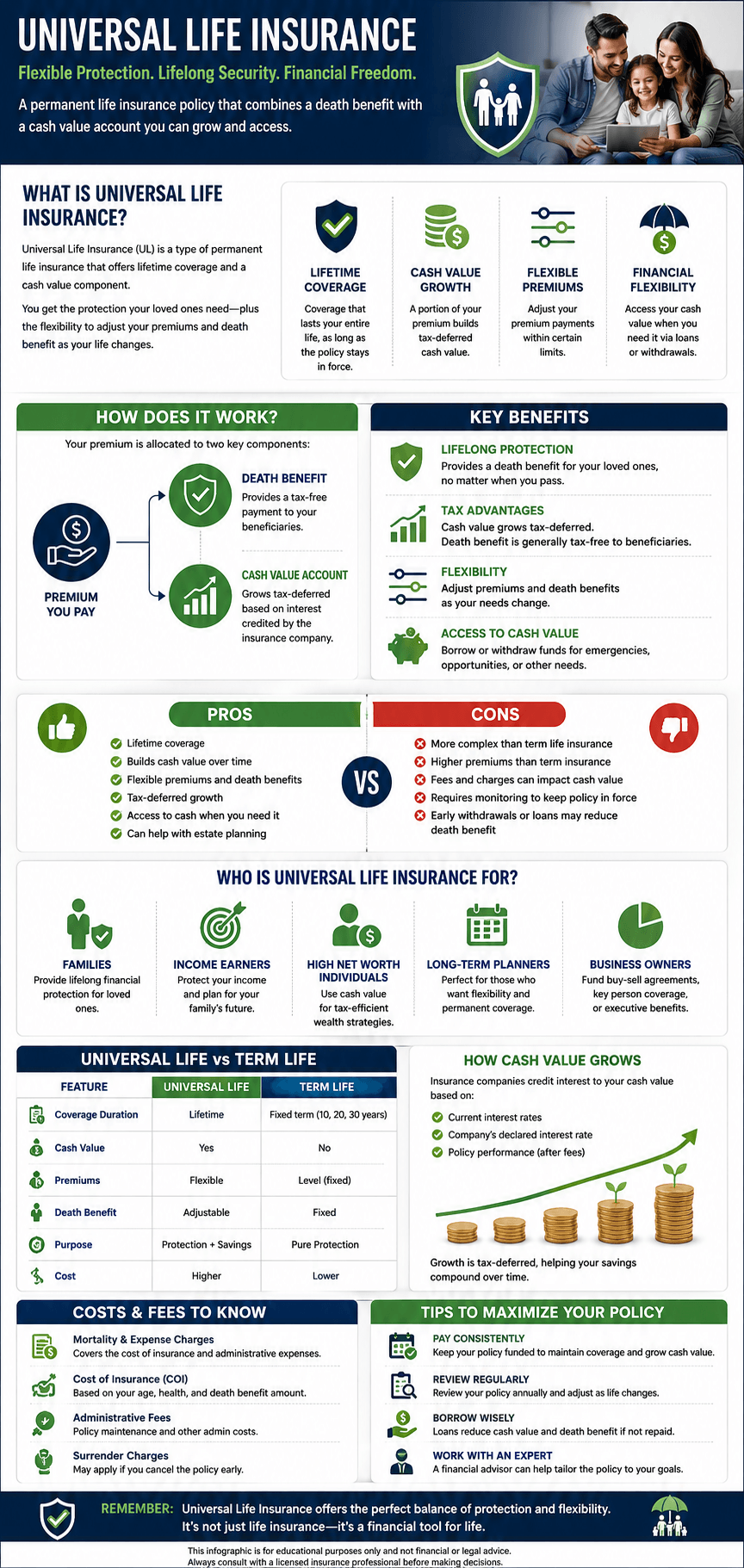
Universal life insurance (UL) is a type of permanent life insurance that combines two elements in a single policy: a death benefit that pays your beneficiaries when you die, and a cash value account that grows on a tax-deferred basis throughout your lifetime.
Unlike term life insurance, which provides coverage for a fixed period (say, 20 or 30 years) and then expires, universal life insurance is designed to last your entire life — as long as you keep the policy funded. And unlike whole life insurance, which locks you into rigid, fixed premiums, universal life insurance gives you the freedom to adjust both your premium payments and your death benefit within certain limits defined by your policy.
The Two Core Components
1. The Death Benefit: This is the amount paid to your designated beneficiaries when you pass away. It can be structured as a level benefit (Option A) or an increasing benefit that includes your accumulated cash value (Option B), depending on your policy election.
2. The Cash Value Account: A portion of every premium payment you make goes into a savings-like account within the policy. This account earns interest — the rate and method depend on which type of universal life policy you choose. The cash value grows tax-deferred, meaning you do not owe income taxes on the gains each year. Over time, you can borrow against this account, make withdrawals from it, or use it to pay your premiums.
A Simple Analogy
Think of universal life insurance like a hybrid bank account that also doubles as a life insurance policy. One part functions like a savings account that earns interest and grows quietly in the background. The other part pays your insurer to keep your coverage active. Every month, your premium gets divided between these two functions — and the beauty of universal life is that you have some control over how that split works.
What Makes It ‘Universal’?
The word ‘universal’ reflects the policy’s adaptability across three dimensions. First, you can adjust premium amounts — paying more in high-income years and less (or even nothing, temporarily) during lean ones, as long as your cash value can cover the cost of insurance. Second, you can increase or decrease the death benefit as your family’s needs evolve. Third, the policy can be structured to prioritize either cash value accumulation or death benefit protection, depending on your financial goals.
Who Is It Designed For?
Universal life insurance is designed for people who need permanent coverage — not just for 20 or 30 years, but for life — and who also want some degree of financial flexibility and a built-in savings component. It tends to attract parents building long-term wealth, business owners funding buy-sell agreements, high-income earners seeking tax-advantaged savings, and estate planners looking to pass wealth efficiently to the next generation.
|
KEY INSIGHT: Universal life insurance is not just protection — it is a lifelong financial tool. The best policies balance affordable coverage with meaningful cash value growth, all within a tax-advantaged wrapper. |
Section 2: How Universal Life Insurance Works
Understanding the mechanics of universal life insurance is essential before you buy — because the devil really is in the details. Here is a step-by-step breakdown of how your money moves through the policy.
Step 1: You Pay a Premium
Each month (or year), you submit a premium payment to your insurance company. Unlike whole life, which has a rigid fixed premium, universal life policies give you flexibility. There is typically a minimum premium (enough to keep the policy from lapsing) and a maximum premium (set to avoid turning the policy into a Modified Endowment Contract — more on that later). You can pay anywhere within that range.
Step 2: Your Insurer Deducts the Cost of Insurance (COI)
Before any money goes into your cash value, the insurance company deducts what is called the cost of insurance. This covers the actual mortality charge — the cost of insuring your life based on your age, gender, health, and the size of your death benefit. COI charges also typically include administrative fees and any rider charges. Here is the important part: COI increases as you age, because the statistical likelihood of death rises. This is why universal life insurance requires careful monitoring over the years.
Step 3: The Remaining Premium Goes into Your Cash Value
After the insurer deducts the COI and fees, the remaining amount is credited to your cash value account. If your premium is higher than the COI plus fees, your cash value grows. If you underpay consistently, the COI will eat into your cash value — and if it is depleted, your policy lapses.
Step 4: Your Cash Value Earns Interest
Your cash value earns interest each month at a rate determined by your policy type. Traditional universal life policies credit a declared interest rate set by the insurer, typically tied to prevailing market rates. Indexed universal life (IUL) policies credit interest based on the performance of a market index like the S&P 500, with a floor (often 0%) to protect against losses. Variable universal life (VUL) policies allow you to invest the cash value in sub-accounts like mutual funds, with no floor protection.
Step 5: The Death Benefit Pays Your Beneficiaries
When you pass away, your named beneficiaries receive the death benefit. Under Option A (Level), the death benefit stays fixed, and as cash value grows, it effectively reduces the insurer’s risk. Under Option B (Increasing), the death benefit equals the face amount plus the accumulated cash value, giving your beneficiaries a larger payout — but at a higher ongoing cost of insurance.
A Real-World Example: Where Does John’s $400 Go?
Let’s say John is 35 years old, in excellent health, and he purchases a $500,000 universal life policy with a $400 monthly premium. Here is a rough breakdown of where that money goes in the early years:
| Premium Component | Amount (Monthly) | Purpose |
| Cost of Insurance (COI) | ~$60 | Mortality charge for $500,000 coverage |
| Administrative Fees | ~$15 | Policy maintenance charges |
| Cash Value Contribution | ~$325 | Earns interest, grows tax-deferred |
Over the next 10 years, assuming a 4% credited interest rate, John’s cash value could grow to approximately $45,000 to $50,000 — a meaningful financial asset he can borrow against, use for retirement income, or pass on as part of his legacy. Of course, actual results vary by policy, insurer, and credited rates, so always review a current policy illustration before purchasing.
|
Section 3: Key Features of Universal Life Insurance
Flexible Premium Payments
This is the defining characteristic that separates universal life from whole life. You are not locked into a rigid monthly payment. If your business has a strong quarter, you can overfund your policy to accelerate cash value growth. If cash flow is tight, you can pay only the minimum — or even skip payments temporarily if your cash value is sufficient to cover the cost of insurance. This flexibility is genuinely useful, but it requires discipline and monitoring. Consistently underpaying can quietly drain your cash value until the policy lapses.
Lifetime Coverage
As long as your policy remains funded, your coverage never expires. This is the fundamental advantage over term life insurance. Term policies are built for temporary needs — paying off a mortgage, covering children until they are independent. Universal life is designed for permanent needs: estate planning, legacy building, and ensuring your beneficiaries are protected no matter when you pass.
Tax-Deferred Cash Value Growth
Every dollar that accumulates in your cash value grows without being taxed annually. You only potentially face taxation on gains if you surrender the policy or withdraw more than your basis (total premiums paid). This tax-deferred compounding can make a significant difference over decades compared to taxable savings accounts, where interest and dividends are taxed each year. If you’re weighing tax-deferred versus taxable growth more broadly, our guide on saving vs. investing walks through the tradeoffs.
Adjustable Death Benefit
Most universal life policies allow you to increase or decrease the death benefit as your financial situation evolves. Getting married? You might want to increase coverage. The mortgage is paid off and the kids are grown? You might scale it back to reduce the cost of insurance. Increases typically require evidence of insurability (a medical exam), while decreases are usually straightforward to request.
Policy Loans
You can borrow against your cash value at any time, for any reason, without a credit check or loan approval process. The loan does not appear on your credit report. Interest accrues on the outstanding balance, and unpaid loans reduce the death benefit paid to your beneficiaries. Critically, policy loans are generally not taxable events as long as the policy remains in force.
Withdrawals
Unlike a policy loan, a partial withdrawal permanently reduces your cash value and death benefit. Withdrawals up to your basis (total premiums paid) are generally tax-free. Withdrawals that exceed your basis are taxable as ordinary income. If you over-withdraw and the policy lapses, you could face a significant tax bill on previously untaxed gains.
Living Benefits Riders
Many universal life policies include accelerated death benefit provisions that allow you to access a portion of your death benefit while still alive if you are diagnosed with a terminal illness, chronic illness, or critical illness. These living benefits can provide a crucial financial lifeline when you need it most.
Optional Riders
Riders are additional coverage enhancements you can add to your policy for extra cost. Common riders include waiver of premium (your COI is waived if you become disabled), long-term care riders, guaranteed insurability riders, and accidental death benefit riders. We cover these in detail in Section 12.
Section 4: Types of Universal Life Insurance
Not all universal life policies work the same way. There are four primary variations, each with a distinct approach to cash value growth and risk. Choosing the right type is just as important as choosing the right insurer.
1. Guaranteed Universal Life Insurance (GUL)
Guaranteed universal life insurance is the stripped-down, budget-friendly version of permanent coverage. It provides a guaranteed death benefit for your entire lifetime (or to age 90, 95, 100, 105, or 121, depending on the policy) in exchange for fixed, level premiums — as long as you pay them on time.
The cash value in a GUL policy is minimal by design. The policy’s primary purpose is providing permanent protection at the lowest possible cost, not accumulating savings. Think of it as permanent life insurance that behaves more like a term policy in terms of simplicity and cost.
Ideal For: People who need permanent coverage without the complexity of cash value management. Great for seniors, business owners with key-person coverage needs, and anyone who simply wants a guaranteed death benefit.
Advantage: Typically the most affordable type of permanent life insurance — often 30% to 50% less expensive than indexed or whole life policies for the same coverage amount.
Disadvantage: Very little flexibility. If you miss a payment or pay late, the no-lapse guarantee can be voided. Minimal cash value means limited financial tool functionality.
2. Indexed Universal Life Insurance (IUL)
Indexed universal life insurance links your cash value growth to the performance of a stock market index — most commonly the S&P 500, though some policies use other indexes or combinations. However, you do not directly invest in the market. Instead, the insurer credits interest based on index performance, subject to a floor and a cap.
The floor — typically 0% — means your cash value cannot decrease due to a negative market year. The cap — often between 8% and 12%, depending on the insurer — limits how much of the market’s upside you capture in a great year. Some policies also use a participation rate (e.g., 80% of the index gain) instead of a cap, or combine both.
Ideal For: People who want potential market-linked growth without the risk of losing their cash value in a market downturn. A popular choice for mid-career professionals building retirement savings.
Advantage: Downside protection via the floor. Potential for higher returns than fixed UL in good market years. Popular for tax-advantaged retirement supplement strategies.
Disadvantage: Caps and participation rates limit upside. Policy illustrations can be overly optimistic if not reviewed carefully. Internal charges can be substantial. Work with an independent agent to compare illustrations.
3. Variable Universal Life Insurance (VUL)
Variable universal life insurance gives you the most investment control of any life insurance product. You allocate your cash value among sub-accounts that function like mutual funds — equity funds, bond funds, money market funds — and the performance directly determines your cash value growth. There is no floor and no cap. In a bull market, your cash value can grow significantly. In a bear market, it can shrink.
Because VUL involves investment risk in securities sub-accounts, it is regulated as a securities product by FINRA as well as state insurance regulators. Your agent must hold a securities license to sell you a VUL policy.
Ideal For: Experienced investors comfortable with market risk who want maximum growth potential and investment flexibility within a life insurance wrapper.
Advantage: Highest potential cash value growth of any UL type in favorable markets. Wide investment choice. No cap on gains.
Disadvantage: Market risk is real — a prolonged downturn can deplete your cash value and cause the policy to lapse. High internal fees. Requires active management and monitoring.
4. Fixed (Current Assumption) Universal Life Insurance
Traditional fixed universal life — also called current assumption UL — credits your cash value with a declared interest rate set by the insurer, typically quarterly or annually. The rate is tied to the insurer’s investment returns and prevailing market interest rates, but it is subject to a guaranteed minimum (often 2% to 3%). When interest rates are high, credited rates are attractive. When rates fall — as they did for much of the 2000s and 2010s — the performance can be disappointing.
Ideal For: Conservative savers who want predictable (if modest) cash value growth without market exposure or the complexity of IUL crediting methods.
Advantage: Simple to understand. Guaranteed minimum interest rate provides a safety net. Lower fees than IUL or VUL in many cases.
Disadvantage: In low-rate environments, credited rates can be disappointing and may not offset rising COI charges in later years. Policies issued during high-rate eras sometimes lapsed decades later when rates dropped.
Section 5: Universal Life Insurance vs. Other Policies
One of the most common questions people ask when shopping for life insurance is: ‘How does universal life compare to my other options?’ Here are direct, head-to-head comparisons with the most common alternatives.
Universal Life vs. Term Life Insurance
| Feature | Universal Life | Term Life |
| Coverage Length | Lifetime (permanent) | 10, 15, 20, or 30 years |
| Monthly Premium (Age 35, $500K) | $200–$500/mo | $25–$45/mo |
| Cash Value | Yes — grows tax-deferred | None |
| Premium Flexibility | High — adjust within limits | None — fixed payment |
| Death Benefit | Adjustable | Fixed |
| Policy Loans Available | Yes | No |
| Complexity | Moderate to High | Low |
| Best For | Lifelong coverage + wealth building | Affordable temporary protection |
The verdict: If you need simple, affordable coverage to protect your family while the kids are young and the mortgage is active, term life is hard to beat on cost. If you need coverage that will still be there in retirement — for estate planning, a surviving spouse’s income, or legacy goals — universal life makes more sense despite the higher premium.
Universal Life vs. Whole Life Insurance
| Feature | Universal Life | Whole Life |
| Premium Flexibility | High — variable within range | None — strictly fixed |
| Cash Value Growth | Variable — interest-dependent | Guaranteed, conservative |
| Death Benefit | Adjustable | Fixed |
| Dividends | Generally none | Yes (participating policies) |
| Cost | Moderate | High |
| Complexity | Moderate to High | Low to Moderate |
| Best For | Flexibility + growth potential | Guaranteed stability + dividends |
The verdict: Whole life offers predictability and guarantees that universal life cannot match. Universal life offers flexibility and potentially higher returns that whole life cannot match. If you value certainty above all else, whole life wins. If you value adaptability and cost efficiency, universal life is the stronger contender.
Universal Life vs. Final Expense Insurance
Final expense insurance is a small whole life policy (typically $5,000 to $25,000) designed to cover funeral costs and end-of-life expenses. It requires no medical exam, making it accessible to seniors with health issues. Universal life insurance offers far greater coverage amounts, cash value growth, and flexibility — but also requires underwriting and costs more. If your only goal is to cover burial costs, final expense insurance is simpler and more accessible. If you want meaningful financial protection and wealth-building, universal life is the appropriate choice. For a broader look at coverage types and how much protection you actually need, see what insurance coverage you need.
Section 6: Pros of Universal Life Insurance
Universal life insurance has some genuinely compelling advantages — here is an honest look at what it does well.
| ✓ | Permanent Coverage: Your coverage lasts your entire life, unlike term insurance, which expires. This matters enormously if you have permanent financial obligations — a surviving spouse to protect, an estate to manage, or a special needs dependent who will need support indefinitely. |
| ✓ | Premium Flexibility: Life is not linear. Business owners know this well — some years are flush, others are lean. Universal life’s flexible premium structure lets you adjust payments accordingly without losing coverage, provided your cash value can absorb the difference. |
| ✓ | Tax-Deferred Cash Value Growth: Your cash value grows without annual taxation. Over decades, this tax-deferred compounding can produce significantly more wealth than a comparable taxable savings account, especially for high-income earners in upper tax brackets. |
| ✓ | Tax-Free Death Benefit: Per IRC Section 101(a), life insurance death benefits are generally received income-tax-free by beneficiaries. For a $1 million policy, that means $1 million passes to your family without federal income tax — a powerful estate planning tool. |
| ✓ | Policy Loans Are Generally Tax-Free: When you borrow against your cash value, the loan is not considered taxable income as long as the policy remains in force. This is a significant advantage for funding large expenses — home renovations, business opportunities, or retirement income — without triggering a tax event. |
| ✓ | Adjustable Death Benefit: Paid off the mortgage? Children are financially independent? You can reduce your death benefit to lower your COI charges. Need more coverage after a major life event? You can increase it (subject to underwriting). This adaptability is unique to universal life. |
| ✓ | Estate Planning Efficiency: For high-net-worth individuals, a universal life policy owned by an Irrevocable Life Insurance Trust (ILIT) can keep the death benefit out of your taxable estate while providing liquidity to pay estate taxes and preserve assets for heirs. |
| ✓ | Living Benefits Access: Many policies include accelerated death benefit riders allowing you to access your death benefit early if diagnosed with a terminal, chronic, or critical illness. This feature can be invaluable when medical costs are devastating. |
| ✓ | Business Planning Tool: Universal life insurance is commonly used to fund buy-sell agreements between business partners, provide key person coverage, and structure deferred compensation plans (COLI — Corporate-Owned Life Insurance) for executives. |
| ✓ | No Contribution Limits (Unlike IRAs/401(k)s): You can put as much as the IRS’s MEC limits allow into a universal life policy’s cash value. This makes it an attractive supplement for high earners who have maxed out their tax-advantaged retirement accounts. |
| ✓ | Creditor Protection in Many States: In many U.S. states, life insurance cash values are partially or fully protected from creditors in bankruptcy proceedings. This can be an important consideration for business owners and professionals in high-liability careers. |
Section 7: Cons of Universal Life Insurance
Universal life insurance is not without its drawbacks. Understanding the risks and limitations before you buy is essential for making a sound financial decision.
| ! | Policy Lapse Risk: This is the most significant danger. If you underfund your policy over the years — whether by paying too-low premiums or taking excessive loans — your cash value can be depleted. When cash value reaches zero, the policy lapses, leaving you with no coverage and potentially a large tax bill on previously tax-deferred gains. Many universal life policies sold in the 1980s and 1990s lapsed when interest rates dropped unexpectedly, because policyholders had been told lower premiums would be sufficient. |
| ! | Complexity: Universal life insurance is considerably more complex than term or even whole life. You need to understand COI charges, credited interest rates, cash value projections, MEC limits, loan provisions, and illustration assumptions. Most buyers do not realize they need to actively monitor and occasionally recalibrate their policy to keep it on track. |
| ! | Fees and Charges: Universal life policies carry multiple layers of charges: COI (which increases as you age), per-policy administrative fees, premium loads (a percentage taken from each premium before it reaches cash value), surrender charges in the early years, and rider charges. These fees can meaningfully reduce your actual return on the cash value component. |
| ! | Rising Cost of Insurance: Because COI is based on your attained age, it increases every year. In later decades, the rising COI can consume a larger and larger share of your premium — or eat into your cash value — unless the policy is well-funded. This is the principal reason poorly designed universal life policies fail. |
| ! | Interest Rate Sensitivity: Traditional fixed UL policies credit interest based on prevailing rates. If you bought a policy in the 1980s when rates were 10%+ and expected that to continue, you may have been unpleasantly surprised by the rate environment of subsequent decades. Even indexed and variable policies have their own sensitivities. |
| ! | Illustrations Can Be Misleading: Policy illustrations — the projections your agent shows you — often present scenarios at illustrated rates that are not guaranteed. A policy that looks great at 6% credited interest may underperform significantly at 3% or 4%. Always ask your agent to run an illustration at a lower, more conservative rate before committing. |
| ! | Not Ideal for Everyone: If you primarily need inexpensive temporary coverage, universal life is overpriced for your purpose. If you want guaranteed cash value growth without any risk of policy lapse, whole life is a better fit. Universal life sits in a middle ground that does not suit every financial profile. |
| ! | Requires Annual Monitoring: Unlike a term policy you can set and forget, universal life needs periodic review — ideally annually. You should review credited rates, COI projections, loan balances, and cash value adequacy with your advisor or insurer to make sure the policy is tracking as expected. |
Section 8: Cash Value Explained
The cash value is the heart of a universal life insurance policy — and it is often the most misunderstood part. Let us break it down clearly.
How Cash Value Grows
Each time you pay a premium, a portion goes into your cash value account after the insurer deducts the cost of insurance and administrative fees. The cash value then earns interest according to the policy’s crediting method — declared rate, index-linked, or sub-account-based — and this interest compounds over time.
In the early years, cash value grows slowly because a larger share of your premium goes toward setting up the policy (front-end loads, initial charges). After five to ten years, the compounding effect begins to accelerate, and cash value growth becomes more meaningful. By years 20 and beyond in a well-funded policy, cash value can represent a substantial financial asset.
The Three Ways to Access Your Cash Value
1. Policy Loans
You can borrow against your cash value at any time. The loan accrues interest at a rate specified in the policy (often 3% to 6% per year). The outstanding loan balance — principal plus accrued interest — is subtracted from the death benefit paid to your beneficiaries if you die before repaying the loan. The beauty of policy loans: they are not reported to credit bureaus, require no repayment schedule, and are generally not taxable.
However, if unpaid loan balances grow large enough and your cash value cannot support them, the policy can lapse — converting any outstanding gains into taxable income immediately. This is a serious risk that many policyholders overlook.
2. Partial Withdrawals
You can make partial withdrawals from your cash value, up to the total premiums you have paid (your ‘basis’), tax-free. Amounts above your basis are taxable as ordinary income in the year you withdraw them. Unlike loans, withdrawals permanently reduce your cash value and death benefit and cannot be ‘repaid’ to the policy.
3. Policy Surrender
If you decide to cancel your universal life policy entirely, you receive the surrender value — your total cash value minus any outstanding loans and minus any applicable surrender charges. Surrender charges typically apply during the first 7 to 15 years of the policy. The taxable gain (surrender value minus your basis) is subject to ordinary income tax. If there is an outstanding loan balance, the tax treatment can become complex — consult a tax advisor before surrendering any policy.
Tax Treatment of Cash Value
One of the most powerful features of universal life insurance is how the IRS treats cash value growth: it is tax-deferred, meaning you pay no annual income taxes on the interest or gains. Your money compounds without an annual tax drag. When you access the cash value via loans (not taxable as long as the policy remains in force) or withdrawals up to your basis (not taxable), the tax benefits are even greater. This makes universal life a compelling supplement to traditional tax-advantaged accounts like 401(k)s and IRAs — similar in spirit to how an HSA shelters healthcare savings from annual taxation.
|
IMPORTANT WARNING: Overfunding your policy beyond IRS limits converts it into a Modified Endowment Contract (MEC). In a MEC, the tax advantages of loans and withdrawals are significantly reduced — gains come out first and are taxable, and early distributions (before age 59.5) may carry a 10% penalty. Work with your advisor to keep premiums within MEC limits. |
Section 9: How Much Does Universal Life Insurance Cost?
Universal life insurance is not cheap — and it is not supposed to be. You are paying for permanent coverage plus a cash value accumulation vehicle. The cost varies significantly based on a range of factors.
Factors That Determine Your Premium
| Age: The single biggest factor. The younger you are, the lower your COI charges, and the longer your cash value has to grow. Buying at 30 versus 50 can mean the difference of hundreds of dollars per month. | |
| Gender: Women statistically live longer than men, so they generally receive lower premium rates for the same coverage amount. | |
| Health Status: Insurers use health classifications (Preferred Plus, Preferred, Standard, Substandard/Rated) determined by your medical exam results, prescription history, family medical history, and attending physician’s records. A Preferred Plus rating can yield rates 30% to 50% lower than a Standard rating. | |
| Tobacco Use: Smokers pay significantly higher premiums — often 2x to 3x the non-smoker rate. Most insurers consider you a non-smoker after 12 months of tobacco-free status. | |
| Coverage Amount (Face Value): More coverage = higher COI charges = higher required premium. Coverage amounts commonly range from $50,000 to $10 million or more for high-net-worth individuals. | |
| Policy Type: GUL policies are least expensive (for pure death benefit); IUL policies have higher internal charges due to the index crediting structure; VUL policies have investment management fees on top of insurance charges. | |
| State of Residence: State insurance regulations, including required policy provisions and mandated reserve requirements, can affect pricing. | |
| Occupation and Hobbies: High-risk occupations (commercial pilots, miners, loggers) or dangerous hobbies (skydiving, race car driving) may result in rated policies with higher premiums. |
Sample Monthly Premium Ranges by Age
The following figures represent approximate illustrative ranges for a $500,000 Guaranteed Universal Life policy for non-smoking individuals in good-to-excellent health. Actual quotes will vary by insurer, health class, and state.
| Age | Male (Preferred) | Male (Standard) | Female (Preferred) | Female (Standard) | Coverage |
| 25 | $155–185/mo | $210–250/mo | $130–160/mo | $175–210/mo | $500,000 |
| 35 | $215–260/mo | $290–350/mo | $175–215/mo | $240–290/mo | $500,000 |
| 45 | $375–450/mo | $490–590/mo | $300–365/mo | $395–475/mo | $500,000 |
| 55 | $640–790/mo | $850–1,025/mo | $510–630/mo | $670–810/mo | $500,000 |
| 65 | $1,150–1,450/mo | $1,550–1,950/mo | $900–1,120/mo | $1,175–1,475/mo | $500,000 |
Note: These are illustrative ranges for educational purposes. Get personalized quotes from multiple insurers before making any purchasing decision. Rates for IUL and VUL policies will differ due to their additional internal cost structures.
|
TAKE ACTION: Compare quotes from at least 3 to 5 insurers before deciding. An independent life insurance broker can access multiple carriers simultaneously and find the most competitive rate for your age, health, and coverage needs. |
Section 10: Real-World Examples and Case Studies
Abstract explanations only go so far. Let us look at how universal life insurance plays out in real financial lives.
Case Study 1: The Young Family — Sarah and Michael, Ages 31 and 33
Sarah and Michael recently had their first child and purchased a home together. Michael works in tech and earns $120,000 annually; Sarah earns $75,000 in healthcare. They already have 20-year term policies for pure income replacement protection. Their financial advisor suggests supplementing with a $500,000 indexed universal life policy on Michael.
The rationale: Even after the term policies expire in 20 years, Michael’s estate planning needs will remain — he wants to leave a legacy for his child and cover potential estate taxes. The IUL also builds cash value that can supplement retirement income when combined with their 401(k)s. They fund the IUL at $450/month, and by the time the children are grown, the projected cash value could exceed $200,000 at a conservative credited rate, available for retirement income via tax-free loans.
Case Study 2: The Business Owner — David, Age 48
David owns a manufacturing business with a partner. They agree that if either dies, the survivor should be able to buy out the deceased partner’s heirs. Their attorney recommends a cross-purchase buy-sell agreement funded with guaranteed universal life insurance policies on each partner. Each partner owns and pays for a GUL policy on the other.
Why GUL? David and his partner do not care about cash value accumulation — they want guaranteed coverage to fund the buyout, at the lowest possible cost. GUL delivers permanent protection without the complexity of cash value management. When David’s partner dies at age 67, David receives the $1 million death benefit tax-free and uses it to purchase his partner’s share from the estate, ensuring the business continues without disruption.
Case Study 3: The High-Income Professional — Dr. Jennifer, Age 44
Dr. Jennifer is a physician earning $400,000 annually. She has maxed out her SEP-IRA and is looking for additional tax-advantaged savings. Her financial advisor suggests a maximum-funded indexed universal life policy as a ‘tax-free retirement’ vehicle — sometimes called LIRP (Life Insurance Retirement Plan).
Case Study 4: The Retired Couple — Robert and Patricia, Ages 68 and 65
Robert and Patricia have accumulated a $3.2 million estate. They are concerned that estate taxes (for estates above the federal exemption threshold) could force their children to sell assets they want to preserve. Their estate planning attorney structures a survivorship universal life policy (also called second-to-die insurance) that covers both of them and pays the death benefit when the second spouse dies — which is typically when estate taxes are due.
The survivorship policy is owned by an Irrevocable Life Insurance Trust (ILIT), keeping the $1.5 million death benefit outside the taxable estate. When both Robert and Patricia are gone, the trust uses the death benefit proceeds to pay estate taxes, preserving the family home, investments, and business interests for their children.
Case Study 5: Planning for a Special Needs Child — The Anderson Family
Tom and Lisa have a 12-year-old daughter with Down syndrome. She will likely require financial support and care for the rest of her life. They need life insurance coverage that will outlast not just a 20- or 30-year term, but potentially 60 or more years. A guaranteed universal life policy with a $750,000 death benefit ensures that no matter when Tom and Lisa die, funds will be available to a Special Needs Trust for their daughter’s care, without jeopardizing her eligibility for government benefits.
Section 11: Tax Advantages of Universal Life Insurance
The tax treatment of universal life insurance is one of its most compelling features — and one that distinguishes it from most other financial products. Here is a structured overview of the key tax advantages.
1. Tax-Deferred Cash Value Growth
Under current U.S. tax law, the interest and gains that accumulate in your policy’s cash value are not taxed annually. This is the same benefit you get from a 401(k) or IRA, but without contribution limits (up to the MEC threshold). The difference this makes over 20 to 30 years is substantial — tax-deferred compounding consistently outperforms taxable compounding, especially for high-income earners in the 32% to 37% federal tax brackets. If you’re comparing this against other retirement vehicles, see our breakdown of Roth 401(k) vs. Roth IRA.
2. Income-Tax-Free Death Benefit
Per Internal Revenue Code Section 101(a), life insurance death benefits are generally excluded from the beneficiary’s gross income. This means a $1 million death benefit passes to your heirs as a full $1 million — not $1 million minus 22%, 24%, or 37% in federal income taxes. This is one of the most powerful and legitimate tax planning tools available to American families.
3. Tax-Free Policy Loans
When you borrow against your cash value, the IRS does not treat the loan as a taxable distribution — it is a loan, not income. As long as the policy remains in force, you can access significant amounts of accumulated value without triggering a tax event. This is why life insurance is often used as a tax-efficient retirement income supplement for high earners.
4. Withdrawals Up to Basis Are Tax-Free
You can withdraw funds from your cash value up to your cost basis (total premiums paid, net of any dividends received) without paying income taxes. Only withdrawals above your basis are taxable as ordinary income in the year received.
5. Estate Tax Planning
For estates that may be subject to federal estate taxes, life insurance owned by an Irrevocable Life Insurance Trust (ILIT) provides estate tax liquidity without increasing the taxable estate. When the insured dies, the trust receives the death benefit outside the estate, providing funds to pay estate taxes without forcing the sale of illiquid assets like a family business or real property.
Modified Endowment Contracts (MECs): The One Big Caveat
If you fund your universal life policy too aggressively — exceeding the IRS’s 7-pay test limit — the policy becomes classified as a Modified Endowment Contract. MECs lose two key tax advantages: (1) loans and withdrawals are taxed on a gain-first basis (meaning the first dollars out are treated as taxable income, not a return of basis), and (2) distributions before age 59.5 face a 10% penalty, similar to early IRA withdrawals. Always work with your advisor to ensure premiums stay within MEC limits.
Note: Tax laws change, and individual circumstances vary. Always consult with a qualified tax advisor or CPA for guidance specific to your situation. For authoritative information, refer to IRS Publication 525 (Taxable and Nontaxable Income) and IRS Publication 550.
Section 12: Riders and Add-On Benefits
Riders are optional enhancements that can be added to a universal life insurance policy — often at an additional cost — to customize coverage for your specific needs.
1. Accelerated Death Benefit (ADB) Rider
Also called a living benefit rider, this allows you to receive a portion of your death benefit while still alive if you are diagnosed with a qualifying terminal illness (typically with a life expectancy of 12 to 24 months), a chronic illness that permanently limits daily activities, or a critical illness such as a heart attack, stroke, or cancer. This rider can provide crucial financial support when medical costs are overwhelming. Many policies include a basic ADB rider at no additional premium.
2. Waiver of Premium Rider
If you become totally disabled and unable to work, this rider waives your policy’s cost of insurance charges, keeping the policy in force without requiring you to make premium payments. The specific definition of disability and waiting period varies by insurer. This is a particularly valuable rider for self-employed individuals and business owners who depend entirely on their own income.
3. Long-Term Care (LTC) Rider
A long-term care rider allows you to accelerate a portion of your death benefit to pay for qualified long-term care expenses — home health aides, assisted living facilities, or nursing home costs. This is an increasingly popular alternative to standalone long-term care insurance, which has faced significant premium increases industry-wide. By combining life insurance with LTC protection, you ensure that the money is used one way or another — for care during life or as a death benefit for heirs.
4. Guaranteed Insurability Rider
This rider guarantees you the right to purchase additional coverage at specified future dates or life events (marriage, birth of a child) without providing evidence of insurability. If your health deteriorates, you cannot be denied coverage or charged higher rates for the additional amount. This is a smart add-on for young buyers who expect their coverage needs to grow over time.
5. Child Rider
Provides term life insurance coverage for your minor children under a single rider, typically up to age 25. It is an inexpensive way to cover all children in the household under one policy, and most child riders include a conversion privilege allowing the child to convert to a permanent policy in adulthood regardless of health.
6. Accidental Death Benefit Rider
Pays an additional death benefit — often equal to the base policy amount — if the insured dies as the result of a qualifying accident. While the probability of accidental death is statistically low, this rider is relatively inexpensive and provides an extra layer of protection for families with active lifestyles or high-risk occupations.
Section 13: Who Should — and Should Not — Buy Universal Life Insurance?
Universal Life Insurance Is Likely a Good Fit If You…
| ✓ | Need permanent life insurance coverage that will not expire, regardless of when you die. |
| ✓ | Want the flexibility to adjust your premium payments as your income fluctuates over time. |
| ✓ | Are a high-income earner who has maxed out your 401(k), IRA, and other tax-advantaged accounts and is looking for additional tax-deferred savings. |
| ✓ | Have estate planning needs — protecting a surviving spouse, equalizing an inheritance among children, or providing liquidity to pay estate taxes. |
| ✓ | Own a business and need to fund a buy-sell agreement, key person coverage, or executive deferred compensation. |
| ✓ | Have a permanent dependent (such as a child or sibling with special needs) who will require financial support for their entire lifetime. |
| ✓ | Want to build a tax-advantaged cash reserve you can access via loans for retirement income, major expenses, or business opportunities. |
| ✓ | Are healthy enough to qualify for preferred underwriting rates, which significantly improve the cost efficiency of the policy. |
Universal Life Insurance Might NOT Be the Right Choice If You…
| ✕ | Primarily need affordable temporary coverage — say, to replace income while your children are young or while your mortgage is being paid off. Term life is far more cost-efficient for this purpose. |
| ✕ | Prefer guaranteed, predictable growth with no risk of policy lapse. Whole life insurance offers guaranteed premiums, guaranteed cash value growth, and no lapse risk if premiums are paid. |
| ✕ | Are not willing or able to monitor the policy annually and adjust funding if needed. Universal life requires active management that term and whole life do not. |
| ✕ | Have tight cash flow and cannot commit to the higher premiums universal life requires for meaningful cash value accumulation. |
| ✕ | Are buying primarily as an ‘investment.’ The internal charges and COI costs mean that cash value growth is typically not competitive with market investments over most time periods — the true value is in the tax treatment and the insurance protection, not investment returns. |
| ✕ | Are a senior without a specific permanent coverage need. At advanced ages, the COI charges are very high, and a GUL may be the only cost-effective option. |
|
TAKE ACTION: Not sure which type of life insurance is right for your situation? Talk to an independent life insurance advisor who can compare multiple carriers and policy types against your specific financial goals. |
Section 14: Best Universal Life Insurance Companies (2026)
Choosing the right insurer matters as much as choosing the right policy type. Here are key factors to evaluate — and how leading carriers generally stack up. Financial strength ratings are from AM Best, the leading insurance rating agency.
| Company | AM Best | Specialty | UL Types Offered | Standout Feature | Best For |
| Pacific Life | A+ | IUL | IUL, Fixed UL, GUL | Strong IUL illustrated performance | Index-linked cash value growth |
| North American Company | A+ | GUL | GUL, IUL | Highly competitive GUL pricing | Affordable guaranteed coverage |
| Lincoln Financial | A | Flexible UL | IUL, VUL, Fixed UL | Flexible premium structures | Premium flexibility needs |
| Protective Life | A+ | Affordable GUL | GUL, IUL | Very competitive GUL rates | Budget-conscious permanent coverage |
| AIG / American General | A | Wide range | GUL, IUL, VUL | Product breadth and availability | Shoppers wanting choices |
| Nationwide | A+ | Financial strength | IUL, Fixed UL, GUL | Strong claims-paying history | Stability and reliability |
| John Hancock | A+ | Vitality program | IUL, VUL | Wellness incentive premium discounts | Health-conscious, active buyers |
| Transamerica | A | IUL innovation | IUL, Fixed UL | Multiple index options in IUL | Index diversification seekers |
Important note: AM Best ratings and product offerings change over time. Always verify current ratings and request an updated policy illustration before purchasing. Working with an independent agent who has access to multiple carriers will give you the most competitive options.
Key criteria to evaluate beyond financial strength: the insurer’s historical credited rates versus illustrated rates (how accurately did they project actual performance?), the transparency of policy fees and charges, the quality of their online account management tools, and their customer service and claims handling reputation.
Section 15: Common Mistakes to Avoid with Universal Life Insurance
Mistake 1: Underfunding the Policy
Many buyers choose the minimum premium because it looks affordable on paper. The problem: minimum premiums are often calculated at optimistic interest rate assumptions. When credited rates are lower than projected, the cash value depletes faster than expected. The smart approach: fund your policy at the target premium or above, especially in the early years, to build a buffer that can absorb fluctuating credited rates.
Mistake 2: Never Reviewing the Policy Illustration
A policy illustration shows projected values at various credited rates. It is not a guarantee. Too many policyholders purchase a policy, file the illustration in a drawer, and never look at it again. Annual policy statements should be compared against the original illustration. If your cash value is running below projections, you may need to increase premium payments to prevent a future lapse.
Mistake 3: Borrowing Too Much
Policy loans are one of the most attractive features of universal life insurance — and one of the most dangerous if abused. Unpaid loan balances accrue interest, and if the combined balance grows beyond your cash value, the policy lapses. That creates an immediate, potentially large tax bill on previously untaxed gains. Borrow wisely and with a plan to repay.
Mistake 4: Ignoring Rising COI Charges
Your cost of insurance increases every year as you age. In a well-funded policy, this is no problem — the cash value growth more than offsets the rising COI. But in an underfunded policy, the rising COI slowly devours the cash value, leading to eventual lapse. Review your COI projections at every annual policy review.
Mistake 5: Relying on Illustrated Rates as Guarantees
This bears repeating: policy illustrations are not guarantees. They show hypothetical scenarios. Insurance regulations now require that illustrations include a guaranteed scenario (showing the absolute worst case at only the guaranteed minimum credited rate) alongside the non-guaranteed illustrated scenario. Always ask to see and understand the guaranteed scenario before purchasing.
Mistake 6: Buying Without Comparing Multiple Carriers
Universal life pricing varies significantly between insurers for the same age, health class, and coverage amount. Getting a quote from only one company — especially if it is the carrier your agent happens to represent — is a mistake. An independent broker with access to 10, 20, or more carriers can often find meaningfully better pricing and policy terms.
Mistake 7: Not Revisiting the Policy After Major Life Changes
Divorce, remarriage, a new child, a business sale, retirement — all of these life events should trigger a policy review. Your beneficiary designations, coverage amount, and even the policy type may need to change. A policy that was perfectly structured at age 40 may not serve your interests at age 55.
Section 16: How to Choose the Right Universal Life Insurance Policy
Buying universal life insurance is a significant financial commitment. Use this step-by-step framework to make an informed, confident decision.
| 1 | Clarify Your Goals. Before looking at policies, write down what you actually need the policy to accomplish: permanent income replacement, estate planning, retirement income supplement, business continuity, or a combination. Your goals determine which type of UL policy is most appropriate. |
| 2 | Determine Your Coverage Amount. A common rule of thumb is 10 to 12 times your annual income, but this is only a starting point. Factor in outstanding debts, future income needs for dependents, estate tax exposure, and business obligations. Online life insurance calculators can help, but a financial advisor can provide a more precise analysis. |
| 3 | Choose the Right Policy Type. If you want the lowest cost for guaranteed permanent coverage: GUL. If you want market-linked growth with downside protection: IUL. If you want investment control and accept market risk: VUL. If you want conservative, simple cash value growth: Fixed UL. |
| 4 | Work with an Independent Agent or Broker. An independent agent represents multiple carriers — not just one — and can shop the market on your behalf. This is particularly important for universal life because pricing, policy terms, and illustration assumptions vary so widely between companies. |
| 5 | Request Illustrations from at Least Three Carriers. Ask for illustrations at the guaranteed rate (worst case), the current credited rate, and a midpoint between the two. Compare them side by side. Look at cash value projections at age 65, age 75, and age 85 to understand the long-term trajectory. |
| 6 | Scrutinize the Fees. Ask your agent to show you the policy’s internal charges: per-unit COI rates by age, administrative fees, premium loads, and any additional rider charges. These fees significantly affect your net return on cash value and are often not prominently displayed. |
| 7 | Verify the Insurer’s Financial Strength. Check the insurer’s AM Best rating (A or better is the standard recommendation), as well as ratings from Moody’s and S&P if available. For a policy you intend to hold for 30 or 40 years, financial strength and claims-paying ability matter enormously. |
| 8 | Understand the Surrender Charge Period. Most universal life policies have a surrender charge schedule that lasts 7 to 15 years. If you surrender the policy during this period, you will lose a portion of your cash value. Make sure you can commit to the policy long-term before purchasing. |
| 9 | Review the Policy Annually. Once purchased, schedule an annual policy review with your advisor to compare current values against the original illustration, assess credited rates, review beneficiary designations, and adjust funding if needed. |
| 10 | Consult a Tax Advisor. Given the tax implications of loans, withdrawals, MEC status, and estate planning, involve your CPA or tax advisor in the decision — especially if you are purchasing a large policy as part of a retirement income or estate planning strategy. |
Section 17: Frequently Asked Questions
General Questions
Is universal life insurance worth it?
For the right buyer, absolutely. If you need permanent coverage, want premium flexibility, and can benefit from tax-deferred cash value growth, universal life offers a compelling combination of features that no other product matches. For someone who only needs temporary coverage or cannot commit to higher premiums, term life insurance is more cost-effective.
Can universal life insurance expire or lapse?
Yes — and this is the most important risk to understand. Universal life insurance lapses when the cash value is insufficient to pay the cost of insurance charges. This can happen if you consistently underpay premiums, take excessive loans, or if credited interest rates are lower than originally projected. Guaranteed universal life (GUL) includes lapse protection as long as scheduled premiums are paid on time.
Can I cash out universal life insurance?
Yes. You can make partial withdrawals from your cash value or surrender the policy entirely to receive the full cash surrender value. Withdrawals above your cost basis (premiums paid) are taxable. Full surrender is subject to surrender charges during the first several years and income tax on any gains above your basis.
Is a universal life insurance death benefit taxable?
The death benefit paid to your named beneficiaries is generally received income-tax-free under IRC Section 101(a). However, if the policy is owned by the insured’s estate rather than a trust or third party, the death benefit may be included in the taxable estate for estate tax purposes.
Can my premiums increase?
In traditional universal life, you control the premium within the minimum and maximum range. The minimum required premium may effectively increase over time if the credited interest rate drops, because more of the cash value gets consumed by rising COI charges. In GUL policies with no-lapse guarantees, the scheduled premium is fixed as long as you pay on time.
Cash Value and Loans
Can I borrow money from my universal life insurance policy?
Yes. Policy loans are available at any time without a credit check, and the borrowed amount is not considered taxable income as long as the policy remains in force. Interest accrues on the loan balance. Unpaid loans reduce the death benefit and can eventually cause the policy to lapse if the cash value is depleted.
How long does it take to build meaningful cash value?
In most universal life policies, the first year or two of premiums go largely toward setup costs and initial COI charges, with minimal net cash value accumulation. By years 5 to 10, depending on the credited rate and premium level, cash value can become a meaningful financial asset. Well-funded policies in their 15th to 20th year can accumulate cash values equal to or exceeding total premiums paid.
What is the surrender value of a universal life policy?
The surrender value is the amount you receive if you cancel the policy. It equals your accumulated cash value minus any outstanding policy loans and minus any applicable surrender charges. In the first several years, surrender charges can significantly reduce the amount you receive.
Is universal life insurance a good investment?
Universal life insurance is a financial planning tool, not a pure investment vehicle. The cash value component earns interest, but after policy charges and COI costs, the net return on the savings component is generally lower than direct market investment. The real value lies in the combination of permanent insurance protection, tax advantages, and supplemental savings — not in the return on cash value alone.
What happens to cash value when I die?
Under Option A (Level Death Benefit), your beneficiaries receive the face amount only. The accumulated cash value is retained by the insurer — it has been factored into the pricing of the policy throughout your life, reducing the insurer’s ‘net amount at risk.’ Under Option B (Increasing Death Benefit), beneficiaries receive the face amount plus the accumulated cash value, providing a larger total payout.
Policy Management
What happens if I stop paying premiums?
If you stop paying premiums, the insurer will deduct the monthly cost of insurance from your cash value. If there is enough cash value, the policy remains in force — this is called an ‘automatic premium loan’ or cash value maintenance. Once the cash value is exhausted, the policy lapses and coverage ends. You typically have a grace period of 30 to 60 days to resume payments and reinstate the policy before lapse becomes permanent.
Can I change my death benefit?
Yes. You can generally request a decrease in the death benefit at any time by submitting a written request to the insurer — no medical exam required. Increasing the death benefit requires evidence of insurability (health underwriting) because the insurer is taking on more risk.
Can I change my beneficiary at any time?
Yes, as long as the original beneficiary designation is revocable (which is the default unless you specify irrevocable). You can update your beneficiary at any time by submitting the appropriate form to your insurer. Irrevocable beneficiary designations require the beneficiary’s consent to change.
What is a policy illustration?
A policy illustration is a document that projects your policy’s future performance under various assumed credited interest rates. It shows projected premiums, cash values, and death benefit amounts at different ages. Illustrations include guaranteed scenarios (at the minimum guaranteed rate) and non-guaranteed scenarios (at current or illustrated rates). Always review both before purchasing.
Can I convert a term life policy to universal life?
Many term life insurance policies include a conversion privilege that allows you to convert to a permanent policy without a medical exam, usually before a specified conversion deadline (often at age 65 or 70, or within a certain number of policy years). Contact your current insurer to see if your term policy is convertible and what permanent options are available.
Special Situations
Can seniors buy universal life insurance?
Yes, though coverage becomes significantly more expensive with age due to higher COI charges. Many insurers offer universal life to applicants up to age 80 or even 85 in some cases, subject to medical underwriting. For seniors primarily seeking final expense coverage, a smaller guaranteed universal life or guaranteed issue whole life policy may be more appropriate and affordable.
Can I have multiple universal life policies?
Yes. There is no legal limit on the number of life insurance policies you can own, but insurers will consider your total in-force and applied-for coverage amounts relative to your income and assets when determining how much coverage to issue. Very high total coverage amounts may require additional financial underwriting.
What is a Modified Endowment Contract (MEC)?
A MEC is a life insurance policy that has been overfunded — premiums paid exceed the IRS’s 7-pay test limits. MECs lose the favorable tax treatment of non-MEC policies: distributions are taxed on a gain-first basis, and withdrawals before age 59.5 face a 10% penalty. Once a policy becomes a MEC, it cannot be converted back to non-MEC status. Work with your advisor to avoid MEC status unless you specifically intend it.
What is the difference between a universal life policy and an annuity?
Both are insurance products with tax-deferred growth, but they serve different purposes. An annuity is primarily a retirement income vehicle — you accumulate funds and then receive income distributions, often for life. A universal life policy provides a death benefit (income-tax-free to beneficiaries) plus tax-deferred savings. Annuities do not provide a meaningful death benefit, while life insurance does not provide guaranteed lifetime income unless riders are added.
How does inflation affect universal life insurance?
Inflation can erode the purchasing power of a fixed death benefit over time. A $500,000 policy purchased at age 35 may represent significantly less in real terms by the time a claim is paid at age 75, given several decades of inflation. Policies with an increasing death benefit option (Option B) or inflation protection riders can help offset this, though at higher cost.
Is universal life insurance portable if I change jobs?
Yes. Unlike group life insurance provided through an employer (which is typically not portable), an individually owned universal life policy belongs to you regardless of your employment status. It follows you through job changes, self-employment, and retirement.
What is the grace period for missed premium payments?
Universal life policies typically provide a grace period of 30 to 61 days after a missed premium due date before the policy lapses. During this time, the cost of insurance is deducted from your cash value. If the cash value is sufficient, the policy remains in force even without a premium payment.
How do I know how much universal life insurance I need?
A comprehensive needs analysis considers: income replacement (typically 10–12x annual income), outstanding debts (mortgage, business loans), future obligations (children’s education, care for dependents), estate planning goals, and existing coverage from employer plans and other policies. An independent financial advisor or CFP can run a personalized needs analysis.
What happens to a universal life policy when I turn 100?
Most modern universal life policies extend coverage to age 120 or even beyond (called a maturity date extension). Older policies issued before 2009 may mature at age 100, at which point the policy’s cash value is paid out as a lump sum — which may be fully taxable as income. If you have an older policy, review the maturity date provisions with your advisor.
Can universal life insurance be used for business succession planning?
Absolutely — it is one of the most common applications. Universal life policies are widely used to fund buy-sell agreements, provide key person coverage (compensating a business for the financial loss of a critical employee or owner), and structure executive benefit plans like split-dollar arrangements and deferred compensation plans.
Section 18: Universal Life Insurance Glossary
Understanding the terminology in your policy documents can make a significant difference in how you manage your coverage. Here are the key terms every universal life insurance policyholder should know.
A – C
Accelerated Death Benefit (ADB): A rider or built-in feature that allows you to receive a portion of your death benefit while still alive upon diagnosis of a qualifying terminal, chronic, or critical illness.
Accumulation Value: Another term for cash value — the total amount that has accumulated in the savings component of your universal life policy, including all credited interest and net premium contributions.
Administrative Fee: A flat monthly charge deducted from your cash value or premium to cover the insurer’s policy maintenance costs, typically ranging from $5 to $20 per month.
Attained Age: Your current age, as opposed to your ‘issue age’ (the age you were when the policy was originally purchased). COI charges are based on your attained age and increase each year.
Basis (Cost Basis): The total amount of premiums you have paid into the policy, net of any dividends or partial withdrawals. Withdrawals up to your basis are generally not taxable.
Beneficiary: The person or entity (trust, charity, business) designated to receive the death benefit when the insured passes away. You can name primary beneficiaries and contingent (backup) beneficiaries.
Cap Rate: In indexed universal life insurance, the maximum interest rate that can be credited to your cash value in any given crediting period, regardless of how strongly the index performs. Caps are typically between 8% and 12%.
Cash Surrender Value: The amount you receive if you cancel your policy — your accumulated cash value minus outstanding loan balances and any applicable surrender charges.
Cash Value: The savings component of a permanent life insurance policy that accumulates over time, earns interest, and can be accessed via loans or withdrawals during the insured’s lifetime.
Cost of Insurance (COI): The monthly charge deducted from your cash value or premium to pay for the actual death benefit coverage. COI is based on your attained age, gender, health class, and the net amount at risk, and it increases each year as you age.
D – G
Death Benefit: The amount paid to your beneficiaries upon your death. In universal life insurance, the death benefit can be structured as a level amount (Option A) or an increasing amount equal to the face value plus accumulated cash value (Option B).
Death Benefit Option A (Level): The death benefit remains constant at the face amount. As cash value grows, it replaces the insurer’s risk, keeping the cost of insurance lower over time.
Death Benefit Option B (Increasing): The death benefit equals the face amount plus the accumulated cash value, providing a growing payout to beneficiaries — but at a higher ongoing cost of insurance.
Declared Interest Rate: In traditional fixed universal life, the interest rate announced by the insurer for a given period, subject to change but bound by a guaranteed minimum floor.
Face Amount: The initial death benefit amount specified in the policy when it is issued. Also called the ‘face value’ or ‘coverage amount.’
Fixed Account: In indexed or variable universal life, a fixed account option credits a declared interest rate rather than linking to an index or sub-accounts, providing a stable, lower-risk allocation for a portion of your cash value.
Floor Rate: In indexed universal life insurance, the minimum interest rate that will be credited, regardless of negative index performance. Most IUL policies have a 0% floor, meaning your cash value cannot decrease due to a down market.
Grace Period: The period (typically 30 to 61 days) after a missed premium payment during which the policy remains in force, with charges deducted from cash value. If payment is not made and cash value is depleted, the policy lapses at the end of the grace period.
Guaranteed Interest Rate: The minimum interest rate the insurer is contractually obligated to credit to your cash value, regardless of market conditions or the insurer’s investment performance. Typically 2% to 3% for fixed UL policies.
Guaranteed Universal Life (GUL): A type of universal life insurance that provides guaranteed permanent coverage at a level premium, with minimal cash value. The policy will not lapse as long as premiums are paid on time and in full.
I – M
Illustration: A document showing projected policy values (premiums, cash values, death benefits) over time under various interest rate assumptions. Not a guarantee — always review both guaranteed and non-guaranteed scenarios.
Indexed Account: A crediting option in indexed universal life insurance that links interest to the performance of a market index. Subject to floor and cap or participation rate constraints.
Indexed Universal Life (IUL): A type of UL insurance that credits interest based on the performance of a stock market index (typically S&P 500), with a floor rate protecting against market losses and a cap rate limiting gains.
Internal Rate of Return (IRR): A metric used to evaluate the true return on a universal life policy relative to the premiums paid. Because of the insurance charges involved, the IRR on cash value is often lower than pure investment alternatives.
Irrevocable Life Insurance Trust (ILIT): A trust that owns a life insurance policy, keeping the death benefit outside the insured’s taxable estate. Commonly used in estate planning to provide estate tax liquidity.
Lapse: The termination of a policy due to insufficient cash value to cover the cost of insurance charges. A lapsed policy provides no death benefit, and any previously untaxed gains may become immediately taxable.
Living Benefits: Benefits accessible while the insured is still alive, including accelerated death benefits for terminal, chronic, or critical illness, and long-term care riders.
Modified Endowment Contract (MEC): A life insurance policy that has been overfunded beyond IRS 7-pay test limits. MECs lose favorable tax treatment — distributions are taxed gain-first, and pre-age-59.5 withdrawals carry a 10% penalty.
Mortality Charge: The portion of the cost of insurance that reflects the pure cost of covering the risk of death for an individual of a given age and health class. Increases with age.
N – S
Net Amount at Risk (NAR): The difference between the current death benefit and the accumulated cash value. This is the amount the insurer is actually ‘at risk’ for at any given time. COI charges are applied to the NAR, so as cash value grows (under Option A), the NAR shrinks and COI charges may stabilize or decrease.
No-Lapse Guarantee: A policy provision found in GUL policies (and some IUL policies) that guarantees the death benefit will remain in force for a specified period or for life, as long as minimum scheduled premiums are paid.
Overfunding: Contributing premiums above the target premium level to accelerate cash value growth, up to but not exceeding the MEC limit. Overfunding is a common strategy for using UL as a tax-advantaged savings vehicle.
Participation Rate: In some IUL policies, the percentage of the index gain that is credited to the cash value. For example, an 80% participation rate on a 10% index gain would credit 8% to the cash value.
Policy Loan: A loan taken against the cash value of a life insurance policy. Not taxable as income as long as the policy remains in force. Accrues interest that, if unpaid, reduces the death benefit.
Policy Value: The total accumulated cash value in a universal life policy at any given point in time, before deducting surrender charges or outstanding loans.
Premium Load: A percentage of each premium payment deducted by the insurer before the remainder is credited to your cash value. Typically ranges from 2% to 10% of each premium, though some policies have zero front-end loads.
Rider: An optional add-on to a base life insurance policy that provides additional coverage or benefits, such as accelerated death benefits, waiver of premium, long-term care, or child coverage.
S – W
Sub-Accounts: Investment options within a variable universal life policy that function like mutual funds, with a range of equity, bond, and money market choices. Sub-account values fluctuate with market performance.
Surrender Charge: A fee charged by the insurer if you surrender the policy during the surrender charge period, typically the first 7 to 15 years. The charge usually decreases gradually each year until it reaches zero.
Surrender Period: The period during which surrender charges apply if you cancel the policy. Also called the ‘free look period’ for the first 10 to 30 days after purchase, during which you can cancel for a full refund.
Target Premium: A premium level calculated by the insurer to keep the policy in force through a specified age under current crediting rate assumptions. Paying the target premium provides a reasonable buffer against underfunding.
Variable Universal Life (VUL): A type of UL policy in which cash value is invested in sub-accounts (similar to mutual funds), subject to full market risk and potential reward. Regulated as a securities product by FINRA.
Waiver of Premium Rider: A rider that waives the policyholder’s cost of insurance charges if they become totally disabled and unable to work, keeping the policy in force without requiring premium payments.
Section 19: Final Verdict — Is Universal Life Insurance Right for You?
Universal life insurance is not a product that fits everyone — and any advisor who tells you otherwise is not giving you the full picture. But for the right person in the right financial situation, it is one of the most powerful and versatile financial instruments available.
Buy Universal Life Insurance If…
| ✓ | You need permanent life insurance coverage that will be there throughout your entire life. |
| ✓ | You have lifelong financial obligations — a surviving spouse, a special needs dependent, an estate to manage. |
| ✓ | You are a high-income earner who has maxed out other tax-advantaged accounts and wants additional tax-deferred growth. |
| ✓ | You own a business and need life insurance for buy-sell funding, key person coverage, or executive benefits. |
| ✓ | You value premium flexibility and the ability to adapt your policy as your financial circumstances change. |
| ✓ | You are committed to monitoring and managing the policy annually with the help of a qualified advisor. |
Consider Term Life Instead If…
| • | You need affordable coverage for a defined period — while children are young, while a mortgage is active, or while building wealth. |
| • | You want the simplest, lowest-cost way to ensure your family is financially protected if you die unexpectedly. |
Consider Whole Life Instead If…
| • | You want guaranteed, predictable cash value growth with no risk of policy lapse. |
| • | You prefer a ‘set it and forget it’ approach with no ongoing management required. |
Your Universal Life Insurance Decision Checklist
|
|||||||||||||||||||
|
TAKE ACTION: Ready to get personalized quotes? Work with an independent life insurance broker who has access to multiple carriers. Request illustrations at conservative credited rate assumptions, and ask your advisor to explain every fee before you sign. |
This guide is provided for educational purposes only and does not constitute financial, legal, or tax advice.
Always consult with a licensed financial advisor, insurance professional, and qualified tax advisor before making insurance purchasing decisions.
|
Related Reading on FinanceNavigatorPro What Insurance Coverage Do You Need? What Is an HSA? A Complete Beginner’s Guide |