
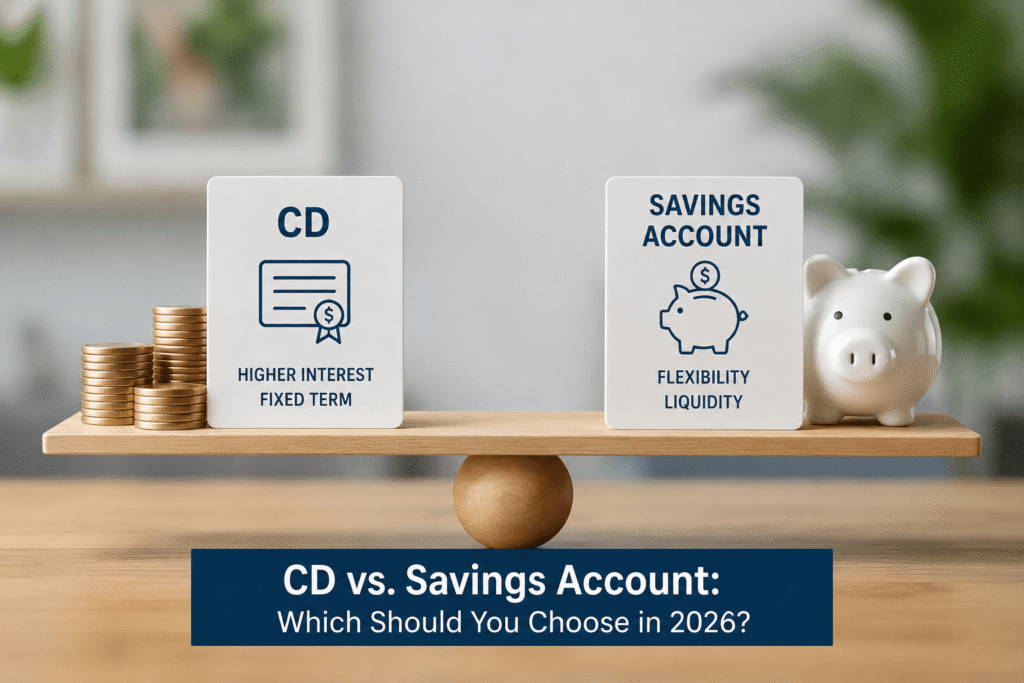
A savings account wins when you need access to your money anytime — especially for an emergency fund or ongoing expenses. A CD wins when you have a lump sum you won’t touch for 6–24 months and want a guaranteed rate that won’t drop if the Fed cuts rates. In mid-2026, the difference in rates is slim (often under 0.5%), so your real decision is: flexibility vs. certainty.
Best CD rates in June 2026 sit around 4.00%–4.30% APY for short-term CDs (6–12 months) at online banks and credit unions.
Top high-yield savings accounts (HYSAs) hover around 4.00%–4.10% APY — but those rates are variable and can drop without notice.
CDs lock your money in — breaking out early costs you 60–270 days of interest as a penalty, depending on the bank.
Savings accounts stay liquid — you can withdraw anytime, but the rate can fall whenever the bank feels like it.
Both are FDIC insured up to $250,000 per depositor, per institution — your principal is safe either way.
Owning both — keeping 3–6 months of expenses in a HYSA and investing a lump sum in a CD — is often the smartest play. See our full guide to types of savings accounts to understand all your options.
CD vs. Savings Account at a Glance: The Key Differences
Let’s be honest — both of these accounts are cousins. They’re both safe, both FDIC insured, both earn more than leaving cash under your mattress. But they work pretty differently when it comes to two things: how much you earn and how easily you can get your money back.
Think of a savings account like a parking spot — you can come and go whenever you want. A CD is more like a storage unit lease — you get a locked-in rate, but you’re committing for a set period. Break that lease early? You pay a fee.
| Feature | Certificate of Deposit (CD) | High-Yield Savings Account |
|---|---|---|
| Interest Rate Type | Fixed — locked in for the term | Variable — changes with market |
| Best APY (June 2026) | Up to 4.30% APY | Up to 4.10% APY |
| Access to Money | Restricted until maturity | Withdraw anytime |
| Early Withdrawal Penalty | 60–270 days of interest | None |
| Can You Add Money? | No (unless it’s an Add-On CD) | Yes, deposit anytime |
| FDIC Insured? | Yes, up to $250,000 | Yes, up to $250,000 |
| Minimum Deposit | $0–$500 at most online banks | $0–$100 at most online banks |
| Terms Available | 3 months to 5 years | No term (ongoing) |
| Best For | Lump sums with a set time horizon | Emergency funds, ongoing savings |
| Rate Protection | Guaranteed — Fed cuts don’t affect you | Exposed — rate drops if Fed cuts |
How Certificates of Deposit (CDs) Actually Work
A CD is a deal you make with a bank. You agree to leave a specific amount of money with them for a set period — say 6 months, 12 months, or 2 years — and in return, they give you a fixed interest rate that doesn’t budge for the entire term.
When the term ends (that’s called the “maturity date”), you get your original deposit back plus all the interest you earned. It’s that simple.
Here’s the catch: if you need your money before the CD matures, you’ll pay an early withdrawal penalty. At most banks, that’s somewhere between 60 and 270 days’ worth of interest — which can wipe out a chunk of what you earned.
Current CD Rates in June 2026
💡 Pro Tip: Shorter-term CDs are often paying more than long-term CDs right now. That’s called an “inverted yield curve” — it means you’re not being rewarded for locking up your money longer. Stick to 6–12 month CDs unless you have a specific reason to go longer.
Types of CDs You Should Know
Standard CD: The classic. Fixed rate, fixed term, penalty if you leave early. Most common.
No-Penalty CD: You can withdraw your money anytime after the first week with zero penalty. Rates are slightly lower, but the flexibility is huge. Marcus by Goldman Sachs is currently offering 4.15% APY on a 7-month no-penalty CD — a pretty sweet deal if you’re not sure about your timeline.
Bump-Up CD: If interest rates rise during your term, you can request a one-time rate increase. Good hedge if you think rates might go back up.
Jumbo CD: Requires a large deposit (typically $75,000–$100,000) in exchange for a marginally higher rate. Usually not worth it for most regular savers.
Add-On CD: Lets you deposit more money into the CD after you open it. Rare, but helpful if you’re adding to savings over time.
How High-Yield Savings Accounts Work
A high-yield savings account (HYSA) is like a regular savings account — but from an online bank that isn’t paying for thousands of branch locations, so they pass some of those savings to you as a higher interest rate.
The rate is variable, which means it can go up or down. When the Federal Reserve raises rates (like it did aggressively in 2022–2023), HYSA rates followed. Now that the Fed has been cutting and pausing, HYSA rates have slid too. For a deeper breakdown, see our comparison of high-yield vs. traditional savings accounts.
You can deposit money, withdraw money, and transfer funds whenever you want. No penalties, no terms, no commitments. That freedom is the whole point.
Sarah, a 34-year-old teacher from Columbus, OH, got a $4,800 federal tax refund in April. She keeps 3 months of expenses ($6,000) in a HYSA as her emergency fund and was debating what to do with the extra $4,800.
She doesn’t need this money for at least a year. After comparing rates, she opened a 12-month CD at 4.05% APY. Over the year, she’ll earn about $194 in guaranteed interest — and she doesn’t have to watch rates every month or worry about the Fed doing something unexpected.
Interest Rates: Who Pays More in 2026?
Here’s the honest truth: right now, it’s really close. The best CDs and the best HYSAs are within about 0.10%–0.30% of each other.
As of mid-2026, the top HYSAs are sitting around 4.00%–4.10% APY, and the best short-term CDs are at 4.00%–4.30% APY. That might sound like CDs win outright, but there’s a catch — longer-term CDs (3–5 years) are actually paying less than short-term ones right now.
The more important question isn’t “which is higher today?” It’s “which rate will I actually keep for the next 12 months?”
If the Fed cuts rates again this year, HYSA rates will fall. Your CD rate? Locked in. That’s where the CD wins on a longer time horizon — not because it’s higher today, but because it doesn’t shrink on you.
💡 The math on a $10,000 deposit for 12 months: At 4.05% APY in a CD = ~$405 guaranteed. At 4.00% APY in a HYSA (if rates hold) = ~$400. But if HYSA rates drop to 3.50% midway through the year, you’re looking at closer to $375. The CD wins by keeping its promise.
Liquidity and Access: The Biggest Trade-Off
This is where the real decision lives. Rates matter, sure. But ask yourself: What if I need this money in three months?
With a savings account, you log in, hit transfer, done. The money hits your checking account in 1–3 business days. No drama.
With a CD, you’re locked in. If life happens — a car breaks down, you lose your job, a medical bill shows up — and you need that CD money, you’ll pay a penalty to access it.
⚠️ Never put your emergency fund in a CD. Your emergency fund exists specifically for surprises. Locking it in a CD defeats the entire purpose. Keep your 3–6 months of expenses in a liquid HYSA, period. Not sure how much to save? Our guide to growing your money can help you build that cushion faster.
Early Withdrawal Penalties: What You Actually Risk
Banks vary a lot on how painful they make early CD withdrawals. Here’s a sampling of real penalties as of 2026:
| Bank | 1-Year CD Rate | Early Withdrawal Penalty |
|---|---|---|
| Marcus by Goldman Sachs | 3.90% APY | 90 days’ interest |
| Capital One 360 | ~3.90% APY | 3–6 months’ interest |
| Synchrony Bank | 3.70% APY | 90 days’ simple interest |
| American Express National Bank | 3.25% APY | 270 days’ interest |
| America First CU | 3.95% APY | 60 days’ dividends |
Notice something? The bank with the harshest penalty (American Express, at 270 days) is paying a pretty average rate. Always weigh the penalty against the rate — it’s not just about the APY on the label.
And here’s a scenario that trips people up: if you open a 12-month CD and break it at month 3 with a 90-day penalty, you might literally walk away with less than you earned. Read the fine print before you commit.
FDIC Insurance: Are Both Accounts Safe?
Yes. Both are equally safe — assuming your bank is FDIC insured (or NCUA insured if it’s a credit union). The coverage limit is $250,000 per depositor, per institution.
So if you have $250,000 in a CD and the bank fails, you get your full $250,000 back. Same deal with a savings account.
If you’re working with more than $250,000, you can spread it across multiple FDIC-insured banks to stay fully covered. This doesn’t come up for most people, but it’s worth knowing.
When a CD Makes More Sense — And When It Doesn’t
✓You have a lump sum you won’t need for 6–24 months
✓You’re worried the Fed will cut rates again
✓You want a guaranteed return — no surprises
✓Saving for something specific (down payment, wedding)
✓You tend to dip into savings and want the friction
✓You already have a solid emergency fund elsewhere
✓This IS your emergency fund
✓Your timeline is uncertain or under 3 months
✓You add to your savings regularly (paycheck deposits)
✓You might need to pivot quickly
✓You prefer flexibility over a guaranteed rate
✓You’re comfortable monitoring and switching banks
Mike, 47, a project manager in Denver, got a $15,000 bonus in January 2026. He already had a 4-month emergency fund in a HYSA. He put $12,000 into a 12-month CD at 4.05% APY, keeping $3,000 liquid.
He’ll earn about $486 in guaranteed interest. If rates drop mid-year, he won’t feel it — his rate is already set.
Here’s the thing most CD articles won’t tell you: for a lot of people right now, a HYSA is actually the smarter call. Why? Because the rate differential is so small that it barely justifies giving up your liquidity. If you’re earning 4.05% in a CD but 3.90% in a HYSA, that’s $15 a year difference on $10,000. Is losing access to your money for 12 months worth $15? Probably not, unless you’re very certain about your timeline.
The Case for Owning Both (This Is What Most Smart Savers Do)
Here’s a strategy that a lot of financial advisors recommend but never explain simply enough: split your money.
Keep your emergency fund in a HYSA — it needs to be liquid, always. Then take any “extra” savings — a bonus, a tax refund, a windfall — and put that in a CD for a guaranteed return. This way, you’re not making a binary choice. You have flexibility and a guaranteed return at the same time.
CD Ladder Strategy (Quick Version)
An even more advanced move is a CD ladder — splitting your lump sum across multiple CDs with different maturity dates. For example:
Take $12,000 and divide it: $3,000 in a 3-month CD, $3,000 in a 6-month CD, $3,000 in a 9-month CD, and $3,000 in a 12-month CD. Every quarter, one CD matures. You either reinvest it at the new rate or use the cash. You always have access to at least part of your money within 3 months — which solves the liquidity problem entirely.
How to Choose Between a CD and Savings Account: Step-by-Step
Not sure which one to pick? Walk through these five questions and you’ll have your answer.
When might you need this money? If it’s within 3 months — savings account, no question. If it’s 6 months or more and you’re confident — a CD starts making sense.
Do you have 3–6 months of expenses covered in a liquid account? If not, stop here — fund your HYSA first. Always. No CD should come before a fully funded emergency fund.
Go to NerdWallet or Bankrate and look up today’s best HYSA rates vs. CD rates for your target term. The gap might be smaller than you think — and that changes the math on whether locking up your money is worth it.
Before you open any CD, check what the penalty is for breaking out early. A bank offering 4.10% APY with a 270-day penalty is a worse deal than a 3.95% bank with a 60-day penalty if there’s any chance you’ll need the money.
If you’re not sure whether you’ll need the money, a no-penalty CD is the best middle ground. You get a fixed rate but can withdraw anytime after the first week with no fee. Marcus by Goldman Sachs has been competitive here in 2026 at 4.15% APY.
Special CD Types Worth Knowing About in 2026
No-Penalty CDs
These are the unsung heroes of the CD world. You get a fixed rate but can withdraw your full balance any time after the first 6–7 days, with zero penalty. The rates are slightly lower than standard CDs, but the flexibility makes them fantastic for people who aren’t 100% sure about their timeline. Marcus by Goldman Sachs currently offers a 7-month no-penalty CD at 4.15% APY with a $500 minimum — one of the best deals in this category right now.
Bump-Up CDs
These let you request a one-time rate increase during your term if the bank’s rates rise. In a falling rate environment like we’re in now, they’re less useful — but if you think rates might tick back up, they’re a reasonable hedge worth considering.
Jumbo CDs
Typically require $75,000–$100,000 as a minimum deposit in exchange for a (usually marginal) rate bump. For most savers, the rate difference isn’t worth the illiquidity on that much capital. Shop regular CDs at online banks first — you’ll often get comparable or better rates without the hefty minimum.
Frequently Asked Questions
Ready to Compare Today’s Best Rates?
Rates change constantly. Use a comparison tool to find the best CD and HYSA rates available at FDIC-insured banks — so you’re not leaving money on the table.
Final Thoughts: Which One Should You Actually Choose?
Here’s the bottom line, no fluff: if you have money sitting idle that you know you won’t need for at least 6 months, a CD is the cleaner choice in 2026. Rates are solid, you’re protected from future Fed cuts, and you don’t have to think about it again until it matures.
If you’re still building your emergency fund, if your timeline is fuzzy, or if you just hate the idea of not having access to your cash — a high-yield savings account wins on pure practicality.
And if you have enough to do both? Do both. Keep 3–6 months of expenses liquid in a HYSA, then park anything extra in a 6–12 month CD. You’re not forced to pick a side here.
The worst thing you can do is leave money sitting in a traditional savings account earning 0.38% while both of these options are paying ten times that. Whatever you choose — CD, HYSA, or both — just make the move. Your money should be working harder than that.