
Credit Cards Credit Score Loans Insurance Investing Subscribe

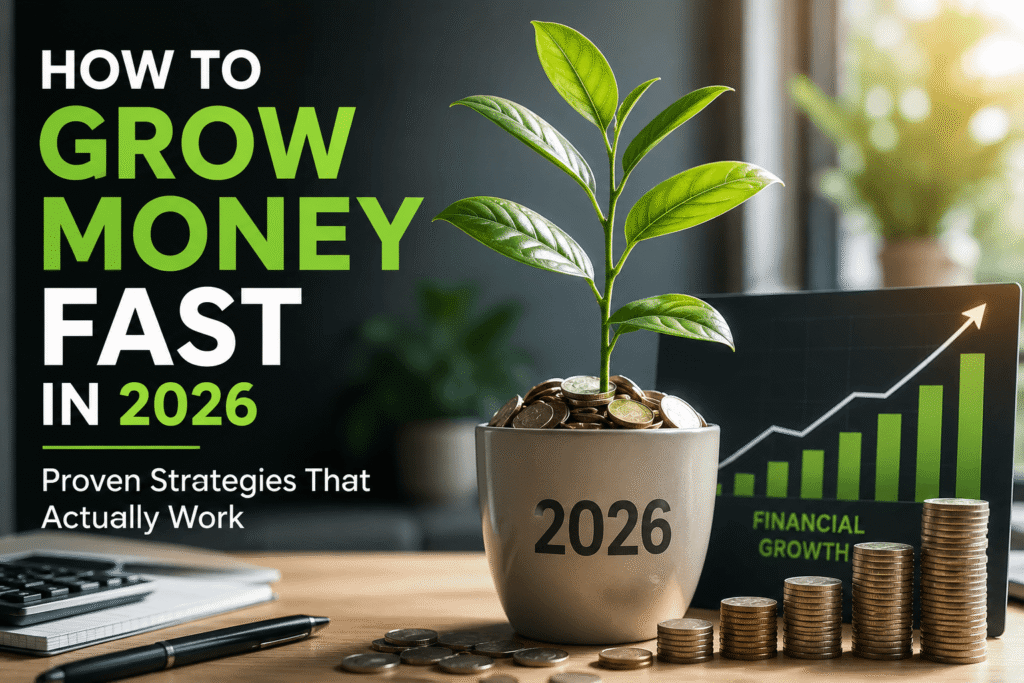
How to Grow Money Fast in 2026: Proven Strategies That Actually Work

how to grow money fast


INVESTING  ·  2026 GUIDE

How to Grow Money Fast in 2026:
Proven Strategies That Actually Work

The fastest way to grow your money in 2026 combines a high-yield savings account, low-cost index funds, and at least one active income stream — no finance degree required.

$200K+
20-yr potential
~10%
S&P 500 avg return
$1
to start investing
~18 min
read time

FN
Finance Navigator Pro Editorial Team
Updated May 2026  ·  Written for US readers

⚡ Quick Answer

The fastest way to grow your money in 2026 is to combine a high-yield savings account for your emergency fund, low-cost index funds for long-term wealth, and at least one active income stream or side hustle to accelerate your savings rate. You don’t need a finance degree or a six-figure salary — you just need a simple plan and the discipline to stick with it.

📌 Quick Summary: What You’ll Learn

  • Why growing money in 2026 requires a different approach than even 5 years ago
  • The #1 mistake most people make when trying to build wealth (and how to avoid it)
  • Exactly where to put your money first — ranked by risk and return
  • Real-life examples of beginners who went from $0 saved to $10K+ in under a year
  • Step-by-step action plan you can start today — even on a tight budget
  • A comparison table of the best platforms and tools for 2026
  • Honest answers to the questions everyone’s too afraid to Google

Let’s Be Honest: Most Money Advice Is Outdated

Here’s the truth most personal finance blogs won’t tell you — a lot of the advice floating around was written for a different economy. The old “just cut your lattes and invest in a 401(k)” playbook still has merit, but in 2026, you’ve got inflation eating at your paycheck, AI disrupting job markets, and interest rates that have been on a wild ride for years.

Growing your money fast isn’t about finding some secret hack. It’s about stacking the right moves in the right order. And honestly? The people who are winning financially right now aren’t smarter than you — they just started earlier and avoided a handful of costly mistakes.

So let’s fix that. Right now.

What Does ‘Growing Money Fast’ Actually Mean?

Before we dive in, let’s get on the same page. “Fast” is relative. If you’re starting from zero, getting to $1,000 in savings is fast. If you’ve got $50K invested, “fast” might mean doubling it in five years. The strategies overlap — it’s mostly about your timeline and risk tolerance.

❌ What We’re NOT Talking About
  • Gambling on meme stocks
  • Dropping life savings into a crypto coin your coworker mentioned
  • Multi-level marketing schemes disguised as “passive income”
✅ What We ARE Talking About
  • Building real, sustainable wealth through proven financial vehicles
  • Speeding up the process with smart habits and modern tools
  • Making your money work harder than you do

Why 2026 Is Actually a Great Time to Build Wealth

I know — the news makes it sound like the economy is always one step away from disaster. But here’s a quick reality check: every generation thinks they’re investing at the worst possible time. And every generation that stayed consistent still came out ahead.

🏦 High-Yield Savings Are Still Paying Real Returns

After years of near-zero interest rates, high-yield savings accounts (HYSAs) are still offering solid APYs compared to traditional banks. That means even your “safe” money is actually growing while it sits there. Platforms like SoFi, Marcus by Goldman Sachs, and Ally are consistently near the top of the list. If your emergency fund is in a regular savings account earning 0.01%, you’re literally losing money to inflation.

📱 Fractional Investing Removed the Barriers

You used to need thousands of dollars to buy a single share of Amazon or Tesla. Today, you can invest $5 into fractional shares through apps like Fidelity or Public. There’s genuinely no excuse anymore about “not having enough to invest.” That barrier is gone.


🤖 AI Tools Are Making Smart Investing More Accessible

Robo-advisors powered by AI — think Betterment or Wealthfront — now offer sophisticated portfolio management that used to cost thousands in advisor fees. For 0.25% per year, you get auto-rebalancing, tax-loss harvesting, and a diversified portfolio. It’s not perfect, but for most people, it outperforms trying to pick individual stocks.

The Biggest Mistakes People Make When Trying to Grow Money

I’ve seen people waste months — sometimes years — on these mistakes. Don’t be that person.

Mistake #1
Waiting Until They ‘Have More Money’
This is the #1 wealth killer. People convince themselves they’ll start investing “when they make more” or “after the holidays.” Meanwhile, compound interest is working overtime — for someone else. Starting with $50/month at 25 is dramatically more powerful than starting with $500/month at 35. The math is brutal.

Mistake #2
Keeping All Their Money in One Place
Either they keep everything in a low-interest checking account “just in case,” or they throw everything into one investment and panic when it dips. Diversification isn’t just a buzzword — it’s how you sleep at night while your portfolio grows.

Mistake #3
Chasing Returns Instead of Building Systems
Every few months there’s a new hot asset class — AI stocks, real estate tokens, whatever. People jump in late, buy at the peak, panic sell at the bottom, and wonder why they’re not getting ahead. The people quietly investing in boring index funds? They’re winning. Consistently. Every decade.

Mistake #4
Not Having an Emergency Fund First
Here’s where most people mess up their investment strategy: they start investing before building a 3–6 month emergency fund. Then one car repair or medical bill forces them to sell investments at the worst possible time. Build the safety net first. Then invest aggressively.

Proven Strategies to Grow Your Money Fast in 2026

Strategy 1

Max Out High-Yield Savings First

Before you invest a single dollar, make sure your emergency fund (3–6 months of expenses) is sitting in a high-yield savings account. In 2026, the top HYSAs are offering APYs that actually beat inflation on short-term savings. This is your financial foundation. Without it, you’re one emergency away from derailing everything.

💡 Best options to check:

SoFi Savings, Marcus by Goldman Sachs, Ally Bank, and CIT Bank. Most are FDIC-insured up to $250,000 and have no fees. Takes 10 minutes to open.

Strategy 2

Invest in Low-Cost Index Funds Consistently

If there’s one strategy that has stood the test of time — every decade, every market cycle, every economic era — it’s buying and holding low-cost index funds. We’re talking about funds that track the S&P 500 (like FXAIX at Fidelity or VOO at Vanguard) with expense ratios under 0.10%.

The secret isn’t timing the market. It’s time IN the market. Set up automatic monthly contributions. Ignore the noise. Check it quarterly, not daily. This is how ordinary people build extraordinary wealth.

📊 Real numbers:

The S&P 500 has averaged roughly 10% annually over the long run (before inflation). $300/month invested at that average rate becomes over $200,000 in 20 years. That’s not a get-rich-quick scheme — but it’s also not magic. It’s just math.

Want to learn more? Read our full guide on how to start investing and the what is a brokerage account explainer.

Strategy 3

Use a Roth IRA for Tax-Free Growth

If you haven’t opened a Roth IRA yet, this should be your next move. You contribute after-tax dollars now, and all your growth — plus withdrawals in retirement — is completely tax-free. In 2026, the contribution limit is $7,000/year (or $8,000 if you’re 50+). That’s a serious tax advantage most people leave on the table.

You can open a Roth IRA at Fidelity or Vanguard in under 15 minutes. Then invest those contributions into index funds. Boom — you’ve just created a tax-free wealth machine.

Compare options in our Roth 401(k) vs Roth IRA guide and understand your average 401(k) return expectations.

Strategy 4

Add a Side Hustle to Turbocharge Your Savings Rate

Here’s the thing about cutting expenses: there’s a floor. You can only cut so much before your quality of life suffers. But income? There’s no ceiling. Even an extra $500/month consistently invested can add over $100,000 to your net worth over a decade.

The best side hustles in 2026 are skills-based (freelance writing, design, coding, consulting), gig-based (delivery, rideshare, TaskRabbit), or knowledge-based (tutoring, online courses, content creation). Pick one that uses a skill you already have. Don’t start from zero.

Strategy 5

Real Estate Without Buying Property

Real estate has historically been one of the best wealth builders in America. But buying property requires a down payment, a mortgage, and a whole lot of headaches. Enter: real estate crowdfunding platforms like Fundrise and Arrived Homes, where you can invest in real estate assets starting at $10–$100.

These platforms pool investor money to buy commercial and residential properties, then pay out rental income and appreciation over time. It’s not liquid like stocks, so don’t put money here that you might need in the next 1–2 years. But as a long-term wealth-building tool, it diversifies your portfolio with a real asset class.

Strategy 6

Automate Everything

The single biggest productivity hack in personal finance is automation. Set up automatic transfers to your HYSA on payday. Set up automatic monthly investments to your index funds. Set up automatic contributions to your Roth IRA. When the money moves before you see it, you spend less and save more — without needing willpower.

Most major brokerages and banks let you do this for free. It takes 20 minutes to set up once and then runs on autopilot for years.

Step-by-Step Action Plan: Start Today

Let’s make this concrete. Here’s exactly what to do, in order:

1
Open a high-yield savings account
(SoFi, Marcus, Ally) and move your emergency fund there. If you don’t have one, start building it — aim for $1,000 first, then 3 months of expenses.
2
Pay off high-interest debt (anything above 7–8% APR)
This is a guaranteed return equal to the interest rate. Nothing beats it. See how debt consolidation affects your credit score.
3
Open a Roth IRA at Fidelity or Vanguard
Contribute what you can — even $25/month. Invest it into a target-date fund or S&P 500 index fund.
4
Set up automatic monthly investments into a taxable brokerage account
If you’ve maxed your Roth. Use the same boring index fund strategy.
5
Add $300–$500/month in side hustle income
Funnel all of it directly into investments for the first 6 months. Feel the momentum build.

That’s it. Five steps. No fancy spreadsheets, no financial jargon. Just action.

Comparison: Best Ways to Grow Money in 2026

Use this table to decide what fits your situation:

Option Best For Pros Cons Cost Verdict
High-Yield Savings
e.g. Marcus, SoFi
Emergency fund, short-term goals Safe, FDIC insured, liquid Lower returns than investing Free ✅ Start here
Index Funds
e.g. Fidelity, Vanguard
Long-term wealth building Diversified, low fees, proven Market risk, not instant Free–0.03% ER ✅ Best for most
Real Estate Crowdfunding
Fundrise
Passive income, diversification Low entry, real assets Illiquid, platform risk $10–$500 min ✅ Great add-on
Side Hustle Income Increasing cash flow fast Immediate extra income Takes time and effort Varies ✅ Fastest growth
Robo-Advisors
Betterment, Wealthfront
Hands-off investing Auto-rebalancing, tax-loss harvest Fees, less control 0.25%/yr ✅ Good for beginners
Crypto
Bitcoin, ETH only
High risk tolerance High upside potential Extreme volatility Varies ⚠️ Max 5%

Also explore our comparison of M1 Finance vs Acorns vs Webull and best investing apps for beginners.

Real-Life Examples: What This Actually Looks Like

S
The Beginner: Sarah, 24, Teacher
$38K/year

Sarah had $200 in savings and no investment accounts. She felt like investing was “for rich people.” After reading a personal finance blog, she opened a Roth IRA at Fidelity with $25, set up a $50/month auto-investment into FXAIX (S&P 500 index fund), and moved her $200 to a Marcus high-yield savings account. Six months later, she’d contributed $300 to her Roth and had $600 in her savings. Not huge numbers — but she’d built the habits. A year later, she got a raise and bumped her monthly contribution to $150. The foundation was already there.

M
The Intermediate: Marcus, 31, Software Engineer
$95K/year

Marcus was making good money but had nothing invested except a work 401(k) he never thought about. He’d been meaning to “figure out investing” for three years. He finally opened a Roth IRA, maxed it out for the year ($7,000), invested in a three-fund portfolio (US stocks, international stocks, bonds), and started freelancing on weekends for an extra $1,200/month — all of which went into a taxable brokerage. In 18 months, his net worth grew by over $35,000. He said the biggest unlock was just automating everything so he didn’t have to think about it.

J
The Cautionary Tale: Jordan, 28, Restaurant Manager
⚠️ What not to do

Jordan saw crypto blowing up in early 2021 and put $8,000 — his entire savings — into a small altcoin his friend recommended. By mid-2022, it was worth $600. He had no emergency fund, no index funds, no backup. He had to sell his car.

The lesson? Speculation with money you can’t afford to lose isn’t investing — it’s gambling. Start boring. Get exciting later, with money you’ve earmarked specifically for high-risk plays (no more than 5% of your portfolio).

Frequently Asked Questions

How much money do I need to start investing in 2026?

Genuinely, as little as $1. Platforms like Fidelity and Schwab have no account minimums, and fractional shares mean you can buy into any stock or fund with just a few dollars. The amount matters less than the habit. Start with what you have — even $25 a month — and increase it over time.

What’s the safest way to grow money quickly?

The safest ‘fast’ growth comes from high-yield savings accounts for short-term money and low-cost index funds for long-term money. ‘Safe’ and ‘fast’ are always in tension — higher returns almost always come with higher risk. If someone promises both, run the other direction.

Is now a good time to invest with market uncertainty?

It’s always uncertain. Seriously — look at any decade in history and you’ll find people warning it’s the worst time to invest. The data is clear: time in the market beats timing the market. Dollar-cost averaging (investing a fixed amount regularly) smooths out the ups and downs and reduces your average cost per share over time.

How can I grow money fast without investing in stocks?

Options include: paying off high-interest debt (guaranteed return), real estate crowdfunding, starting a side hustle, selling unused items, renting out space on Airbnb, or peer-to-peer lending. None of these are as passive or scalable as index fund investing long-term, but they can generate meaningful cash in the short term.

Also consider checking your Treasury bills options for low-risk returns.

What’s the biggest financial mistake people make in their 20s and 30s?

Waiting. Full stop. The people who are financially comfortable in their 50s and 60s almost universally started saving and investing in their 20s — even small amounts. The math of compounding is ruthlessly unforgiving about time. Every year you wait, you’re not just delaying gains — you’re losing the compounding that would have grown on top of those gains.

Should I use a financial advisor or do it myself?

For most people starting out, a robo-advisor (Betterment, Wealthfront) or just a simple three-fund portfolio at Fidelity or Vanguard is all you need. Traditional financial advisors make more sense once you have $500K+ in assets or complex situations like business ownership, estate planning, or divorce. For straightforward wealth building? Do it yourself. The fees you save become returns.

Curious about advisor costs? Read our guide on how much a financial advisor costs.

Final Thoughts: The Simplest Truth About Building Wealth

Here’s what I want you to walk away with:

Growing money fast in 2026 doesn’t require insider knowledge, lucky timing, or a trust fund. It requires building a simple system — one that earns more, saves consistently, invests automatically, and avoids the dumb mistakes that wipe people out.

The boring answer is the real answer: emergency fund first, then index funds, then maximize tax-advantaged accounts, then add income, then repeat. That’s it. That’s the whole playbook.

The people winning financially right now aren’t doing exotic things. They’re doing simple things consistently. And the sooner you start — even imperfectly — the more the math works in your favor.

Start simple. Stay consistent. That’s what actually works.
— Finance Navigator Pro Editorial Team

📚 Keep Reading
How to Start Investing: A Beginner’s Guide → How to Get Rich Young in 2026 → Roth 401(k) vs Roth IRA: Full Comparison →

This article is for informational purposes only and does not constitute financial advice. Always consult a licensed financial professional before making investment decisions.


Leave a Comment

Your email address will not be published. Required fields are marked *

Scroll to Top