
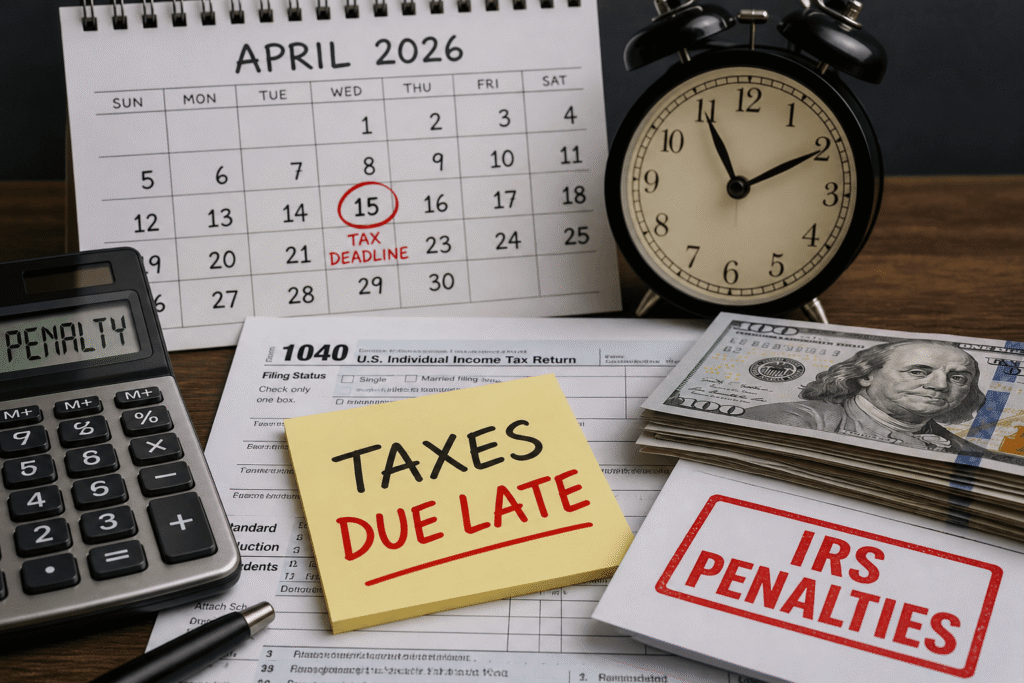
Quick Answer
If you file your taxes late and owe money, the IRS charges a Failure-to-File penalty of 5% of your unpaid taxes per month (up to 25%), plus interest. But here’s the good news — if you’re owed a refund, there’s no penalty at all. The worst thing you can do is ignore it entirely. Filing late is fixable; not filing at all is where serious trouble begins.
Let’s be honest — life gets busy. Maybe you lost your W-2, went through a major life change, or simply kept pushing the deadline further and further back until April 15 came and went. You’re not alone. Millions of Americans file late every single year.
The stress that follows can feel overwhelming. You start imagining IRS agents at your door, wage garnishments, or worse. Here’s the truth most people don’t realize: the situation is almost always more manageable than it feels. This guide will walk you through exactly what happens if you file taxes late, how the IRS calculates penalties, and — most importantly — how to fix it step by step.
⚡ Quick Summary: Late Tax Filing at a Glance
What Happens If You File Taxes Late?
So what actually happens the moment you miss the April 15 tax deadline? The IRS doesn’t immediately come knocking. Instead, the clock starts ticking on two separate penalty meters — and interest begins accruing on any unpaid balance.
Here’s the deal: the IRS distinguishes between two different failures. One is failing to file your return. The other is failing to pay what you owe. Both carry their own penalties, and in the worst case, you could be hit with both simultaneously.
If you filed an extension (Form 4868), you moved your filing deadline to October 15, 2025. But — and this is a critical point most people miss — an extension only buys you time to submit your paperwork, not to pay. If you owed money on April 15 and didn’t pay it, the late-payment penalty already started running.
Late Filing vs. Late Payment: An Important Difference
This distinction can save you real money once you understand it.
Late Filing Penalty
This penalty kicks in when you don’t submit your tax return by the deadline (or extended deadline). The IRS charges 5% of the unpaid tax amount for each month or partial month your return is late, up to a maximum of 25%.
Late Payment Penalty
This is a separate, smaller penalty of 0.5% per month on unpaid taxes, also capped at 25%. It runs from the original due date (April 15) regardless of whether you filed an extension.
Interest on Top of Everything
Beyond penalties, the IRS charges interest on any unpaid tax balance. The rate is the federal short-term interest rate plus 3 percentage points, which currently sits around 7–8% annually, compounded daily. Interest applies to both the original unpaid tax AND any penalties that have built up.
💡 Pro Tip: Interest never stops until the balance is paid in full. The longer you wait, the more your debt grows — even if the penalty percentage has already maxed out.
IRS Penalties Explained (2026 Updated)
Failure-to-File Penalty
Failure-to-Pay Penalty
Real Dollar Example: What $5,000 Owed Looks Like
Let’s say you owed $5,000 in taxes and didn’t file or pay by April 15, 2025.
| Time Late | Late Filing Penalty | Late Payment Penalty | Est. Interest (7.5%) | Total Added Cost |
|---|---|---|---|---|
| 1 month | $250 (5%) | $25 (0.5%) | ~$31 | ~$306 |
| 3 months | $750 (15%) | $75 (1.5%) | ~$93 | ~$918 |
| 5 months (cap) | $1,250 (25%) | $125 (2.5%) | ~$156 | ~$1,531 |
| 12 months | $1,250 (capped) | $300 (6%) | ~$375 | ~$1,925 |
⚠️ On a $5,000 tax bill, delaying for just 5 months can add over $1,500 in penalties and interest. That’s money you could have kept — or at least minimized — by filing immediately, even if you couldn’t pay.
Quick Comparison: Your Situation and Risk Level
| Situation | Penalty | Interest | Risk Level |
|---|---|---|---|
| Filed late, owe taxes | Up to 25% filing + 25% payment | ~7–8% annually, compounding daily | 🔴 High |
| Filed late, no taxes owed | No penalty | None | 🟢 Low |
| Filed extension, didn’t pay | Late-payment penalty from April 15 | Accrues from April 15 | 🟡 Medium |
| Filed on time, can’t pay | Only late-payment penalty (0.5%/mo) | Accrues on unpaid balance | 🟡 Medium |
| Didn’t file, don’t owe | No penalty (file within 3 years for refund) | None | 🟢 Low |
| Didn’t file, owe taxes | Maximum penalties + possible enforcement | Daily compounding | 🔴 Very High |
Real-Life Scenarios: What Happened to Sarah, Mike, and John
Scenario 1: Sarah — Missed the Deadline but Gets a Refund
Sarah is a school teacher who always meant to file but kept putting it off. By June, she finally sat down with her tax software and realized she was actually owed a $1,200 refund. Panic over. Because Sarah didn’t owe any taxes, the IRS charged her zero penalties — not a single dollar. The only downside? She waited two extra months to get her refund. The IRS won’t pay you interest for keeping your money, so filing promptly still matters — but Sarah’s situation shows you don’t always need to fear the worst.
Scenario 2: Mike — Owed $3,000 and Delayed Filing
Mike is a freelance graphic designer who had a great year. He knew he owed money but kept avoiding it, hoping the problem would go away. By the time he filed — four months late — his $3,000 bill had grown significantly.
Mike’s story is a cautionary tale: the penalty alone added nearly 25% to his original bill. Had he filed on time — even without paying — he’d have only faced the smaller 0.5%/month payment penalty while he arranged a payment plan.
Scenario 3: John — Filed an Extension but Didn’t Pay
John thought he was being smart. He filed Form 4868 in April, extending his deadline to October 15. What John didn’t know — and many people miss this — is that his payment was still due on April 15. When October came and he paid his $2,000 balance, he found a surprise notice from the IRS: six months of 0.5% late-payment penalties (~$60) plus interest (~$70). Not catastrophic, but a lesson in the extension misunderstanding that trips up thousands of taxpayers every year.
What Happens After 1 Month, 3 Months, and 1 Year?
If you’re wondering what the trajectory looks like, here’s a realistic timeline on a $3,000 unpaid tax balance:
| Timeframe | What the IRS Does | Est. Total Added Cost |
|---|---|---|
| 1 month late | Penalty notice mailed; 5% filing + 0.5% payment penalties begin | ~$165 |
| 3 months late | Second notice; penalties growing; interest compounding daily | ~$495 |
| 5 months late | Filing penalty maxes at 25%; payment penalty continues | ~$825 |
| 6+ months late | IRS may file a substitute return on your behalf (often less favorable) | ~$900+ |
| 12 months late | Possible lien or levy; aggressive collection may begin | ~$1,100+ |
| 3+ years (refund owed) | Refund forfeited — IRS keeps your money permanently | Loss of full refund |
The IRS generally won’t take aggressive collection action immediately — but after 6–12 months of non-response, the situation escalates significantly. Don’t let it get there.
📘 Related: Understanding your overall tax picture can help you avoid surprises. See our guide on How Federal Income Tax Brackets Work in 2026 to understand what you actually owe before filing.
What If You Can’t Afford to Pay Your Taxes?
This is one of the most common fears — and one of the most misunderstood situations. Here’s something important: the IRS would rather work with you than spend resources chasing you down.
If you can’t pay in full, you have real options:
IRS Installment Agreement (Payment Plan)
You can apply online at IRS.gov for a payment plan in minutes. If you owe $50,000 or less, you can typically get approved automatically without needing to negotiate. Monthly payments spread your balance over up to 72 months. The late-payment penalty rate drops to 0.25% per month once you’re on an approved plan.
Offer in Compromise
If you genuinely cannot pay the full amount — even over time — the IRS has a program called the Offer in Compromise (OIC) that lets qualifying taxpayers settle for less than the full amount owed. It’s not easy to qualify, and you’ll need to demonstrate financial hardship, but it exists for a reason.
Currently-Not-Collectible Status
If paying your tax debt would leave you unable to cover basic living expenses, the IRS can temporarily pause collection efforts. This doesn’t erase the debt, but it buys time without enforcement action.
Penalty Abatement
If this is your first time filing late, you may qualify for First-Time Abatement (FTA) — a program where the IRS waives the penalty. You generally need a clean compliance history (no penalties in the prior three years) and must have filed (or extended) your current-year return.
What to Do If You Filed Taxes Late: Step-by-Step Plan
Don’t overthink this. Follow these steps in order and you’ll be back on track.
Gather your W-2s, 1099s, and any other income documents. Run a quick estimate using free tools like the IRS Tax Withholding Estimator or a tax software preview. If you’re getting a refund, your urgency level just dropped significantly — file and collect what’s yours.
This single step stops the more expensive late-filing penalty (5%/month) from growing. The late-payment penalty (0.5%/month) is dramatically smaller. Filing now, even without full payment, is always the right financial decision.
Use the IRS Penalty Calculator or request a tax transcript at IRS.gov to see exactly what your balance is, including all fees that have accrued.
Apply for an installment agreement at IRS.gov/OPA, contact a tax professional if you owe a large amount, or explore an Offer in Compromise if you’re facing genuine financial hardship.
Call the IRS at 1-800-829-1040 or submit Form 843 to request penalty abatement. If you’ve been compliant in prior years, there’s a real chance the IRS will waive the penalty — but you have to ask.
Tax debts that escalate to IRS liens can show up on your credit report, affecting your ability to borrow money or rent housing. Stay on top of any IRS correspondence and respond promptly to every notice.
Mark tax deadlines in your calendar, consider adjusting your W-4 withholding if you regularly owe a balance, and keep digital copies of all tax documents throughout the year in a dedicated folder.
Tools That Can Help You Get Back on Track
Here are some practical resources worth knowing about — each serves a different need depending on your situation.
Common Mistakes and Myths to Avoid
This one causes a lot of unnecessary panic. Criminal prosecution for simply filing late — without fraud or deliberate tax evasion — is extraordinarily rare. The IRS pursues civil penalties (money), not criminal charges, for ordinary late filers. Tax fraud (intentionally lying on your return) is a different matter entirely — but that’s not what we’re talking about here.
Every additional month increases the penalties. There is no benefit to waiting — only additional cost. File today, even if you can’t pay.
This is probably the most common misunderstanding in all of tax filing. Form 4868 extends your time to file your paperwork — your payment was still due April 15. If you didn’t pay by then, the late-payment clock started running on that date regardless.
This is the worst thing you can do. Filing without paying triggers only the smaller 0.5%/month penalty. Not filing at all triggers both the 5%/month filing penalty AND the payment penalty simultaneously — plus it can eventually lead to the IRS filing a substitute return for you, which almost never reflects your actual situation favorably.
Actually filing and engaging with the IRS dramatically reduces the severity of your situation. Taxpayers who communicate with the IRS and work toward resolution almost always face smaller consequences than those who disappear entirely.
Frequently Asked Questions
Final Thoughts: Don’t Ignore It — Fix It
Here’s the honest truth about filing taxes late: the anxiety you feel staring at the problem is almost always worse than the problem itself. The IRS has seen it all, and their primary goal is to collect what’s owed — not to punish people who made an honest mistake.
The worst thing you can do is nothing. Ignoring the issue doesn’t make it disappear — it makes it more expensive. Every month that passes without action costs you more money in penalties and interest that you simply don’t have to pay.
Filing late is fixable. Not filing at all is where real, lasting problems start.
Open your tax software (or pull out your forms) right now — today. Even if you can only spend 30 minutes on it, start the process. File first, figure out payment second. That simple order of operations could save you hundreds of dollars.
And if the penalties have already piled up? Ask about First-Time Abatement. Set up a payment plan. Contact the Taxpayer Advocate Service if you need help navigating the process. Resources exist — use them.
You’ve got this.
E-E-A-T Note: This guide was written to reflect current IRS rules and penalty structures as of 2026. All penalty amounts, rates, and thresholds are sourced from official IRS publications. For personalized tax advice specific to your situation, consult a licensed CPA, Enrolled Agent, or tax attorney. This content is for educational purposes only.
Key IRS References: IRS Publication 17 (Your Federal Income Tax) | IRS Penalty Relief | IRS Payment Plans