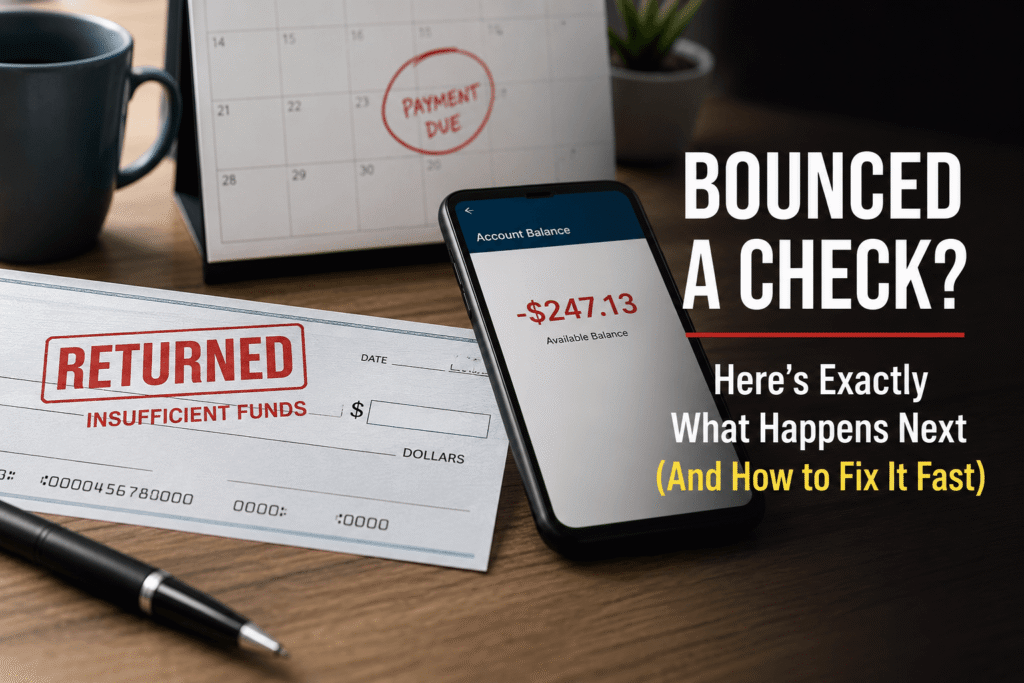
When a check bounces, it means your bank couldn’t process it due to insufficient funds or another issue—and it gets returned to the recipient unpaid. You’ll typically be charged a non-sufficient funds (NSF) fee of $20–$40 by your bank, the recipient may charge their own returned-check fee, and repeated bounces can get your account flagged or even closed. The good news: a single bounced check won’t wreck your credit score—but ignoring it can spiral into serious financial and legal trouble.
What Does It Mean When a Check Bounces?
When you write a check, you’re essentially making a promise—”my bank account has the money to cover this.” When the recipient deposits that check, their bank reaches out to your bank to collect the funds. If the money isn’t there, your bank sends the check back unpaid. That’s a bounced check.
The technical term is a returned check or NSF check (non-sufficient funds check). Banks also use the term “dishonored check.” No matter what it’s called, the result is the same: the payment fails, fees pile up, and someone is left holding an IOU.
There are several reasons a check might bounce beyond just having no money in your account:
Most bounces are honest mistakes—a forgotten subscription charge, an unexpected bill, or just poor timing between deposits and payments. It happens to more people than you’d think.
What Happens Immediately After a Check Bounces?
Here’s the cascade of events that unfolds within 1–3 business days of a check bouncing:
Your Bank Returns the Check
Your bank rejects the payment and sends notice to the recipient’s bank that the check cannot be honored. This happens electronically in most cases, so it’s fast. You’ll typically see this as a “Returned Item” on your account statement.
Your Bank Charges You an NSF Fee
This hits your account almost immediately. NSF fees typically range from $20 to $40 per item, though some banks charge more. According to the Consumer Financial Protection Bureau (CFPB), these fees are disclosed in your account agreement, but they still catch people off guard.
The Recipient Gets Notified
The person or business you paid is notified that the check was returned. They’re out the money and will need to contact you to collect it.
The Recipient May Charge Their Own Fee
Businesses especially tend to charge a returned check fee of $25–$50, sometimes called a “bounced check fee” or “bad check fee.” This is separate from your bank’s NSF fee. So for one bounced check, you could owe fees to two different parties.
You May Receive a Notice
Some banks send a physical notice by mail, others send email or push notifications. Check your bank’s communication preferences. If you bank online, log in and look for any alerts or messages.
The Full Fee Breakdown: What a Bounced Check Actually Costs You
| Fee Type | Typical Amount | Who Charges It |
|---|---|---|
| NSF / Returned Item Fee | $20–$40 per check | Your bank |
| Returned Check Fee | $25–$50 | The recipient (business or individual) |
| Extended Overdraft Fee | $15–$35/day (some banks) | Your bank (if balance stays negative) |
| Late Payment Penalty | Varies | Creditor (if check was for a bill) |
| Legal Filing Fees | $30–$100+ | Court system (if taken to small claims) |
| Collection Fees | 15–25% of amount owed | Debt collector (if sent to collections) |
The bottom line: One bounced check for $200 could end up costing you an extra $60–$100 in fees alone. That’s before you even pay back what you owed.
Does a Bounced Check Affect Your Credit Score?
Here’s the part that surprises most people: a bounced check by itself does not appear on your credit report and will not hurt your FICO score.
Standard credit bureaus—Equifax, Experian, and TransUnion—don’t track whether your checks bounce. Your credit report focuses on loans, credit cards, and debt repayment history.
However, here’s where it gets complicated:
If the debt goes to collections: If you don’t repay the bounced check and the recipient sends the debt to a collection agency, that collection account WILL appear on your credit report and can drop your score significantly
If the creditor files a civil judgment: Court judgments related to unpaid checks can affect your creditworthiness
ChexSystems: Banks report problematic account behavior—including repeated bounced checks—to ChexSystems, a banking industry reporting agency. A negative ChexSystems record can prevent you from opening a new bank account for up to 5 years
Think of it this way: the check bounce itself isn’t reported to credit bureaus. But the domino effect of ignoring it absolutely can be. You can check your ChexSystems report for free once a year at ChexSystems.com.
Can You Get in Legal Trouble for a Bounced Check?
Let’s not sugarcoat this: yes, you can—but the circumstances matter enormously.
Accidental Bounce vs. Intentional Fraud
There’s a massive legal difference between “I forgot I had a car payment coming out” and “I wrote a check knowing I had no money.” The first is a mistake. The second is check fraud, which is illegal in all 50 states.
What Does Check Fraud Look Like?
Writing a check with no intention of covering it
Deliberately closing an account after writing checks against it
Altering a check to change the amount or payee
Writing checks on someone else’s account without permission
Potential Penalties by State
Most states prosecute bad checks based on the dollar amount:
Usually a misdemeanor with fines and possible short jail time
Can be a felony, with fines up to several thousand dollars and potential prison time
How to Avoid Legal Trouble
The safest thing you can do after accidentally bouncing a check is act fast. If you contact the recipient, acknowledge the issue, and make it right before they escalate it, most businesses and individuals won’t pursue legal action. Courts and prosecutors generally aren’t interested in honest mistakes that get fixed promptly.
The Federal Trade Commission (FTC) recommends keeping detailed records of any payments you make to cover a bounced check—amounts paid, dates, and who you paid.
⚠️ Important: If you receive a certified letter demanding payment for a bounced check, don’t ignore it. Respond promptly and in writing.
What the Recipient Experiences When Your Check Bounces
It’s easy to focus on your side of the situation, but understanding what the recipient goes through can actually help you handle it better.
They deposited money they were counting on—and now it’s not there. Their bank may have even made the funds temporarily available before the check was returned, then pulled them back. That’s a really frustrating experience, especially if they made spending decisions based on that deposit.
Businesses often get hit with their own bank fees when a customer’s check bounces. Many businesses use third-party check verification services like TeleCheck or Certegy. If you bounce a check at a retailer, you might find your future checks declined at other stores in their network until the debt is resolved.
A landlord may add the bounced check fee to your next rent payment and require certified funds going forward. In some states, bouncing a rent check can trigger a formal eviction notice process, though this typically requires multiple violations.
How Banks Handle Returned Checks: Your Bank’s Side of the Story
Your bank isn’t just a passive participant here—they’re actively monitoring your account behavior. Here’s what’s happening behind the scenes:
NSF vs. Overdraft: What’s the Difference?
| NSF / Bounced Check | Overdraft (with protection) | |
|---|---|---|
| Payment outcome | Check returned unpaid | Bank covers the payment |
| Recipient notified? | Yes—gets check back | No—payment goes through |
| Fee charged? | $20–$40 NSF fee | $0–$35 overdraft fee |
| Balance after? | Unchanged or slightly lower | Negative (you owe the bank) |
| Credit impact? | None directly | None directly |
| Bank account risk? | High (repeated = account closure) | Lower (if used occasionally) |
When Banks Close Your Account
Banks have the right to close your account for chronic overdrafts or bounced checks. If that happens, they’ll report it to ChexSystems, which can make it very difficult to open a new checking account anywhere for up to five years. If you’re worried about your account history, you can pull your ChexSystems report for free and see what’s been reported.
Real-Life Scenarios: How a Bounced Check Plays Out
Step-by-Step: How to Fix a Bounced Check
Okay, it happened. Here’s exactly what to do—in order:
Confirm what happened. Log into your bank account immediately. Look for a “Returned Item” or “NSF” charge. Note the date, amount, and payee so you have the full picture.
Find out why it bounced. Was it a low balance? A hold on your account? Call your bank’s customer service line if the reason isn’t clear in your statement. Understanding the cause prevents it from happening again.
Contact the recipient immediately. Don’t wait for them to come to you. A quick, honest call goes a long way. Something like: “Hey, I’m so sorry—my check didn’t go through. I’m going to fix this today.”
Repay via guaranteed funds. Use cash, a certified check, a money order, or a payment app like Zelle or Venmo. Don’t write another check from the same account until you’ve verified your balance is solid.
Pay all fees. Cover both your bank’s NSF fee and the recipient’s returned check fee. This is part of making it right.
Request written confirmation. Once you’ve paid, ask the recipient to confirm in writing (even a quick text or email) that the matter is resolved. Keep this for your records.
Monitor your account. Watch your balance closely for the next few weeks. Set up email or text alerts for low balances so you’re not caught off guard again.
Address the root cause. Was it a budgeting issue? An unexpected charge? Build a small buffer—even $100–$200—in your checking account as a cushion, and review your automatic payments calendar monthly.
How to Prevent a Bounced Check in the Future
The best bounced check is the one that never happens. Here are the practical tools and habits that prevent them:
Use Overdraft Protection
Most banks offer overdraft protection—where your savings account or a line of credit automatically covers any shortfall. It’s not free (there may be a transfer fee), but it’s far cheaper than an NSF fee.
Set Low-Balance Alerts
Every major bank lets you set up automatic alerts when your balance drops below a threshold you choose. Set yours at $200 or $300 so you have time to react before a check clears.
Keep a Buffer Balance
Try to keep at least $150–$300 more than you think you need in your checking account at all times. This “padding” cushions against timing issues.
Use a Budgeting App
Apps like YNAB or Mint connect to your bank and show you your real spending in real time, making it harder to accidentally overdraw.
Consider a Credit Union or Online Bank
Many credit unions and online banks—like Chime or Ally—offer free overdraft protection or even small spot advances. Their fee structures are often more forgiving than traditional big banks.
Switch to Digital Payments
Automated ACH payments and digital payment apps clear faster and give you more visibility into your balance. Checks can take days to process, creating a gap where you might spend money that’s earmarked elsewhere.
Can You Redeposit a Bounced Check?
Yes—in many cases, you can redeposit a returned check. But you need to make sure the underlying problem is fixed first.
If the check bounced because of insufficient funds, the only reason to redeposit it is if you’re confident the payer has since added funds. You can contact the payer to confirm, then redeposit.
However:
Some banks won’t allow redeposit of a check that’s already been returned
The check may be stamped “Void” or “Non-Negotiable” after being returned
If the account is now closed, no amount of redepositing will help
In many situations, it’s cleaner to request a new form of payment (Zelle, Venmo, cashier’s check) rather than redepositing. That way there’s no ambiguity.
Smart Tools That Can Help
If a bounced check was your wake-up call, here are some tools worth considering to get your finances on better footing:
Monitor Your Credit
Even though a bounced check doesn’t hit your credit directly, the aftermath can. Services like Credit Karma let you monitor your Equifax and TransUnion reports for free, and alert you if any new collections or negative marks appear. For deeper insight, check our guide on how to check your credit score for free.
Set Up Overdraft Protection
Talk to your bank about linking your savings account to your checking account for overdraft coverage. It’s usually free or costs a small flat fee per transfer—much cheaper than NSF fees.
Use a Secured Credit Card as a Safety Net
If you’ve had banking issues, a secured credit card can serve as an emergency payment option. It also helps rebuild credit if yours has taken a hit. The CFPB has a guide on choosing credit cards that’s worth reading. Also see our guides on secured vs. unsecured credit cards and how to build credit from scratch.
FAQs: Everything Else You’re Wondering About Bounced Checks
Disclaimer: This article is for informational purposes only and does not constitute legal or financial advice. Laws regarding bounced checks vary by state. Consult a qualified attorney or financial advisor for advice specific to your situation.