That difference comes down to one thing: the loan term.
A loan term is simply how long you have to pay back the money you borrowed. It sounds straightforward, but the length of your loan touches everything — your monthly payment, how much interest you pay, and even how long you carry debt into your financial future.
Choose the right loan term and you’ll feel comfortable paying each month while keeping long-term costs under control. Choose the wrong one and you could end up paying thousands of dollars more than you needed to — or feeling squeezed by payments that are just a little too high every month.
Understanding how loan terms work can help you choose a payment plan that actually fits your budget. Let’s break it all down.
What Is a Loan Term?
A loan term is the agreed-upon length of time you have to repay your loan in full. It starts when you take the loan and ends when you make your last payment.
Different loan types come with different typical term lengths:
Personal Loans
Usually 2–7 years
Auto Loans
Typically 36–84 months
Mortgages
Most commonly 15 or 30 years
Student Loans
Often 10 years (standard)
The loan term is set before you sign anything, and it directly shapes two critical numbers: your monthly payment and your total interest cost.
Think of It This Way
Think of it like splitting a restaurant bill. If four people split a $100 tab, each pays $25. If ten people split it, each pays $10. More months sharing the loan = less you pay each month. But — and this is key — the total amount doesn’t magically shrink.
Why Loan Terms Change Your Monthly Payment
When you borrow money, your lender charges interest on the outstanding balance every single month. The longer your loan runs, the more monthly interest charges pile up — even if your interest rate stays the same.
So here’s the trade-off that defines every loan decision:
A shorter term means your lender has less time to charge you interest. A longer term gives interest more time to accumulate. Neither is inherently “bad” — it depends entirely on your financial situation and goals.
Example: Same Loan, Different Terms — See the Real Difference
Let’s make this concrete. Say you’re borrowing $20,000 at a 6% annual interest rate — a common scenario for a car loan or personal loan.
Here’s what happens when you change only the loan term:
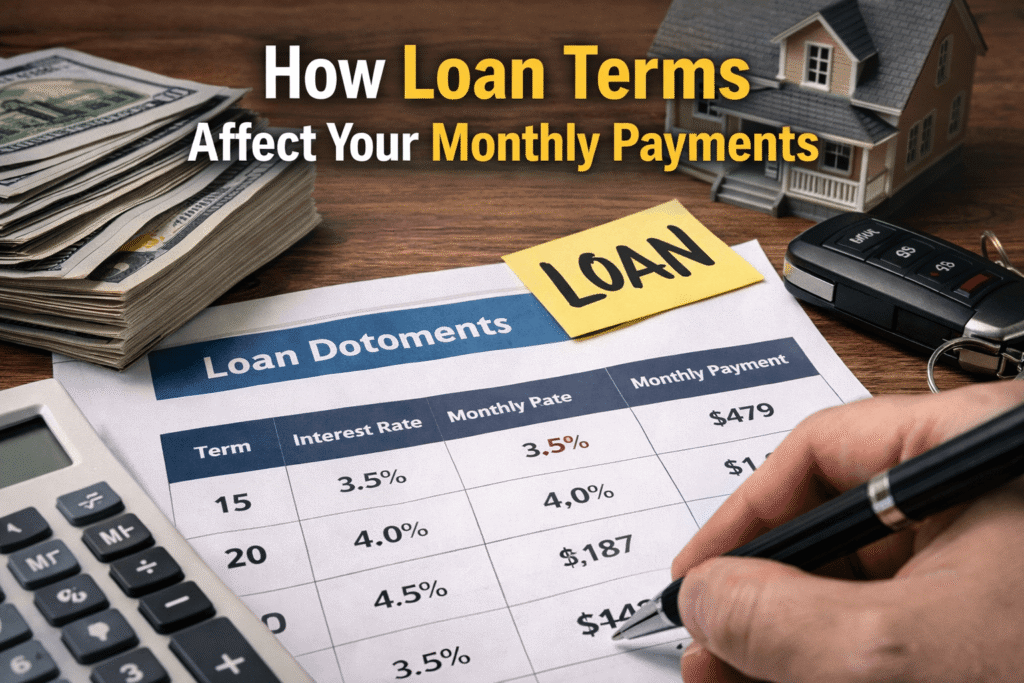
| Loan Term | Monthly | Interest | Total Cost |
|---|---|---|---|
| 3 Yrs (36 mo.) | $609 | $916 | $20,916 |
| 4 Yrs (48 mo.) | $470 | $1,551 | $21,551 |
| 5 Yrs (60 mo.) | $387 | $2,319 | $22,319 |
| 7 Yrs (84 mo.) | $293 | $4,600 | $24,600 |
A few things jump out immediately:
Going from 3 years to 7 years cuts your monthly payment nearly in half — from $609 down to $293.
But your total interest cost explodes — from $916 to $4,600. That’s five times more in interest.
The 7-year borrower pays $3,684 more over the life of the loan just for the convenience of lower payments.
That extra $3,684 isn’t a penalty or a fee — it’s simply what happens when interest has more time to accumulate. Understanding this is the key to making a smarter borrowing decision.
Short vs. Long Loan Terms: Pros and Cons Side by Side
Here’s a clear look at what you gain — and give up — with each choice:
Short Loan Terms: The Full Picture
Short loan terms are for people who want to minimize the total cost of borrowing and get out of debt quickly. Imagine you take out a 3-year auto loan. Your payment is higher each month — but after 36 payments, you own the car outright, you’ve paid minimal interest, and your monthly expenses drop. You’re free to redirect that money toward savings, investments, or your next goal.
With a mortgage, a 15-year term builds equity aggressively. Every extra dollar that goes toward principal (rather than interest) adds to your ownership stake in the home.
The challenge: Higher monthly payments require a more stable, higher income. If your budget is already stretched, a short term can create real financial stress.
Long Loan Terms: The Full Picture
Long loan terms are for people who need manageable monthly payments — even if it means paying more over time. Consider someone with a tight monthly budget who’s buying their first car. A 72-month term might be the difference between affording the vehicle and not. Lower payments create breathing room for rent, groceries, and emergencies.
The danger: Auto loans with very long terms (72–84 months) carry a real risk of being “underwater” — where you owe more than the car is worth. If you need to sell midway through a 7-year term, you could owe thousands more than you receive.
How Loan Terms Affect Total Interest Paid — The Numbers Don’t Lie
The interest difference can be staggering — especially on large loans like mortgages. Let’s look at a $300,000 home loan at 7% interest:
| Loan Term | Monthly | Total Interest |
|---|---|---|
| 15-Year Mortgage | ~$2,108 | ~$79,440 |
| 30-Year Mortgage | ~$1,432 | ~$215,520 |
Difference in total interest
$136,080
For the exact same house.
That’s not a typo. The 30-year borrower pays $136,080 more in interest than the 15-year borrower — for the exact same house.
The 30-year borrower pays $676 less per month. Over 15 years, that’s roughly $121,680 in freed-up cash. If that money is invested wisely, the math can actually favor the longer term. It depends entirely on your financial discipline and goals — which is why focusing only on the monthly payment is a mistake.
Loan Terms by Loan Type: What’s Typical?
Not all loans work the same way. Here’s a quick guide to what loan terms look like across different borrowing situations:
How to Choose the Right Loan Term for You
There’s no universal right answer — but there is a right answer for your situation. Here’s how to think through it:
Pro Tip: Choose the shortest loan term you can comfortably afford.
“Comfortably” is the key word. Don’t stretch so tight that one unexpected expense breaks your budget. But don’t default to the longest term just to get the lowest payment — the interest savings from a shorter term are real money.
Common Mistakes Borrowers Make with Loan Terms
These are the mistakes that cost people the most money — and they’re all avoidable:
Mistake #1
Choosing the Longest Term Without Doing the Math
That 7-year auto loan feels great at $293/month. But you’re paying $3,684 more than the 3-year borrower. Always calculate total interest before signing.
Mistake #2
Focusing Only on the Monthly Payment
Lenders know people focus on monthly payments. That’s why they pitch longer terms to make loans seem affordable. A lower payment can mean a much higher total cost.
Mistake #3
Not Shopping Multiple Lenders
Different lenders offer different term options at different rates. Compare at least 3 to 4 lenders — including banks, credit unions, and online lenders — before committing.
Mistake #4
Ignoring Prepayment Options
Planning to make extra payments to pay off early can work — but only if your loan has no prepayment penalties. Always check before assuming this strategy will save you money.
When a Longer Loan Term Actually Makes Sense
Longer terms get a bad reputation in personal finance circles, but they’re not always the wrong choice. Here are scenarios where stretching the term can be the smart move:
- Your monthly budget is tight and a shorter term would leave no room for emergencies
- You’re going through a temporary financial constraint and need breathing room right now
- You have high-interest debt (like credit cards) you’ll use your freed-up cash flow to pay off first
- You’re disciplined enough to invest the payment difference and expect strong investment returns
- You’re early in your career and expect your income to grow significantly in the coming years
The key word is intentional. If you choose a longer term with a clear strategy for the extra monthly cash, it can be a reasonable financial decision. If you’re just choosing it to afford something you can’t really afford — that’s when it becomes a problem.
Final Thoughts: The Right Term Is the One That Fits Your Life
Loan terms are one of the most powerful — and most overlooked — levers in personal finance. A few extra years on a loan can mean thousands of dollars in additional interest. But a term that’s too short can strain your budget and put you in a tough spot when life throws a curveball.
Key Takeaways
Shorter terms = higher payments, less interest, faster debt payoff
Longer terms = lower payments, more interest, extended debt commitment
The right term depends on your budget, goals, and financial stability
Always compare the total cost of the loan — not just the monthly payment
Before you sign anything, run the numbers on at least two or three different term options. Look at what you’d pay per month and what you’d pay in total. That comparison is worth fifteen minutes of your time — and potentially thousands of dollars over the life of the loan.
Before choosing a loan term, compare both the monthly payment AND the total cost of the loan.
Your future self will thank you for spending 15 minutes on this math today. Use our free mortgage calculator to compare your options. You can also use the CFPB’s free loan calculator at consumerfinance.gov.