
Auto Insurance · 2026 Guide
Everything American Drivers Need to Know in 2026
A Complete Guide to Pay-As-You-Drive,
Pay-How-You-Drive, and Telematics-Based Auto Insurance Discounts in the United States.
⚡
Quick Answer: What Is Usage-Based Insurance?
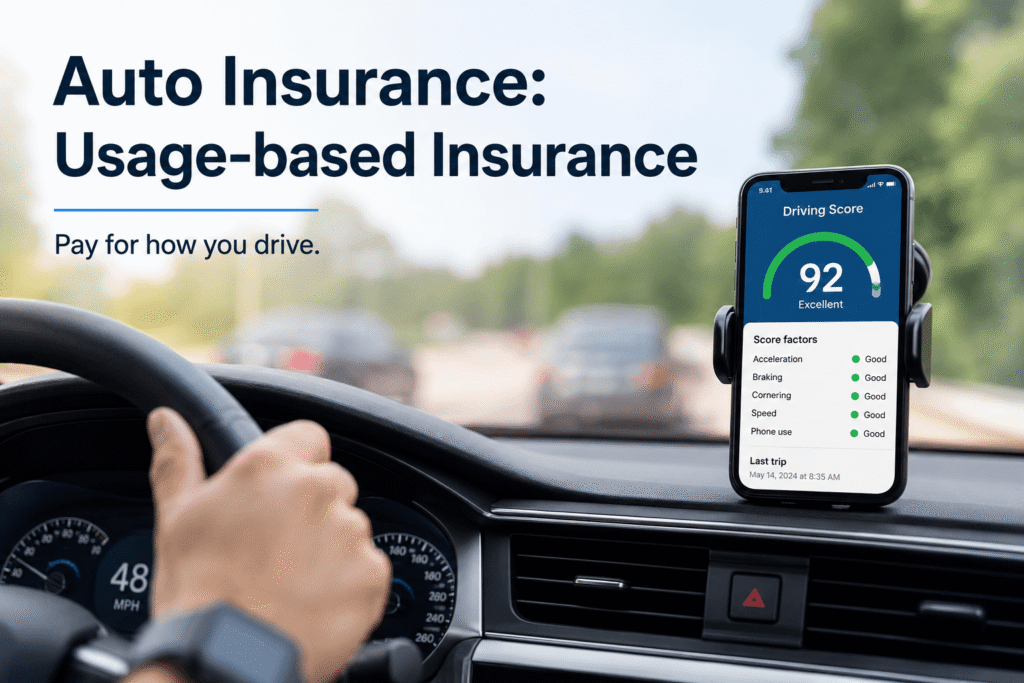
Usage-based insurance (UBI) is a type of auto insurance that prices your premium, in whole or in part, based on how, when, or how much you actually drive — measured through a smartphone app, a plug-in OBD-II device, or your car’s built-in telematics.
Section 1: What Is Usage-Based Insurance?
If you’ve ever wondered why your insurance bill doesn’t seem to reflect how carefully you actually drive, this section explains the shift that’s changing that — and why it happened.
Traditional Insurance vs. Usage-Based Insurance
Traditional auto insurance prices your policy almost entirely on static, backward-looking data: your age, gender (in states where allowed), marital status, credit-based insurance score, vehicle make and model, where you live and park, and your history of claims and violations. None of that data tells an insurer what you did behind the wheel yesterday.
Usage-based insurance flips that model. Instead of relying only on who you are on paper, UBI measures what you actually do on the road — your mileage, your braking habits, the times of day you drive, and in some programs, your phone usage and cornering speed. The result is a premium that responds to real behavior rather than statistical averages for people who share your demographic profile.
Think of it this way: traditional insurance prices you like everyone else in your peer group. Usage-based insurance prices you like you.
A Brief History: Why Insurers Introduced It
Telematics-based pricing isn’t brand new — Progressive launched an early version of its Snapshot program back in the late 2000s, and General Motors’ OnStar had been quietly collecting vehicle data even before that. But early systems were clunky, relying on physical devices that had to be mailed out, plugged in, and mailed back.
Two things changed everything: smartphones and connected cars. Once nearly every driver carried a phone with a GPS chip and an accelerometer, insurers no longer needed special hardware to monitor driving behavior — they could just ask customers to download an app. Around the same time, automakers began building telematics modules directly into new vehicles, turning every connected car into a potential data source without any extra equipment at all.
Add to that the explosion of consumer comfort with data sharing (think fitness trackers and smart thermostats), and insurers found a willing audience. Today, nearly every major U.S. auto insurer offers some form of usage-based program, and independent research from the Insurance Information Institute notes that telematics-based pricing has moved from a niche experiment to a mainstream pricing tool across the industry.
How Technology Changed the Pricing Model
Three technologies made modern UBI possible:
Combined with cloud computing and machine learning, insurers can now process millions of trips a day and translate raw sensor data into a usable driving score — something that simply wasn’t feasible at scale fifteen years ago.
Section 2: How Usage-Based Insurance Works
The mechanics behind UBI are more straightforward than most people expect. Here’s the journey from signing up to seeing a discount on your bill.
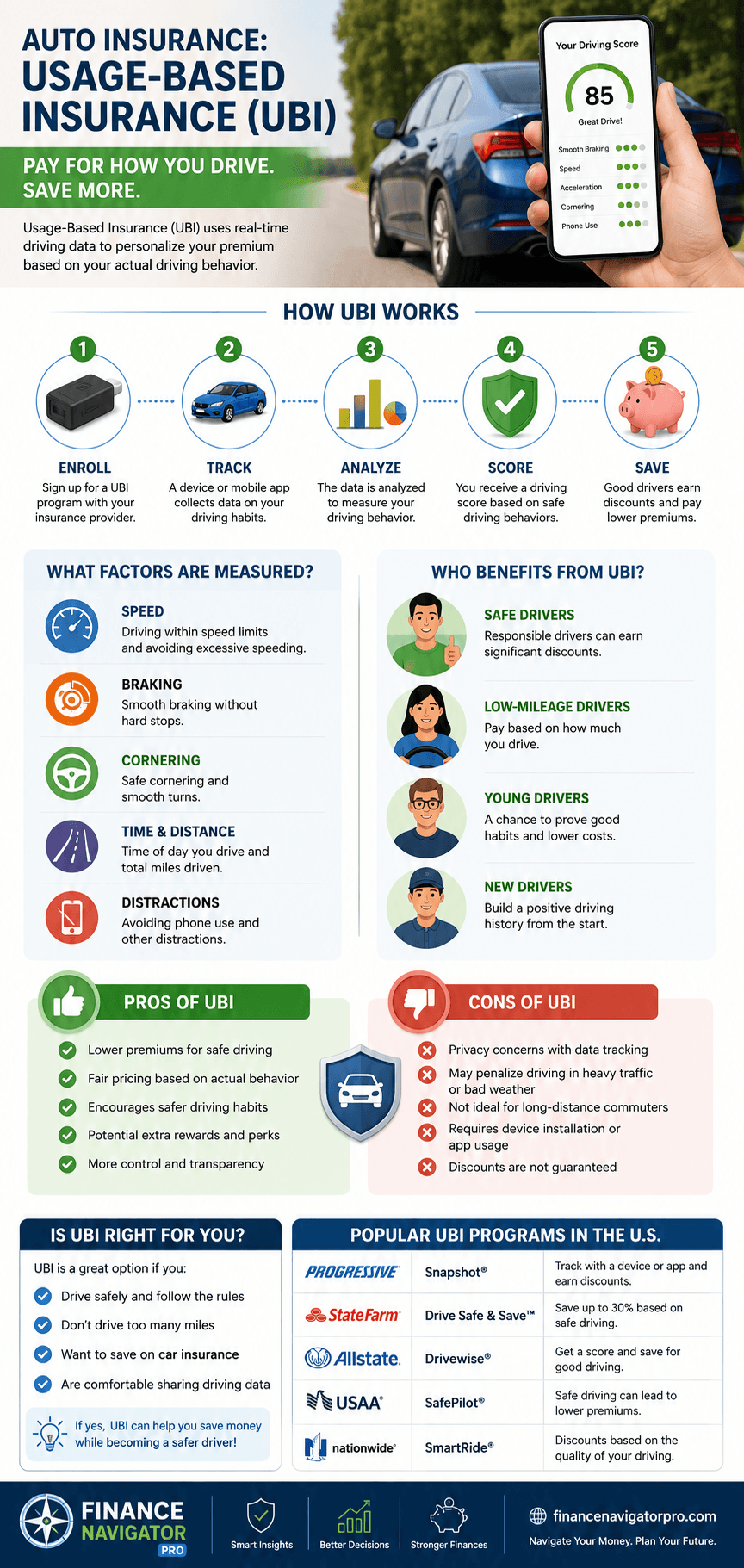
Step 1: Enrollment
You typically opt into a UBI program either when you first get a quote or partway through an existing policy term. Some insurers make telematics enrollment mandatory for certain discounts; others offer it as a purely optional add-on with no downside for declining.
Step 2: Choose Your Tracking Method
Depending on the insurer, you’ll be offered one or more of these options:
Step 3: Driving Monitoring Begins
Once activated, the app or device starts recording trip-level data in the background: when you drive, how far, how fast, how smoothly you accelerate and brake, and in some programs, whether your phone is being handled while the car is moving.
Step 4: Data Upload
Your device or app periodically uploads this trip data to the insurer’s servers, usually via your phone’s cellular or Wi-Fi connection, or the plug-in device’s own cellular radio. Most programs upload data continuously or after each trip rather than waiting for a single large batch.
Step 5: Score Generation
The insurer’s system runs your trip data through a proprietary scoring algorithm, weighing factors like hard-braking frequency, mileage, night driving, and acceleration patterns. This produces a driving score, usually on a scale like 1–100, that updates as new trips come in.
Step 6: Discount Calculation
Your driving score (and in mileage-based programs, your total miles driven) feeds into a discount or surcharge calculation. Many insurers guarantee that initial enrollment won’t raise your rate — it can only lower it during a trial period — though this varies by company and state.
Step 7: Policy Renewal
At renewal, your accumulated driving data is used to adjust your premium going forward. Some programs apply a fresh look at every renewal; others lock in a discount tier for a set period before re-evaluating.
| Stage | What Happens | Typical Timeframe |
|---|---|---|
| Enroll | Sign up via app, device request, or connected car activation | Day 1 |
| Onboard | Install app or plug in device; calibration period begins | Days 1–7 |
| Monitor | Trips are tracked in the background automatically | Ongoing |
| Upload | Trip data syncs to insurer servers | After each trip or daily |
| Score | Driving score and/or mileage total is calculated | Continuously updated |
| Discount Applied | Premium adjustment reflected on your bill | At renewal or trial-period end |
Section 3: Types of Usage-Based Insurance
“Usage-based insurance” is an umbrella term that covers several distinct pricing models. Understanding which type you’re being offered matters, because each one rewards a different kind of driver.
Pay-As-You-Drive (PAYD)
PAYD insurance prices your premium primarily around how many miles you drive. The less you drive, the less you pay, full stop — your braking habits or driving times matter less or not at all. This model is built for low-mileage drivers: retirees, remote workers, and people who simply don’t put many miles on the odometer each year.
Pay-How-You-Drive (PHYD)
PHYD shifts the focus from how much you drive to how well you drive. Mileage may still factor in, but the bigger drivers of your discount are behavioral: smooth braking, gentle acceleration, safe cornering, and avoiding risky hours like late night driving.
Manage-How-You-Drive (MHYD)
MHYD programs go a step further than PHYD by giving you active coaching and feedback — think real-time alerts, post-trip scorecards, and tips for improvement — with the goal of actively shaping your habits over time, not just measuring them. This model blurs into more sophisticated app-based programs that combine monitoring with built-in driver coaching features.
Mileage-Based Insurance
This is a more general term for any program priced primarily off odometer readings or GPS-tracked mileage, whether or not behavior is factored in. It’s a close cousin of PAYD and is especially popular with insurers targeting low-mileage and EV-owning households.
Behavior-Based Insurance
The behavior-focused counterpart to mileage-based insurance — premiums move based on driving habits like braking, acceleration, and time-of-day patterns, regardless of total mileage. This is functionally very close to PHYD and the two terms are often used interchangeably.
Connected Vehicle Insurance
Rather than relying on a phone app or a plug-in device, connected vehicle insurance pulls telematics data directly from the manufacturer’s built-in systems — common in newer GM, Ford, Toyota, and Tesla models, among others. Some automakers now partner directly with insurers (or offer their own insurance products) using this built-in data stream.
| Model | Primary Factor | Best For |
|---|---|---|
| Pay-As-You-Drive (PAYD) | Total mileage | Low-mileage drivers, retirees, remote workers |
| Pay-How-You-Drive (PHYD) | Driving behavior | Safe, skilled drivers with average mileage |
| Manage-How-You-Drive (MHYD) | Behavior + active coaching | Drivers wanting feedback to improve habits |
| Mileage-Based | Odometer/GPS mileage | Second cars, occasional drivers, EV owners |
| Behavior-Based | Braking, speed, timing | Careful drivers regardless of mileage |
| Connected Vehicle | Built-in vehicle telematics | Owners of newer connected or electric vehicles |
Section 4: What Driving Behaviors Are Tracked?
Not every program tracks every behavior — a pure mileage-based plan may ignore braking entirely, while a behavior-heavy plan might barely care how many miles you log. Here’s a rundown of the data points insurers commonly collect, and why each one matters.
| Behavior | Why It Matters | Possible Effect on Premium |
|---|---|---|
| Mileage | More miles generally means more exposure to accident risk | Lower mileage typically lowers premium |
| Hard braking | Sudden stops correlate with following too closely or distracted driving | Frequent hard brakes can raise premium |
| Rapid acceleration | Aggressive starts are linked to higher collision risk | Frequent rapid starts can raise premium |
| Cornering speed | Taking turns too fast suggests reduced vehicle control | Sharp cornering can lower your score |
| Speed relative to limit | Speeding is one of the strongest predictors of accident severity | Consistent speeding raises premium |
| Night driving | Nighttime hours carry statistically higher fatality rates | Frequent late-night trips can raise premium |
| Phone handling | Distracted driving is a leading cause of preventable crashes | Phone use while driving can lower your score |
| Trip duration | Longer trips increase exposure time on the road | Very long average trips may modestly affect score |
| Road type | Highway driving has different risk patterns than surface streets | Used as context, rarely a standalone factor |
| Time of day | Risk varies by rush hour, late night, and weekend patterns | Off-peak driving can be favorably scored |
| Location (where applicable) | Some programs use general trip data for context, not just monitoring | Varies significantly by insurer and state |
It’s worth repeating: not every insurer tracks every item on this list, and a few states restrict certain data points (location tracking in particular draws more regulatory scrutiny than basic acceleration data). Always check your specific program’s terms before assuming you know what’s being measured.
Section 5: How Insurance Companies Collect Data
Every UBI program relies on one (or a combination) of these data collection methods. Knowing which one you’re dealing with helps you understand what’s actually being measured — and what isn’t.
Mobile Apps
The most common method today. You download the insurer’s app, grant it permission to access motion sensors and location services, and it automatically detects when you start and stop driving. No extra hardware required, which is why this has become the default option for most major insurers, including Progressive Snapshot’s app-based option and State Farm Drive Safe & Save.
OBD-II Plug-In Devices
A small device plugs into your vehicle’s OBD-II port (standard on virtually every car built after 1996, usually located under the dashboard near the steering column). These devices read directly from your car’s onboard computer and transmit data via built-in cellular connectivity, which means they work even if you forget your phone at home. This was the original telematics method and is still offered by several insurers, including Liberty Mutual RightTrack’s device option.
Factory-Installed Connected Cars
Many vehicles built in the last several years come with telematics hardware already installed by the manufacturer — GM’s OnStar, Toyota’s Connected Services, and similar systems in Ford and other brands. Some insurers can pull driving data directly from these systems with your consent, skipping the app or device altogether.
Bluetooth Beacons
A smaller piece of the puzzle: some programs use a Bluetooth beacon (a tiny plug-in transmitter) paired with the smartphone app specifically to help the app distinguish whether you were the driver or a passenger — a known weak point of phone-only tracking.
GPS
GPS chips, present in virtually every smartphone and increasingly in vehicles themselves, provide the location and speed data that underlies most trip detection and many behavior calculations.
Vehicle Sensors
Accelerometers and gyroscopes (in your phone or built into the vehicle) detect acceleration, braking force, and cornering — the raw motion data that scoring algorithms convert into a driving score.
Telematics Platforms
Behind the scenes, most insurers don’t build this technology entirely in-house. Many license telematics analytics platforms from specialized data and analytics firms like LexisNexis, which aggregate and process raw sensor data into usable risk scores across the industry.
| Collection Method | Requires Phone? | Requires Hardware? | Works Without App Open? |
|---|---|---|---|
| Mobile App | Yes | No | Yes, runs in background |
| OBD-II Device | No | Yes (plug-in) | Yes, independent of phone |
| Connected Car (Factory) | No | No (built-in) | Yes, built into vehicle |
| Bluetooth Beacon + App | Yes | Yes (small beacon) | Yes, supports app detection |
Section 6: How Driving Scores Are Calculated
Every insurer guards its exact scoring formula as a trade secret, but the underlying inputs are broadly similar across the industry — not unlike the broader process behind how insurance quotes are calculated in general. Here’s what typically goes into the number that determines your discount.
Driving Habits (Composite Behavior)
This is the umbrella category combining braking, acceleration, and cornering data into an overall “smoothness” measure. Insurers generally compare your braking and acceleration patterns against thresholds calibrated from millions of trips, flagging events that exceed a certain force or rate of change.
Consistency
A driver who’s mostly smooth but has one rough week might score better than someone who’s consistently middling, because sudden spikes in risky events tend to weigh more heavily than a steady, average pattern. Consistency rewards predictable, low-variance driving.
Mileage
In mileage-sensitive programs, total miles driven over the scoring period is a direct input — fewer miles generally means a better score, independent of how well you drive those miles.
Driving Times
Trips logged late at night or during early morning hours (often midnight to 4 a.m.) are statistically associated with higher accident severity, partly due to fatigue and partly due to a higher concentration of impaired drivers on the road at those hours. Programs that track time-of-day will often weight these trips more heavily.
Braking
Hard-braking events — typically defined as decelerating faster than a set threshold, like dropping from 55 mph to 30 mph in a few seconds — are one of the most heavily weighted inputs in most scoring models, because they often indicate following too closely or delayed reaction time.
Cornering
Less universally tracked than braking, but present in many app-based programs: sharp, high-speed turns can indicate reduced control and contribute negatively to your score.
Phone Distraction
Apps that can detect phone handling while the vehicle is in motion (as opposed to hands-free use) often weight this heavily, since distracted driving is consistently cited by the National Highway Traffic Safety Administration as a major factor in preventable crashes.
Speeding
Driving meaningfully above the posted limit, particularly on surface streets where pedestrian risk is higher, is one of the more heavily weighted negative factors across nearly every PHYD-style program.
Section 7: Pros of Usage-Based Insurance
For the right driver, usage-based insurance can be one of the most meaningful ways to cut an auto insurance bill without changing coverage levels. Here’s what’s genuinely good about it.
Large Potential Savings
Safe, low-mileage drivers frequently see double-digit percentage discounts, and some can reach 30–40% off in the right program. Even cautious estimates put typical UBI savings well above what most other discounts most people don’t know about (bundling, good student, multi-car) offer on their own.
Fairer Pricing
If your actual driving is better than what your demographic profile would predict, UBI lets that reality show up in your bill instead of being buried under averages for your age group or ZIP code.
Encourages Safer Driving
Knowing that hard braking or speeding shows up in your score gives many drivers a tangible incentive to ease up — which is good for your wallet and arguably good for everyone else on the road too.
Personalized Premiums
Your rate becomes a reflection of you specifically, not a blended average of everyone who shares your age, gender, or neighborhood.
Eco-Friendly Side Benefit
Mileage-based programs indirectly reward driving less, which dovetails nicely with reduced fuel consumption and emissions — a meaningful side benefit for environmentally conscious drivers and remote workers who already drive less.
Useful Driving Insights
Most apps provide a dashboard showing your trip history, braking events, and trends over time — genuinely useful feedback most drivers never get otherwise.
Teen Driver Coaching
Several programs offer a parent or family dashboard that flags risky events for a newly licensed teen driver, turning UBI into a practical coaching tool rather than just a pricing mechanism.
Fleet and Multi-Car Benefits
Families or small fleets with multiple connected vehicles can sometimes see compounding benefits, with each well-driven vehicle reinforcing a household’s overall discount.
Section 8: Cons of Usage-Based Insurance
UBI isn’t a universal win. Here are the legitimate downsides worth weighing before you enroll.
Privacy Concerns
Sharing detailed driving data — and in some programs, location data — with an insurance company understandably makes some drivers uncomfortable, even when the stated purpose is limited to risk scoring.
GPS Tracking
Programs that log trip-level location data raise a different category of concern than simple accelerometer-based braking detection. We address exactly what is and isn’t typically shared in Section 14.
Potential Premium Increases
Not every driver saves money. If your real driving habits (frequent hard braking, lots of night driving, high mileage) are riskier than what your traditional rating factors assumed, UBI can raise your premium rather than lower it.
Data Sharing Questions
Drivers reasonably want to know whether their data could be shared with third parties, used in claims disputes, or retained longer than expected. These policies vary meaningfully by insurer and state.
Device Compatibility Issues
Older vehicles may lack a working OBD-II port, and some plug-in devices have spotty compatibility with certain makes and models, leading to connectivity drop-outs that can frustrate accurate scoring.
Driving Anxiety
Some drivers report feeling more anxious or self-conscious behind the wheel knowing they’re being scored, which can paradoxically make driving feel less relaxed even if it doesn’t make it less safe.
Battery Drain
App-based programs that run continuously in the background, using GPS and motion sensors, can noticeably increase phone battery consumption, especially on longer drives.
Phone Permission Requirements
Many apps require fairly broad permissions — background location access, motion and fitness data, sometimes contacts for crash detection features — which some users are reluctant to grant.
Coverage Misconceptions
A common point of confusion: enrolling in a UBI program changes how your premium is priced, not what your policy covers. Your liability limits, collision, and comprehensive coverage remain exactly what you selected — UBI is a pricing mechanism, not a coverage type. If you’re unsure what you actually need, see What Insurance Coverage Do You Need?.
| Concern | How Significant Is It? | How to Reduce It |
|---|---|---|
| Privacy / data sharing | Moderate — varies heavily by insurer | Read the privacy policy before enrolling; ask what’s shared and for how long |
| Premium increase risk | Real but limited — many insurers cap or avoid first-term increases | Check if there’s a no-penalty trial period before enrolling |
| Device compatibility | Low for most modern vehicles | Confirm OBD-II compatibility for your make/model before requesting a device |
| Battery drain | Minor to moderate for app-based tracking | Use a car charger or choose a plug-in device instead of the app |
Section 9: Who Should Consider Usage-Based Insurance?
UBI tends to reward a specific profile of driver. If you see yourself in the list below, it’s well worth getting a quote.
Remote Workers
If you’re not commuting five days a week, your mileage is almost certainly lower than the average baseline insurers assume — which usually translates directly into savings on a mileage-sensitive program.
Retirees
Lower average mileage, more flexibility to avoid rush-hour and late-night driving, and often decades of accumulated safe-driving habits make retirees one of the strongest-fit groups for UBI.
Stay-at-Home Parents
Driving patterns built around school runs and errands tend to mean shorter trips, daytime hours, and lower overall mileage — favorable territory for most behavior- and mileage-based programs.
College Students
Students without a daily commute, or who leave their car at home during the school year, can see meaningful savings on a low-mileage program — particularly helpful given how expensive coverage for young drivers tends to be on traditional pricing alone.
Safe Drivers
If your habits are genuinely smooth — gentle braking, reasonable speeds, limited late-night driving — a behavior-based program is likely to reflect that better than traditional rating factors ever could.
Low-Mileage Drivers
Anyone logging under roughly 8,000–10,000 miles a year is a strong candidate for a mileage-based or pay-per-mile program.
Hybrid Workers
Splitting time between home and office often means meaningfully lower mileage than a full-time commuter, even if it’s not as low as a fully remote worker’s.
Electric Vehicle Owners
Many EVs already come with built-in telematics, making enrollment frictionless, and EV owners as a group tend to skew toward lower average annual mileage and newer, well-maintained vehicles — both favorable signals.
| Driver Profile | Why UBI Tends to Work Well |
|---|---|
| Remote workers | Lower commuting mileage than average baseline |
| Retirees | Lower mileage, flexible daytime driving schedule |
| Stay-at-home parents | Shorter trips, daytime hours, school-run patterns |
| College students | Reduced or seasonal driving, often lower overall mileage |
| Safe, smooth drivers | Behavior data directly rewards good habits |
| Low-mileage drivers | Mileage-based discounts apply directly |
| Hybrid/part-time commuters | Mileage below full-time commuter averages |
| EV owners | Built-in telematics, often lower average mileage |
Section 10: Who Might Want to Avoid It?
UBI isn’t the right fit for every driver. If your situation matches the profiles below, proceed carefully — or skip it altogether.
Delivery Drivers
High daily mileage, frequent stops and starts, and time spent driving during off-peak hours can all work against you in a typical personal-auto UBI program. Beyond the pricing mismatch, most personal UBI programs aren’t designed for commercial use at all — see the note below.
Uber and Lyft Drivers
Rideshare driving generally requires specific rideshare insurance endorsements or commercial coverage, not a standard personal UBI program. Even setting that aside, the sheer volume of miles and mixed-risk hours (including plenty of late-night trips) typically works against favorable scoring.
DoorDash and Other Gig Delivery Drivers
Similar to rideshare driving: high mileage, frequent short trips with lots of starts and stops, and a personal auto policy that may not even apply to commercial delivery use without an endorsement.
High-Mileage Commuters
If you’re driving 20,000+ miles a year on a long highway commute, a mileage-sensitive program is working against you by design, even if your actual driving behavior is excellent.
Aggressive or Inconsistent Drivers
If hard braking, quick acceleration, or speeding are part of your regular driving style, a behavior-based program will likely flag exactly that — potentially raising your premium rather than lowering it.
Night Shift Workers
Driving regularly during the overnight hours that most scoring models penalize can work against you even if your actual driving skill is excellent, simply because the timing itself is treated as higher risk.
Frequent Travelers
If your driving patterns are irregular — long road trips, unfamiliar roads, inconsistent schedules — your data may not paint a stable, representative picture of your typical habits, which can muddy your score either direction.
| Driver Profile | Why UBI Often Backfires |
|---|---|
| Rideshare/delivery drivers | High mileage, commercial use mismatch with personal UBI |
| High-mileage commuters | Mileage-based discounts work against high annual totals |
| Aggressive drivers | Behavior tracking directly penalizes hard braking/speeding |
| Frequent night-shift workers | Late-night hours are commonly weighted as higher risk |
| Frequent long-distance travelers | Irregular patterns can produce an unrepresentative score |
Section 11: How Much Money Can You Save?
Let’s talk real numbers — with an important caveat up front: every figure below is an illustrative scenario, not a guarantee. Actual savings depend on your insurer, state, vehicle, driving record, and the specific program you enroll in. Treat these as a framework for thinking about your own potential savings, not a promise of what you’ll personally see.
Scenario 1: 5,000 Miles Per Year (Remote Worker)
A driver who works from home and mostly uses their car for errands and occasional trips might log around 5,000 miles annually — well below the U.S. average. On a mileage-based program, this kind of low usage commonly qualifies for a meaningful discount tier, since exposure to risk scales closely with time spent on the road.
Scenario 2: 8,000 Miles Per Year (Part-Time Commuter or Retiree)
At 8,000 miles, a driver is still comfortably below the national average annual mileage, which generally hovers in the 12,000–14,000 mile range for the typical U.S. driver. This range often still qualifies for solid mileage-based savings, particularly when paired with smooth driving behavior.
Scenario 3: 12,000 Miles Per Year (Average U.S. Driver)
This mileage level sits close to the national average, meaning a pure mileage-based discount may be modest. However, a driver in this range with excellent braking and speed habits can still see solid savings on a behavior-focused (PHYD) program, since the discount isn’t coming from mileage at all.
Scenario 4: 18,000 Miles Per Year (Above-Average Commuter)
At this level, mileage-based programs become less advantageous, and may offer little to no discount at all. A behavior-based program is the more realistic path to savings here — assuming driving habits are genuinely smooth and consistent.
Scenario 5: 20,000+ Miles Per Year (High-Mileage Driver)
This is the range where usage-based insurance often stops making sense from a pure cost perspective, particularly on mileage-sensitive programs. Even an excellent behavior score may only partially offset the mileage penalty in some program structures. Drivers in this range should compare a UBI quote carefully against a traditional policy before committing.
| Annual Mileage | Driving Profile | Illustrative Savings Potential |
|---|---|---|
| 5,000 miles | Careful driver | Often among the highest discount tiers available |
| 8,000 miles | Careful driver | Strong discount potential on mileage-based programs |
| 12,000 miles | Careful driver | Moderate mileage discount; behavior-based savings can add more |
| 12,000 miles | Average/inconsistent driver | Limited mileage discount; behavior may offset or reduce savings |
| 18,000 miles | Careful driver | Limited mileage-based savings; behavior-based programs more favorable |
| 20,000+ miles | Careful driver | Mileage-based savings typically minimal regardless of behavior |
| 20,000+ miles | Aggressive driver | UBI enrollment may not be financially advantageous |
The ranges above are illustrative only, intended to show the general relationship between mileage, driving behavior, and typical UBI outcomes — not a quote or a guarantee.
Section 12: Top U.S. Companies Offering Usage-Based Insurance
Nearly every major U.S. auto insurer now offers some form of usage-based program, but the details — maximum discount, tracking method, and whether poor driving can raise your rate — vary significantly. If you’re also weighing pricing more broadly, it’s worth cross-referencing this list against the cheapest car insurance companies in the U.S.. Here’s a closer look at the major players, current as of 2026.
Progressive Snapshot
Overview: One of the original mainstream telematics programs, Snapshot is available exclusively to Progressive customers and runs primarily through Progressive’s mobile app, with an OBD-II plug-in device also offered for drivers who prefer not to use their phone.
State Farm Drive Safe & Save
Overview: State Farm’s telematics program stands out for one specific reason — it’s structured as a discount-only program. Your rate can be lowered by safe driving, but State Farm does not use the data to raise your premium.
Allstate Drivewise
Overview: Allstate’s flagship behavior-based program, Drivewise runs through a smartphone app, tracking speed, braking, time of day, and phone handling, and is positioned as a rewards-focused (rather than penalty-focused) program in most states.
Allstate Milewise
Overview: Allstate’s pay-per-mile companion to Drivewise, Milewise charges a small daily base rate plus a per-mile charge, tracking mileage only — not driving behavior.
Nationwide SmartRide and SmartMiles
Overview: Nationwide offers two distinct UBI products. SmartRide is a behavior-based discount program tracking mileage, hard braking, fast acceleration, and nighttime driving (defined as midnight to 5 a.m.). SmartMiles is a separate pay-per-mile product for low-mileage drivers.
Liberty Mutual RightTrack
Overview: RightTrack stands out for its short, defined tracking period — typically just 90 days — after which your discount is calculated and locked in, rather than continuously monitoring you for the life of the policy. A small number of states offer a continuous-tracking variant called RightTrack Continuous.
Travelers IntelliDrive
Overview: Travelers’ telematics program (also offered in an enhanced “IntelliDrive 365” version with a more interactive dashboard and ongoing streak-based rewards) tracks driving behavior through a mobile app.
GEICO DriveEasy
Overview: GEICO’s app-based telematics program runs continuously in the background once installed, tracking cornering, distracted driving, braking, and other behaviors, with a particular emphasis on distinguishing real phone distraction from passive navigation use.
Farmers Signal
Overview: Farmers’ usage-based program is generally positioned as a discount-only option, similar in structure to State Farm’s and USAA’s approach, rewarding safe driving without penalizing risky patterns with a rate increase.
USAA SafePilot and SafePilot Miles
Overview: USAA offers two programs — SafePilot, a standard behavior-based telematics program, and SafePilot Miles, a pay-per-mile option for low-mileage drivers. Both are exclusive to USAA’s military-affiliated membership.
Root Insurance
Overview: Root built its entire business model around telematics from day one, rather than adding it to an existing traditional product. New applicants typically complete an initial test-drive period through the app before receiving a quote, with pricing weighted heavily toward measured driving behavior.
Metromile (and Similar Pay-Per-Mile Insurers)
Overview: Metromile pioneered a pure pay-per-mile model — a low base rate plus a per-mile charge, tracked via a plug-in device or app — aimed squarely at low-mileage urban drivers. It has since become part of Lemonade’s auto insurance offering in the states where it operates.
| Program | Tracking Method | Can Rates Increase? | Advertised Max Discount |
|---|---|---|---|
| Progressive Snapshot | App or device | Yes, in some states | Up to 30% |
| State Farm Drive Safe & Save | App, beacon, OnStar, or Hum device | No | Up to 30% |
| Allstate Drivewise | App only | Yes, in some states | Up to 40% |
| Allstate Milewise | App or device | N/A (per-mile pricing) | Varies by mileage |
| Nationwide SmartRide | App or device | No | Up to 40% |
| Nationwide SmartMiles | App or connected car | N/A (per-mile pricing) | ~25% average reported |
| Liberty Mutual RightTrack | App | No (rate-increase protection) | Up to 30% |
| Travelers IntelliDrive | App | Yes, in some cases | Varies by state |
| GEICO DriveEasy | App only | Yes | Up to 10% |
| Farmers Signal | App | No (commonly cited) | Varies |
| USAA SafePilot | App | No | Up to 30% |
| Root Insurance | App | Built into core pricing model | Varies by driving profile |
Discount figures, availability, and program rules change over time and vary by state — always confirm current details directly with the insurer or a licensed agent before enrolling.
Section 13: Usage-Based Insurance vs. Traditional Insurance
Side by side, the two pricing philosophies diverge in some important ways. Here’s how they compare across the factors that matter most.
| Factor | Traditional Insurance | Usage-Based Insurance |
|---|---|---|
| Pricing basis | Demographics, credit-based score, ZIP code, vehicle type, claims history | Actual driving behavior and/or mileage, plus some traditional factors |
| Flexibility | Fixed for the policy term regardless of changes in habits | Can adjust at renewal based on updated driving data |
| Privacy | Minimal ongoing data collection beyond initial application | Ongoing location, motion, and/or mileage data collection |
| Technology required | None beyond standard policy paperwork | Smartphone app, plug-in device, or connected car system |
| Savings potential | Limited to standard discounts (bundling, multi-car, etc.) | Potentially larger, but variable — and not guaranteed |
| Risk of increase | Stable for the policy term | Some programs can raise rates for risky driving; others cannot |
| Eligibility | Broadly available regardless of driving habits | Best suited to specific driver profiles (see Sections 9–10) |
| Renewal process | Standard underwriting review | Often incorporates fresh driving data into the renewal calculation |
| Claims handling | Unaffected by enrollment status | Generally unaffected, though some telematics data could theoretically be referenced during a disputed claim |
The bottom line: traditional insurance offers predictability and simplicity, while usage-based insurance offers the potential for greater savings (or, in some cases, a premium increase) in exchange for ongoing data sharing. Neither approach is universally “better” — it depends entirely on your driving profile and comfort with monitoring.
Section 14: Privacy & Data Security
This is the section most drivers skip past — and the one most worth reading carefully. Usage-based insurance runs entirely on data sharing, and the rules governing that data are evolving quickly. Here’s where things actually stand.
Who Owns Your Driving Data?
Surprisingly, this isn’t fully settled. Legal analyses of the issue have found no conclusive determination of who owns the data generated by telematics devices, though the general direction of legal and regulatory thinking increasingly leans toward treating it as belonging to the consumer who generated it. In practice, today, your insurer’s privacy policy — not a universal legal standard — is what actually governs how your data is used.
How Long Is Data Stored?
Retention periods vary by insurer and aren’t always clearly disclosed. Your best source of truth is the specific telematics program’s terms and privacy disclosure, which should spell out how long trip data is retained and whether it’s deleted after the discount period ends or kept on file longer.
Can Insurers Sell Your Data?
This has become one of the most consequential live issues in the industry. In a high-profile case, the Texas Attorney General sued a major insurer and its data-analytics affiliate over allegations of collecting and selling driving data from tens of millions of Americans to insurance companies, citing state data privacy, data broker, and unfair-practices laws. Separately, a federal court allowed a related class action to proceed on wiretap and Fair Credit Reporting Act claims.
A second lawsuit specifically alleges that an automaker shared connected-car driving data with an insurer without clear policyholder consent — highlighting an important distinction worth understanding: opt-in telematics apps you knowingly download (like Snapshot or Drive Safe & Save) are a different category from connected-car data sharing, where your vehicle’s built-in systems may share driving data with the manufacturer by default, even if you never enrolled in any telematics program at all.
Can Police Access Telematics Data?
Legal scholarship on this topic notes a real tension: telematics records could theoretically be subpoenaed and used in criminal or civil proceedings, and constitutional challenges to this kind of data access have so far largely failed under existing Fourth Amendment case law governing information shared with third parties. This remains a genuinely unsettled and actively debated area, and protections vary by state.
Can Telematics Data Affect a Claim?
It’s possible, though not common practice for most personal-line programs today. Consumer advocates have specifically called for rules ensuring that, if telematics data is used in claims settlement, policyholders should be able to review all data collected about them. Always check your specific policy’s terms regarding claims-related data use.
State Privacy Laws You Should Know About
The regulatory landscape shifted meaningfully heading into 2026. As of mid-2026, 23 states have comprehensive consumer privacy laws, with Indiana, Kentucky, and Rhode Island among the most recent to take effect. Separately, several states introduced telematics-specific bills focused squarely on insurance data: Maryland’s proposal would require insurers to disclose exactly what data they collect for telematics purposes; Missouri’s would block insurers from buying driving data from third parties like automakers; New York’s would require public filing of telematics discount methodologies; North Carolina’s would mandate written notice and consent before enrollment; and Tennessee’s would require similar consent and disclosure standards.
California remains the only state that does not permit telematics-based rating to influence general auto insurance pricing at all, under its long-standing Proposition 103 framework — vehicle data there has historically been limited to verifying actual mileage driven, in a way designed to protect privacy. A 2026 California bill aims to formally establish a path for voluntary telematics-based driving records, though as of this writing it remains under legislative consideration and has drawn both support and pushback from consumer advocates.
Separately, several states — including Maryland, Oregon, and a Virginia bill moving through that state’s legislature — have moved specifically to restrict the sale of precise geolocation data, a category that overlaps directly with the kind of location information some telematics programs collect.
Consumer Rights
Depending on your state, you may have rights to access, correct, delete, or port the data collected about you, and in a growing number of states, to opt out of having certain sensitive data (including precise geolocation) sold to third parties. That said, a recent review by a privacy advocacy organization graded most existing state privacy laws poorly, on the basis that they generally place the burden on consumers to read disclosures and proactively opt out, rather than limiting upfront how much data companies can collect in the first place.
This section reflects the regulatory landscape as it stood in mid-2026. Telematics privacy law is moving quickly at the state level, so it’s worth checking your own state’s current rules before enrolling — not just relying on a one-time read of this guide.
Section 15: Common Myths About Usage-Based Insurance
UBI has picked up a lot of misconceptions over the years — some from outdated programs, some from genuine confusion about how the technology works. Let’s clear them up, one by one.
Myth 1: “They track every second I’m driving.”
Reality: Most programs are interested in trip-level patterns — speed, braking, timing — not a constant, second-by-second surveillance feed of your whereabouts. Some programs do log GPS trip data for scoring and fraud-prevention purposes, but that’s different from continuous personal monitoring.
Myth 2: “My rates always go up once I enroll.”
Reality: Several major programs, including State Farm Drive Safe & Save, Nationwide SmartRide, and USAA SafePilot, are structured as discount-only — your rate can improve, but the program itself won’t raise it. Others can raise rates for risky driving, so this genuinely depends on which program you choose.
Myth 3: “They watch me with cameras.”
Reality: Standard UBI programs rely on motion sensors, GPS, and OBD-II data — not in-car video surveillance. Dashcams are a separate technology entirely and aren’t a standard part of mainstream telematics insurance programs.
Myth 4: “The app drains my battery completely.”
Reality: Background GPS and motion tracking does use some battery, but it’s a modest drain for most users, not a dramatic one — and drivers who are concerned can typically opt for a plug-in device instead, which doesn’t touch phone battery at all.
Myth 5: “Only young or new drivers benefit.”
Reality: Retirees, remote workers, and experienced low-mileage drivers are often among the strongest-fit candidates for UBI — age has little to do with it directly.
Myth 6: “If I get in one accident, my rate skyrockets immediately.”
Reality: Most scoring models use rolling averages over weeks or months, not a single incident. A claim itself is handled through normal claims underwriting, separate from your telematics score.
Myth 7: “UBI changes what my policy covers.”
Reality: UBI is a pricing mechanism, not a coverage type. Your liability limits, comprehensive, and collision coverage remain exactly what you selected when you bought the policy.
Myth 8: “My data gets sold to anyone who wants it.”
Reality: Some high-profile cases have alleged unauthorized data sales, which is exactly why this is now drawing serious regulatory and legal scrutiny. But that’s not the same as saying every insurer freely sells your data — check your specific program’s privacy disclosure rather than assuming the worst (or the best).
Myth 9: “I have to use my phone, so it’s always going to ding me for distraction.”
Reality: Some programs distinguish between active phone use (texting, calls) and passive use (navigation), while others are less precise. If accurate detection matters to you, ask specifically how a program handles this before enrolling.
Myth 10: “If I drive a lot for work, I’ll definitely save money.”
Reality: The opposite is often true. High-mileage driving, especially for rideshare or delivery work, frequently works against mileage-based discounts and may not even be appropriate for a personal UBI policy in the first place.
Myth 11: “Turning the app off occasionally won’t matter.”
Reality: Several programs explicitly warn that disabling location services or unplugging a device can void your discount calculation for that period, since the program simply can’t measure driving it doesn’t detect.
Myth 12: “All usage-based programs work the same way.”
Reality: As covered in Section 3, mileage-based, behavior-based, and hybrid programs reward very different driving profiles. The “best” program for one driver may be a poor fit for another.
Myth 13: “My credit score doesn’t matter anymore if I use UBI.”
Reality: Most insurers still weigh credit-based insurance scores and other traditional factors alongside telematics data — UBI typically supplements traditional rating rather than replacing it entirely.
Myth 14: “If I cancel, my data disappears immediately.”
Reality: Retention policies vary significantly by insurer. Some data may be retained for a period after cancellation. Check your specific program’s data retention disclosure rather than assuming immediate deletion.
Myth 15: “Telematics discounts are the same no matter which insurer I pick.”
Reality: As Section 12 shows, advertised maximum discounts range from around 10% to as high as 40% depending on the company and program — the difference between programs can be substantial.
Myth 16: “Hard braking always means I’m a bad driver.”
Reality: Consumer advocates have specifically raised concerns that what insurers classify as risky hard-braking in some testing scenarios actually reflected safe, appropriate braking — a reminder that these algorithms aren’t infallible and a single flagged event doesn’t necessarily reflect poor driving.
Section 16: How to Maximize Your Usage-Based Insurance Discount
If you’ve decided to enroll, here’s how to get the most out of it — practical, specific tips rather than vague “drive safely” advice.
Driving Behavior Tips
Mileage and Timing Tips
Phone and Distraction Tips
Maintenance and Setup Tips
Strategic Tips
Section 17: Frequently Asked Questions
Here are the most common questions American drivers ask about usage-based insurance, answered directly.
Section 18: Expert Tips
Beyond the basics, here are a few sharper insights worth keeping in mind as you evaluate usage-based insurance.
Ask About the Evaluation Window, Not Just the Discount Cap
Two programs can both advertise “up to 40% off,” but one might lock in your discount after 90 days while another continuously re-evaluates you every renewal. The evaluation window matters just as much as the headline number, especially if your driving habits might change.
Don’t Assume Your Current Insurer’s Program Is Your Only Option
If your current insurer’s UBI program doesn’t fit your driving profile well — say, you’re a high-mileage driver but excellent behind the wheel — a competitor’s behavior-focused program might be a meaningfully better fit, even if it means switching carriers.
Treat the In-App Dashboard as a Diagnostic Tool, Not Just a Score
Most apps show you exactly which trips triggered hard-braking or speeding flags. Reviewing this regularly, rather than only checking your overall score, helps you identify specific routes or habits worth adjusting.
Multi-Driver Households Should Have an Honest Conversation First
If a program averages or pools scores across everyone who drives an enrolled vehicle, one consistently aggressive driver in the household can offset everyone else’s careful habits. It’s worth discussing driving style as a household before enrolling jointly.
Re-Shop Annually, Not Just at First Enrollment
Your ideal program type can change as your life does — a new job with a longer commute, a move to a new state, or a shift to remote work can all change which UBI structure actually benefits you. Revisit the decision at each renewal rather than assuming your original choice is still optimal.
Section 19: Real-Life Scenarios
Sometimes the easiest way to see whether usage-based insurance fits your life is to see it through someone else’s. Here are nine composite, illustrative scenarios covering a range of common driver profiles.
The Family with Two Cars and a Teen Driver
A household insures two vehicles — a parent’s daily commuter and a car shared with a newly licensed teenager. Enrolling both vehicles in a behavior-based program with a family dashboard lets the parents monitor the teen’s hard-braking and speeding events directly, turning the discount program into a coaching tool as much as a pricing one.
The Teen Driver on a Tight Budget
A first-time driver, already facing higher baseline premiums simply due to limited experience, enrolls in a behavior-based program specifically to demonstrate safe habits early and offset some of that inherent cost disadvantage over time.
The Retiree Driving Less Than Ever
After retiring, a driver finds their annual mileage has dropped sharply — no more daily commute, just errands and the occasional weekend trip. A mileage-based program captures that shift in driving directly, rather than continuing to price them as if they were still commuting daily.
The Remote Worker Who Rarely Leaves the Neighborhood
Working entirely from home, a driver’s mileage drops to a fraction of what it once was. A pay-per-mile structure aligns their premium with their actual, much-reduced usage rather than a fixed annual rate built around outdated commuting assumptions.
The Gig Worker Who Needs to Look Elsewhere
A driver supplementing their income with delivery work quickly learns that a personal UBI program isn’t designed for that kind of mileage or use case — and more importantly, that proper rideshare or commercial coverage is needed regardless of any telematics discount.
The Military Family Relocating Frequently
A military family that moves every few years finds a program designed for service members particularly appealing, since eligibility and structure stay consistent across relocations in a way that switching civilian insurers repeatedly would not.
The College Student Living on Campus
A student leaves their car parked at a parent’s home for most of the school year, driving only during breaks. A low-mileage program reflects that seasonal pattern far more accurately than a standard annual policy would.
The EV Owner with Built-In Telematics
An electric vehicle owner discovers their car already has the hardware needed for a connected-vehicle UBI program, making enrollment essentially frictionless — no app download, no plug-in device, just an opt-in conversation with their insurer.
The Suburban Commuter Who Drives Exactly Average
A driver with a fairly typical commute — right around the national average mileage — finds that a pure mileage-based program offers little benefit, but a behavior-based program still rewards their consistently smooth, careful driving style.
The Urban Driver Navigating Heavy Traffic
Frequent stop-and-go city driving naturally produces more braking events than highway commuting. A driver in this situation focuses specifically on gradual, early braking technique to offset the sheer number of stop-and-go events baked into their daily routine.
Section 20: Final Verdict
After walking through the mechanics, the math, the privacy trade-offs, and the company-by-company details, here’s the honest bottom line.
Who Should Buy It
Who Shouldn’t
Expected Savings, Realistically
Across the industry, typical savings cluster more modestly than the eye-catching “up to 40%” headlines suggest — often landing in the range of a few hundred dollars a year for an average enrolled driver, with meaningfully larger savings available to the best-fit profiles described above. Treat advertised maximums as a ceiling, not an expectation.
The Privacy Trade-Off, Honestly Assessed
Usage-based insurance asks you to share real driving (and sometimes location) data in exchange for the possibility of savings. The regulatory landscape protecting that data is still developing, with active lawsuits, state legislation, and regulatory scrutiny all in motion as of 2026. That doesn’t mean UBI is inherently unsafe to use — it means it’s worth reading the specific program’s privacy disclosure rather than treating all telematics programs as interchangeable on this front.
Best Situations for UBI
This guide reflects program details, discount structures, and privacy regulations as understood in mid-2026. Insurance programs, state laws, and company offerings change over time — always confirm current details directly with insurers or a licensed agent before making a final decision.