
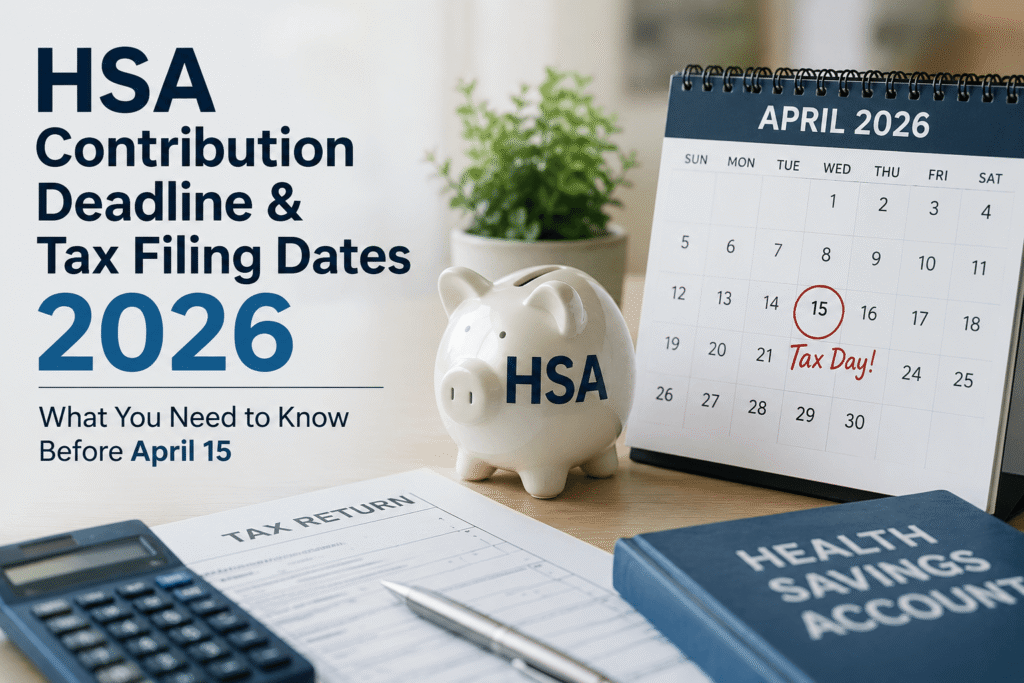
The deadline to make HSA contributions for the 2026 tax year is April 15, 2027 — the same as the federal tax filing deadline. That means even if money was tight during the year, you have until mid-April of the following year to make contributions and lower your taxable income. One important rule most people get wrong: filing a tax extension does NOT push the HSA deadline back. April 15 is the cutoff, full stop.
Quick Summary
| 2026 HSA contribution deadline | April 15, 2027 |
| 2026 federal tax filing deadline | April 15, 2027 |
| Catch-up contribution (age 55+) | Extra $1,000 per eligible account holder |
| Tax extension rule | Extensions give more time to file — not more time to contribute |
| Excess contribution correction deadline | April 15, 2027 (to avoid the 6% excise tax) |
| Employer contributions | Count toward your annual limit |
| Payroll deductions | Must be made by December 31, 2026; direct contributions allowed through April 15, 2027 |
What Is the HSA Contribution Deadline for 2026?
A lot of people assume the HSA contribution window closes on December 31. It doesn’t. The IRS gives you until your federal tax filing deadline — typically April 15 of the following year — to make contributions for the prior year.
So for the 2026 tax year, you have until April 15, 2027 to make contributions. This applies whether you’re contributing for the first time, catching up, or just topping off an account that ran short during the year.
The reason the IRS allows this extra time is practical: many people don’t know exactly how much they can contribute until they’re sitting down to do their taxes. The flexibility gives you a chance to make strategic last-minute contributions before finalizing your return.
Important distinction: The tax year your contribution counts toward isn’t when the money hits the account — it’s how you designate it. If you contribute in February 2027 and mark it for 2026, it reduces your 2026 taxable income, not 2027’s.
Does Filing a Tax Extension Extend Your HSA Deadline?
This is one of the most common points of confusion — and the answer is no.
Filing a tax extension gives you more time to submit your return (usually until October 15). It does not give you more time to contribute to your HSA. The contribution deadline stays fixed at April 15, regardless of whether you filed for an extension.
Here’s a real-world example: Sarah is a freelancer who filed a tax extension until October 2027. She assumed that meant she had until October to fund her HSA. She didn’t. Her HSA contribution deadline for 2026 was still April 15, 2027 — and she missed it, costing her a deduction she could have taken.
Filing a tax extension moves your filing deadline — not your HSA contribution deadline. Mark April 15 on your calendar regardless of whether you plan to file on time.
Can You Contribute to an HSA After December 31?
Yes — and many people don’t realize this. Direct contributions (meaning you send money to the HSA yourself, outside of payroll) can be made for the prior tax year up until the tax filing deadline.
The key is labeling. When you make the contribution, your HSA provider will ask which tax year you want it applied to. You need to select the prior year explicitly. If you don’t, it defaults to the current tax year.
Payroll contributions work differently. Those are deducted from your paycheck and submitted by your employer, which means they’re locked to the calendar year — the last deduction happens with your final paycheck of the year. After December 31, payroll contributions for that year are done.
Step-by-Step: How to Make a Prior-Year HSA Contribution
If you’re reading this in early 2027 and want to make a contribution for 2026, here’s exactly how to do it:
Check your remaining contribution room.
Subtract what you’ve already contributed (including any employer contributions) from the annual limit. The 2026 limits are $4,400 for self-only coverage and $8,750 for family coverage.
Confirm you’re still HSA-eligible.
You must be enrolled in a qualifying High-Deductible Health Plan (HDHP) and not covered by Medicare. If your eligibility changed during 2026, your contribution limit may be prorated.
Log into your HSA provider’s website or app.
Look for the option to make a contribution or deposit. Most providers have a clear interface for this.
Select the correct tax year.
Choose 2026 — not 2027. This step is critical. Getting it wrong means your deduction lands in the wrong year.
Submit before the deadline and save confirmation.
Screenshot the confirmation page and note the transaction date. Some providers take a day or two to process contributions, so don’t wait until April 14.
Pro tip: Call or chat with your HSA provider if you’re unsure how to designate a prior-year contribution. It’s a common request and most support teams handle it daily during tax season.
HSA Contribution Limits for 2026
Before you contribute, make sure you know how much you’re allowed to put in. Here are the IRS limits for 2026 — for a full breakdown, see our 2026 HSA contribution limits guide for individuals and families:
A few things worth noting here:
- Employer contributions count. If your employer puts $500 into your HSA, that reduces how much you can add yourself. The limit is a combined cap, not a personal one. Learn more about HSA contribution limits and how all sources are counted.
- Married catch-up rule. If both spouses are 55 or older, each can make a catch-up contribution — but they must each have their own HSA. You can’t double-stack catch-ups into a single account. See our full guide on HSA catch-up contributions for age 55+.
- Mid-year HDHP enrollment. If you enrolled in an HDHP partway through 2026, your contribution limit may be prorated — unless you qualify for the last-month rule, which allows full-year contributions if you maintain HDHP coverage through the following year.
Payroll Contributions vs. Direct Contributions: Which Saves More?
Most people know HSA contributions are tax-deductible. Fewer realize that how you contribute affects how much you actually save.
| Feature | Payroll Contributions | Direct Contributions |
|---|---|---|
| Reduces federal income tax | ✓ Yes | ✓ Yes |
| Reduces FICA taxes (Social Security + Medicare) | ✓ Yes | ✗ No |
| Automatic and recurring | ✓ Yes | ✗ No |
| Best for year-round savers | ✓ Yes | Sometimes |
| Best for last-minute tax planning | ✗ No | ✓ Yes |
| Available after December 31 | ✗ No | ✓ Yes, until April 15 |
Here’s why this matters in real dollars: FICA taxes add up to 7.65% on most wages. If you contribute $4,400 through payroll, you avoid roughly $337 in FICA taxes on top of your regular income tax savings. A direct contribution doesn’t give you that FICA break — it only reduces your federal (and sometimes state) taxable income.
That said, direct contributions are incredibly useful for last-minute planning. If you didn’t max out through payroll during 2026, you can still make a direct contribution up until April 15, 2027, and claim the deduction on your 2026 return.
What Happens If You Contribute Too Much?
Overcontributing to your HSA is more common than you’d think — especially when employer contributions are involved. Nobody enjoys IRS penalties, but the fix is usually straightforward if you catch it in time. For a full walkthrough, see our dedicated guide on what happens if you over-contribute to your HSA.
Excess contributions are subject to a 6% excise tax each year they remain in the account. To avoid that, you need to withdraw the excess — along with any earnings on that amount — by your tax filing deadline (April 15, 2027 for the 2026 tax year).
Real-World Example
Tom has self-only HDHP coverage and contributed $4,400 in 2026. His employer quietly added $600 in contributions mid-year, pushing his total to $5,000 — $600 over the limit. If Tom doesn’t remove the excess by April 15, 2027, he’ll owe a $36 excise tax (6% of $600). Not huge, but it repeats every year the excess sits there.
To fix it: Tom contacts his HSA provider, requests a corrective distribution of $600 plus any earnings, and reports it properly on Form 8889. Done. No penalty if handled before the deadline.
The takeaway: double-check your total contributions before you file. If you used payroll deductions and also made direct contributions, add them all up — including employer contributions — and compare against the annual limit.
Important HSA Tax Dates for 2026
| Event | Deadline |
|---|---|
| Last day to contribute to HSA for 2026 | April 15, 2027 |
| Federal tax filing deadline for 2026 returns | April 15, 2027 |
| Excess contribution correction deadline (avoid 6% tax) | April 15, 2027 |
| Q1 2027 estimated tax payment due | April 15, 2027 |
| Payroll deduction cutoff for 2026 contributions | December 31, 2026 |
| First day to begin 2027 HSA contributions | January 1, 2027 |
Common HSA Deadline Mistakes to Avoid
Assuming December 31 is the final deadline. You have until April 15, 2027 to make direct contributions for 2026. Don’t leave money on the table.
Forgetting employer contributions count toward your limit. Always check your total before contributing. Find out exactly what happens if you over-contribute to your HSA and how to fix it.
Contributing after Medicare enrollment. Once you enroll in Medicare (Part A or Part B), you’re no longer eligible to contribute to an HSA. This catches a lot of people over 65 off guard.
Assuming a tax extension extends the HSA deadline. It doesn’t. Mark April 15 — not October 15.
Not designating the correct tax year. If you want a contribution to apply to 2026, you must specifically select 2026. Default is the current year.
Waiting until the last minute without accounting for processing time. Some HSA providers take 1–3 business days to process contributions. If April 15 falls on a weekend or holiday, check the adjusted date.
Smart Strategies Before the HSA Deadline
Here are a few moves worth considering before April 15. For a deeper dive, check out our full guide on how to maximize your HSA contributions:
Use Your Tax Refund to Fund Your HSA
If you’re expecting a refund, you can route that money directly into your HSA before the deadline. It’s essentially recycling the return into a tax deduction — reducing next year’s bill while building your healthcare savings.
The March Contribution Strategy
If cash was tight throughout 2026, consider waiting until February or March 2027 to contribute. By then, you’ll know exactly how much room you have and can contribute the maximum remaining amount in one shot. Planning ahead is also a key part of maximizing your HSA contributions year over year.
Self-Employed? HSA + IRA Together
If you’re self-employed, you can contribute to both an HSA and a traditional IRA before the tax deadline. That’s potentially thousands in additional deductions. A fee-only CPA or tax advisor can help you figure out the right split for your situation. You might also want to compare options — see our guide on the Rollover IRA vs. Traditional IRA.
Review Employer Contributions First
Before making any direct contributions, log into your HSA and check the running total. Some employers front-load contributions in January or add them incrementally throughout the year. Knowing your actual balance prevents accidental overcontributions.
Special Situations and IRS Extensions
In some cases, the standard April 15 deadline may shift. Here’s when that can happen:
Federally declared disaster areas
The IRS occasionally extends tax deadlines — including HSA contribution deadlines — for residents in federally declared disaster zones. Check IRS.gov for the latest announcements.
Military combat zone service
Service members deployed to combat zones may receive extended deadlines for both filing and HSA contributions under IRS combat zone rules.
State tax treatment differences
California and New Jersey do not conform to federal HSA tax treatment, meaning HSA contributions are not deductible for state income tax in those states. If you live in either state, verify the impact on your state return.
Frequently Asked Questions
Can I contribute to my HSA after filing my taxes?
Yes, as long as you haven’t passed the April 15 deadline. If you file your return in February but later realize you have remaining contribution room, you can still make a prior-year contribution up until April 15 — and then file an amended return or simply report it correctly on your original return if you haven’t filed yet.
Does a tax extension extend the HSA contribution deadline?
No. A tax extension only extends the deadline to file your return — not to make HSA contributions. The HSA contribution deadline remains April 15, 2027, for the 2026 tax year.
What happens if I miss the HSA contribution deadline?
After April 15, 2027, any contributions you make will count toward the 2027 tax year, not 2026. You can’t go back and apply contributions retroactively once the deadline passes. The opportunity to reduce your 2026 taxable income via HSA is gone.
Can I contribute to last year’s HSA in January?
Yes. In January and February 2027, you can still make contributions designated for 2026. Your HSA provider will ask which tax year to apply the contribution to during the deposit process. Just make sure to select 2026.
Do employer contributions count toward my HSA limit?
Yes. The IRS annual contribution limit ($4,400 for self-only, $8,750 for family in 2026) is a combined limit that includes both your contributions and your employer’s. If your employer contributes $800, you can personally contribute up to $3,600 (for self-only coverage).
Can retirees contribute to an HSA?
Only if they’re enrolled in a qualifying HDHP and haven’t yet enrolled in Medicare. Once you enroll in Medicare — even just Part A — you can no longer make HSA contributions. However, you can still use existing HSA funds tax-free for qualified medical expenses.
How do I report HSA contributions on my taxes?
Use IRS Form 8889, which is filed with your federal tax return. It tracks your total contributions (including employer contributions), calculates your deduction, and reports any qualified distributions. Most tax software will guide you through this automatically.
Can married couples each make catch-up contributions?
Yes — but only if each spouse is 55 or older and each has their own individual HSA. Catch-up contributions cannot both be made to a single account. If only one spouse is 55+, only that spouse’s HSA can receive the extra $1,000. See our full guide on HSA catch-up contributions for age 55+ for all the rules.
Final Thoughts
The HSA contribution deadline isn’t something most people think about during tax season — but it’s one of the most valuable moves you can make before April 15. Even if you didn’t contribute much (or at all) during 2026, you may still have time to lower your taxable income and grow your healthcare savings at the same time.
Start by checking what you’ve already contributed, then figure out how much room you have left. If a direct contribution makes sense, move quickly — especially if you’re close to the deadline.
And if any of this feels complicated — overcontributions, partial-year eligibility, catch-up rules — it’s worth a quick conversation with a CPA or tax professional. The rules aren’t hard to navigate once you know them, but getting them wrong is almost always more expensive than getting help up front.
HSA Contribution Limits
2026 HSA Limits: Individual & Family
What Happens If You Over-Contribute?
HSA Catch-Up Contributions (Age 55+)
What Is an HSA?
How to Open an HSA
HSA vs. FSA
Roth IRA Withdrawal Rules
What Happens If You File Taxes Late?
Federal Income Tax Guide
Rollover IRA vs. Traditional IRA
Roth 401k vs. Roth IRA
Disclaimer: This article is for informational purposes only and does not constitute tax or financial advice. Consult a qualified tax professional for guidance specific to your situation. Always verify current IRS rules at IRS.gov before making financial decisions.